Smarter Compliance for a Global Industry: Why Poultry Companies Must Modernize Documentation Systems
The global poultry industry has entered a new era, the one defined not only by scale and efficiency, but by transparency, regulatory scrutiny, and international accountability.
- Poultry is one of the most widely traded animal proteins in the world.
From vertically integrated operations in North America to major exporters in Brazil, Thailand, the European Union, and emerging suppliers in Africa and Eastern Europe, poultry companies now operate in a complex network of cross-border requirements.
In this environment, documentation is no longer a clerical function buried within the quality assurance department. It has become strategic infrastructure that determines market access, shipment velocity, food safety assurance, and long-term competitiveness.
- Every poultry operation whether integrated or decentralized, depends on documentation flowing across the supply chain.
- Feed mills generate Certificates of Analysis (COAs) for raw materials and finished feed.
- Hatcheries maintain vaccination and biosecurity logs.
- Grow-out farms document antibiotic usage, mortality rates, and animal welfare compliance.

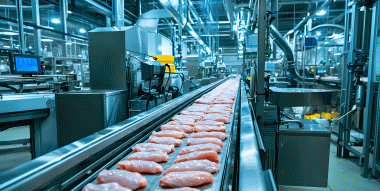
Processing plants maintain HACCP plans, environmental monitoring data, sanitation verification records, and export health certifications. Packaging and ingredient suppliers submit allergen statements, product specifications, insurance certificates, and audit documentation.
Export departments compile country-specific declarations to meet the requirements of importing nations. When companies export to multiple markets, documentation multiplies further as each region imposes unique standards related to antimicrobial residues, animal welfare, labeling, or religious certifications such as Halal.
The sheer volume of documentation presents a structural challenge. A mid-sized exporter managing 150 suppliers may collect 10 to 20 documents per supplier annually, resulting in thousands of records that must be reviewed, approved, renewed, and archived. Larger integrators with global operations may manage tens of thousands of documents each year.
Yet despite this scale, many poultry companies still rely on spreadsheets, shared drives, and email reminders to manage compliance. These systems are inherently reactive. They depend on human follow-up, manual cross-checking, and fragmented storage. As regulatory expectations intensify, the margin for error shrinks.
The risks embedded in manual documentation systems are often invisible until they surface at the most critical moment. Expired certifications may go unnoticed until discovered during a third-party audit. Insurance documents may lapse without visibility across departments.
- Supplier COAs may be reviewed manually, increasing the chance of overlooking a microbiological result or contaminant level that exceeds company specifications. When preparing for BRCGS, SQF, ISO, Global G.A.P., or customer audits, teams may spend weeks locating documents, verifying expiration dates, and reconciling inconsistencies.
Export shipments may be delayed because a declaration is incomplete or a health certificate is outdated. In the event of a recall, fragmented documentation slows response time and complicates traceability.
An automated, AI-powered documentation system directly addresses these vulnerabilities by transforming compliance from a reactive activity into a proactive, continuous control process. The impact is particularly significant in three core areas: audit readiness, food safety assurance, and operational efficiency.
- From an audit perspective, automation fundamentally changes the preparation process. Instead of assembling documentation manually days or weeks before an audit, companies operating within a centralized online platform maintain continuous audit readiness.
- Required supplier documents are uploaded directly into structured portals.
Expiration dates are tracked automatically, with alerts issued well in advance of renewal deadlines. Compliance dashboards show document completeness in real time. When auditors request supplier verification records, HACCP documentation, or COA histories, reports can be generated instantly. This reduces audit preparation time from weeks to hours and significantly lowers stress on quality teams. More importantly, it demonstrates to auditors that compliance is embedded in daily operations rather than assembled temporarily for inspection.

Automated systems also enhance food safety performance. Artificial intelligence can extract critical data points from uploaded COAs such as Salmonella results, moisture content, heavy metals, or mycotoxin levels and compare them instantly against company specifications.
- Deviations are flagged immediately, allowing corrective action before affected materials enter production.
- This reduces reliance on manual comparison and minimizes the risk of human oversight.
- By centralizing environmental monitoring reports, sanitation verification records, and supplier test results, companies gain improved visibility into emerging trends.
- Patterns of recurring non-conformance can be identified early, strengthening preventive controls and hazard analysis programs.
- In essence, automation strengthens the integrity of the food safety management system by ensuring documentation is actively analyzed rather than passively stored.
Operational efficiency improves in parallel. Quality assurance teams often spend significant time chasing suppliers for missing documents, manually reviewing COAs, updating spreadsheets, and preparing compliance summaries. These repetitive administrative tasks consume valuable technical expertise.
An AI-powered documentation platform reallocates this time toward higher-value activities such as supplier development, risk assessment, and process improvement. Automated reminders reduce late submissions. Structured upload portals eliminate inconsistent document naming and storage. Real-time dashboards reduce internal email traffic and status-check meetings.


- Export teams benefit from centralized access to required declarations and certificates, reducing shipment delays and minimizing port-related costs. Across large operations, cumulative labor savings can be substantial.
Consider a multinational poultry exporter managing multiple processing plants and hundreds of suppliers. Under a traditional system, documentation collection may rely on periodic email reminders and spreadsheet tracking. COA verification requires manual comparison of each parameter. Audit preparation demands extensive document retrieval. Export documentation errors occasionally result in shipment holds. When such a company implements an AI-powered platform like TraceR2C, supplier onboarding becomes structured. Each supplier receives a defined compliance profile outlining required documentation categories. Uploaded COAs are automatically analyzed against specifications.
- Expiration alerts are triggered in advance.
- Compliance performance is visible at both facility and corporate levels.
- Audit documentation can be exported within minutes.
- Shipment-related compliance documents can be attached systematically to export files.
- For more information on the Trace R2C AI-powered documentation system, please contact Amit Morey.
Within one-year, measurable improvements often include a sharp reduction in late document submissions, significant decreases in manual COA review time, and dramatic improvements in audit readiness. More importantly, compliance becomes continuous and transparent rather than episodic and reactive.
- In global trade, transparency is rapidly becoming a competitive differentiator.
- International buyers increasingly demand digital traceability and structured compliance systems.
- Retailers and food service companies expect exporters to demonstrate continuous supplier oversight, not just annual audit certificates.
- Automated documentation platforms provide the infrastructure to meet these expectations confidently.
As global regulatory frameworks evolve including increased antimicrobial monitoring, enhanced sustainability reporting, and stricter import verification programs documentation requirements will continue to expand. Manual systems cannot scale sustainably under these pressures. Automated, AI-enabled documentation platforms represent the natural evolution of compliance management in the poultry industry.
Ultimately, documentation is no longer an administrative burden to be minimized; it is a strategic asset to be optimized. In an industry where a single missing certificate can delay a shipment or jeopardize a contract, intelligent documentation management protects both revenue and reputation.
Companies that invest in automated systems today are strengthening audit performance, elevating food safety assurance, and improving operational efficiency all while positioning themselves as trusted partners in the increasingly digital future of global poultry trade.