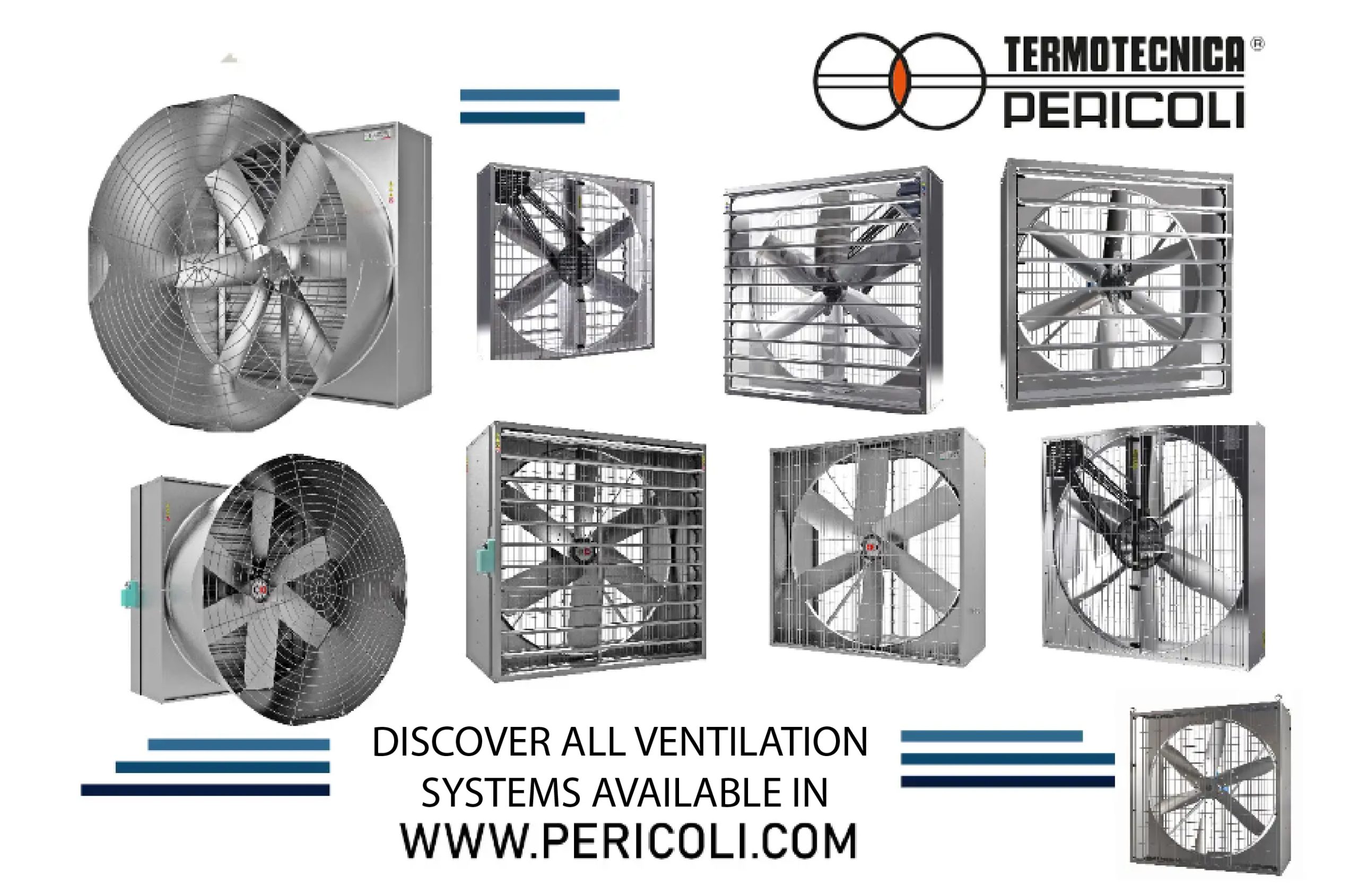







When it comes to providing optimal ventilation in large environments such as livestock facilities, greenhouses, and industrial spaces, selecting the right fan drive is crucial. Two popular options in the market are direct drive and belt drive fans. In this article, we will explore the differences between these two types of fans, helping you make an informed decision for your specific application.
Belt drive fans have been a traditional choice for large industrial applications. They consist of an electrical motor connected to the fan blades through a belt and pulleys. While they may have more components, belt drive fans offer unique advantages for specific environments.
Termotecnica Pericoli includes among its best sellers EOS and EWS, but also the cone fan EOC and the circulator EOR, all belt-driven fans.
Direct drive fans have gained popularity in recent years due to their simplicity and efficiency. These fans have the impeller directly connected to the motor, eliminating the need for a belt and pulleys system. This direct coupling enhances energy efficiency and reduces maintenance requirements.

’Discover all our direct-driven models such as EWD, ERD, EOC DS or the G-line
Discover all our models
In conclusion, the choice between direct drive and belt drive fans for large environments depends on specific application requirements and, budget considerations. Direct drive fans are energy-efficient and low-maintenance, while belt drive fans offer simplicity and cost advantages. Consider your unique needs and consult with ventilation experts to determine the most suitable fan drive for your large environment.


Direct drive fans are recommended to be used in all those applications where due to biosecurity restrictions or the inconveniency of the equipment set-up, the maintenance process is limited to the minimum. In all these cases (layer farms, breeder farms, special industrial applications, etc.), the direct drive fans can give peace of mind to the user.
Belt-driven fans are the ideal solution for users who are looking for simplicity at a competitive price. In particular, in all those areas where spare parts or skilled workers are not easy to find, the usage of a simple equipment is recommended.
For more information visit: https://www.pericoli.com/




Subscribe now to the poultry technical magazine
AUTHORS

Newcastle Disease: One Hundred Years On, Why Transmission Control Matters More Than Ever
Mustafa Seckin Sandikli
Egg Size Versatility in Nick Chick – Part I
H&N Technical Department
Interview with Khaled Abdel Nasser Awwad
Khaled Abdel Nasser Awwad
When the Supply Chain Breaks: Poultry Prices and the Economics of Maritime Disruption in the Middle East
Dima Chatila
Reovirus Infections in the Broiler Industry
Edgar O. Oviedo Rondón
Egg Condensation in Hatcheries: A Hidden Risk for Embryo Development, Hatchability and Chick Quality
Rasel Ahmed
From Chat to Farm Insight: Bridging the Social Data Gap in Indonesian Broiler Farming
Setiawan Guntarto
Labor Shortage in the Poultry Industry: Potential Solutions
Edgar O. Oviedo Rondón
A Comparison of Soybean Meal from Different Origins in Terms of Nutrient Composition, Amino Acid Profile, and Protein Quality
Güner GÖVENÇ
When Algorithms Start to Control Feed Composition
Henri E. Prasetyo DVM. M.Vsc