Sources: Available upon request.





Cage-free eggs can give hens a dignified life and offer a product with many benefits for the consumer.
Eggs are one of the basic foods for mankind and in recent years the consumption of cage-free eggs has become a trend. There are different types of egg production; the classic multi-story cage systems and cage-free eggs. This last is an animal-friendly option that prevents hens from having limited space and in general offer a higher quality of life, which translates into a product that provides more health benefits for people also.
Some problems related to the limited space are almost non-existent perches and dirt baths, which are natural basic needs of this species and can also lead to bone wear in the birds.
This problem not only affects the conditions of the birds, but it has been proven by specialists that cage-free eggs can have better characteristics and more benefits for consumers when the hens have adequate space to carry out their basic survival needs. These organic eggs are superior in quality as they contain less saturated fat and cholesterol and have higher protein levels compared to a “normal” or cage-produced egg.


They also add more vitamin A, vitamin E, Omega-3, and alpha-tocopherols (an antioxidant that has the property of protecting polyunsaturated fatty acids in membranes and other cellular structures) and also alpha-linolenic acid (an essential polyunsaturated fatty acid of the Omega-3 series).
They also add high levels of carotenoids and lutein; a type of organic pigment called carotenoid that is related to the natural care of visual health. All this for the benefit of the consumer, but for the hens it represents a proper quality of life without being subjected to the stress and constraints of cages.
Some reasons to consume cage-free eggs:

To identify these cage-free eggs, the consumer should read the specifications on the product label, since producers usually put a seal or certificate of organic product.
Now that the nutritional goodness of cage-free eggs and the animal welfare benefits they represent for hens are clear, it is up to consumers to pay a little more to support this growing global trend in the poultry sector.
Sources: Available upon request.


White-Egg Layers Rise in UK



Subscribe now to the poultry technical magazine
AUTHORS

Setting the Global Standard for Soy
Isa Tan
Importance of Eggshell Temperature, Checking and Record Keeping in a Commercial Poultry Hatchery
Rasel Ahmed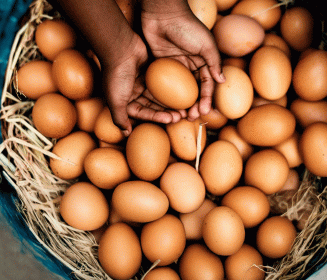
The Reality of the South African Egg Industry
Abongile Balarane
Mycoplasmosis update: Antimicrobial Resistance, Vaccines, and Control Challenges
Edgar O. Oviedo Rondón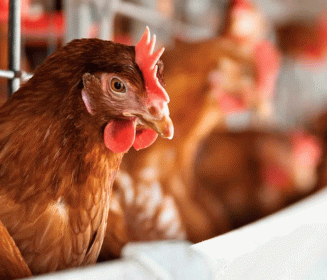
Future Flock: Antibiotic-Free Solutions for a Rising Population
Dr Ahmad Safi Dr. Faran Hameed
Interview Dr. Nivin Nasser
Dr. Nivin Nasser
Disinfection of Fertile Broiler Breeder Eggs
Edgar O. Oviedo Rondón
Precision Matters: Tackling Quality Issues in on‑Farm Vaccination
Jaime Sarabia Fragoso Kevin Gandon Pascal Paulet
Process Control: 30 Specific Aspects to Evaluate from Pre-Slaughter to Slaughter
Eduardo Cervantes López
Ishikawa Diagram Applied to Processing of Chickens
Eduardo Cervantes López