Sources: Available upon request




In a surprising turn of events, Brazil, the world’s largest exporter of chicken meat, has managed to increase its poultry exports despite a recent outbreak of highly pathogenic avian influenza (HPAI). The outbreak, first detected in May 2025 at a poultry farm in Montenegro, Rio Grande do Sul, prompted immediate trade suspensions from over 30 countries, including major importers like China, the European Union, and several Latin American nations.
Despite the initial shock to the industry, Brazil has since regained momentum. By mid-July, the country had resumed exports to key markets including Peru, Jordan, and Hong Kong, after being declared free of avian influenza in affected zones. Negotiations are ongoing with other nations to lift remaining restrictions, and officials are optimistic about a full return to normal trade conditions within weeks.
Minister of Agriculture Carlos Fávaro emphasized the effectiveness of Brazil’s containment strategy, noting that the outbreak was limited in scope and duration. “There are no new deaths, and the virus has been contained. Our protocols worked,” he stated during a press briefing.
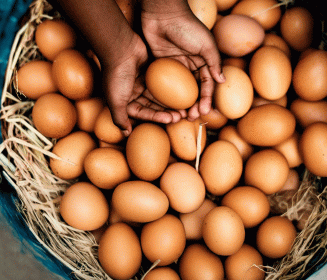
Interestingly, the United States, facing its own severe HPAI crisis, did not impose restrictions on Brazilian poultry. This has led to a dramatic increase—over 800%—in Brazilian egg exports to the U.S. market in 2025.


While the global spread of avian influenza remains a concern, Brazil’s experience highlights the importance of rapid response, transparent communication, and international cooperation in managing animal health crises. As the country works to fully reopen its export channels, it also reinforces its position as a resilient and trusted player in the global poultry market.
Sources: Available upon request


Subscribe now to the poultry technical magazine
AUTHORS

Newcastle Disease: One Hundred Years On, Why Transmission Control Matters More Than Ever
Mustafa Seckin Sandikli
Egg Size Versatility in Nick Chick – Part I
H&N Technical Department
Interview with Khaled Abdel Nasser Awwad
Khaled Abdel Nasser Awwad
When the Supply Chain Breaks: Poultry Prices and the Economics of Maritime Disruption in the Middle East
Dima Chatila
Reovirus Infections in the Broiler Industry
Edgar O. Oviedo Rondón
Egg Condensation in Hatcheries: A Hidden Risk for Embryo Development, Hatchability and Chick Quality
Rasel Ahmed
From Chat to Farm Insight: Bridging the Social Data Gap in Indonesian Broiler Farming
Setiawan Guntarto
Labor Shortage in the Poultry Industry: Potential Solutions
Edgar O. Oviedo Rondón
A Comparison of Soybean Meal from Different Origins in Terms of Nutrient Composition, Amino Acid Profile, and Protein Quality
Güner GÖVENÇ
When Algorithms Start to Control Feed Composition
Henri E. Prasetyo DVM. M.Vsc