


In the global animal protein trade, poultry stands out as the fastest-growing segment. The latest Livestock and Poultry: World Markets and Trade report from the US Department of Agriculture highlights how rising production, evolving export profiles, and new market demand are redefining poultry flows, particularly across Asia.
China’s production surpasses Brazil
China’s poultry production is forecast at 17.3 million tons in 2026, surpassing Brazil and narrowing the gap with the US. Expanding integrated producers, rising grandparent stock inventories, and government subsidies have fueled this surge.
With domestic consumption growth limited, China is channeling surplus supplies into exports. Per capita chicken consumption remains modest at 11kg, far below pork at 43kg and beef at 8kg, and well below levels in the US and Taiwan.
Exports shift toward new Asian markets
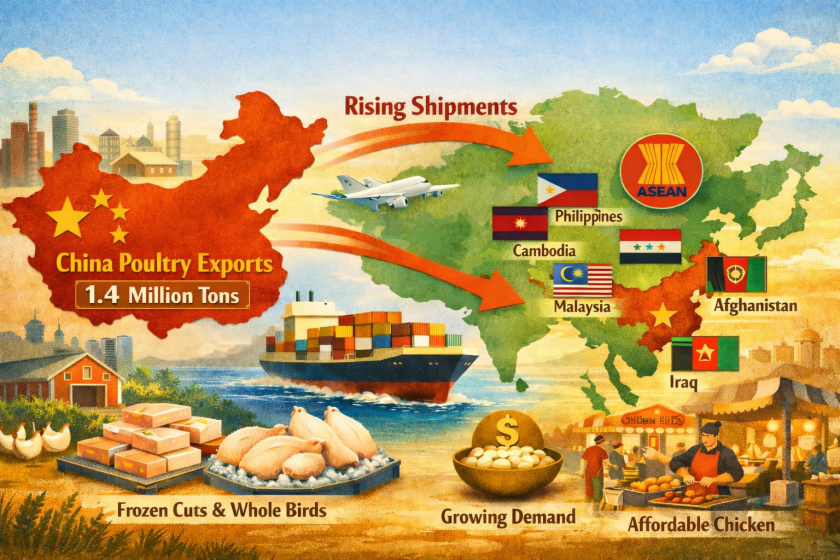
Exports are forecast at 1.4 million tons in 2026, nearly triple 2020 volumes. China became a net exporter in 2024, and exports as a share of production are expected to reach 8% in 2026.
Traditional markets such as Japan and Hong Kong remain important, but their combined share fell from 79% in 2020 to 37% in 2025. New markets in Southeast and Central Asia are filling the gap, reflecting China’s ability to penetrate price-sensitive economies.
The Philippines, Cambodia, and Malaysia have emerged as fast-growing buyers of Chinese poultry. Philippine imports rose to more than 20,000 tons in 2025, up 45% from 2024. Cambodia’s purchases surged almost 300% in one year, while Malaysia expanded imports by 49%.
Kyrgyzstan and Russia also became significant destinations. Afghanistan and Iraq showed sharp increases, underscoring China’s reach into South and West Asia. Africa has also absorbed larger volumes, but Asia remains the core growth region.
Changing export profile and product mix
China’s export profile has shifted from processed products toward frozen cuts and chilled whole birds. In 2025, frozen cuts accounted for 55% of shipments, compared with just 22% in 2020. Prepared and preserved products, once dominant, now represent a smaller share.
This reflects both rising processing capacity and changing buyer preferences, with developing economies favoring affordable, less processed protein.
Competitive pressures in developing economies
China faces restricted or no access to several top global import markets, including the EU, UK, Japan, Saudi Arabia, and Mexico. As global demand grows only modestly, China’s expansion will increasingly depend on displacing competitors in mid-size and developing markets.
Brazil and Thailand remain strong suppliers, but China’s low-cost poultry is gaining ground. The Philippines, Cambodia, and Malaysia are already absorbing larger volumes, while other Asean members may follow.
Asia shapes the global poultry map
China’s poultry surge signals a wider shift in Asia’s protein trade. With pork imports easing as domestic supplies recover, poultry is filling the gap. Exporters worldwide are turning to Southeast and South Asia, where rising demand and price sensitivity align with China’s expanding supply.
Affordable chicken is reshaping consumption patterns and positioning Asia as the central stage for future growth in global poultry trade.