


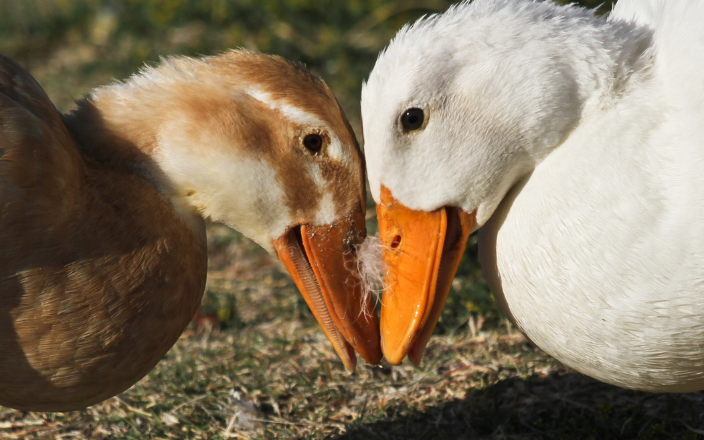
Welfare of ducks and geese in farming systems has become a central concern globally. Recent evaluations by the European Food Safety Authority (EFSA) and peer‑reviewed research provide complementary perspectives on how husbandry practices affect these waterfowl. Together, they underline the urgent need for improved housing, enrichment, and management to safeguard bird health and meet ethical standards1.
EFSA’s Scientific Opinion
EFSA’s 2023 opinion was the first comprehensive assessment of duck and goose welfare on farms. It focused on domestic ducks, Muscovy ducks, mule hybrids, and domestic geese. The evaluation excluded practices such as feather collection, foie gras overfeeding, and hunting rearing, concentrating instead on breeding and meat production systems1.
Key welfare consequences identified include:
- Restriction of movement in cage or confined systems.
- Group stress due to inappropriate stocking densities.
- Inability to perform comfort behaviors such as preening and bathing.
- Physical injuries including bone lesions, soft tissue damage, and locomotory disorders.
EFSA emphasized that welfare risks are strongly linked to space allowance, floor quality, nesting facilities, and access to open water. Recommendations included providing three‑dimensional space per bird, environmental enrichment, and improved nesting design.
Insights from Scientific Literature
Complementing EFSA’s findings, recent peer‑reviewed studies highlight how housing systems and management practices directly influence waterfowl welfare. Research shows that ducks and geese have strong behavioral needs for swimming, foraging, and social interaction. Systems that restrict water access or limit exploratory behavior lead to stress, feather damage, and reduced immune function2.
The literature also points to nutritional and environmental factors:
- Poor flooring increases footpad dermatitis and leg problems.
- Lack of water bodies reduces plumage quality and natural thermoregulation.
- Overcrowding exacerbates aggression and stress hormones.
These studies argue for integrated welfare frameworks that combine biological needs with production efficiency, aligning with the EU’s Farm to Fork strategy2.
Towards Better Practices
Both EFSA and scientific reviews converge on the need for systemic changes in waterfowl farming. Practical measures include:
- Providing access to open water for bathing and preening.
- Improving floor design to reduce injuries.
- Adjusting group sizes and densities to minimize stress.
- Enhancing enrichment to allow exploratory and nesting behaviors.
Such interventions not only improve welfare but also support sustainable production and consumer trust in poultry products.
Conclusion
The combined evidence from EFSA and academic research underscores that current farming systems often fail to meet ducks’ and geese’s behavioral and physical needs. By adopting science‑based recommendations—especially regarding space, water access, and enrichment—producers can significantly enhance welfare outcomes while aligning with evolving regulatory and ethical expectations1,2.
Sources: