Prices of chicken egg, a staple on dining tables, in South Korea are once again on the rise. The spread of highly pathogenic avian influenza (HPAI) has led to an increase in the culling of laying hens, compounding supply instability.
According to the Livestock Distribution Information of the Korea Institute for Animal Products Quality Evaluation on December 25, the average retail price for a carton (30 eggs) of large eggs has exceeded USD 4.84 since mid-December.
After remaining in the USD 4.15 range since last month, the consumer price of eggs climbed back above USD 4.84 for the first time in about a month.
As of December 23, the price stood at USD 4.85, which is 0.8% higher than last year and 8.3% higher than the average year (USD 4.48).


Farm-gate prices for eggs are also trending upward. According to data from the Korea Agro-Fisheries & Food Trade Corporation, the farm-gate price for 30 large eggs was USD 3.61 as of December 23, up 8.5% compared to both last year and the average year.
Concerns over supply instability
Amid rising prices, concerns over supply instability are also emerging.

This winter, there have been 11 cases of HPAI outbreaks at laying hen farms, nearly double the six cases reported during the same period last year.
According to the Ministry of Agriculture, Food and Rural Affairs, the number of laying hens culled due to confirmed AI cases this winter has increased to 3 million.
With around 50 million eggs produced daily nationwide, this culling is estimated to have reduced daily production by about 3-4%. If 5 million laying hens are culled, egg production is expected to decrease by approximately 3 million eggs per day.
Recently, AI has been repeatedly detected at laying hen farms. On this day, the H5 antigen was found at a laying hen farm in Pyeongtaek, Gyeonggi province, which houses 250,000 birds.
On December 24, a case of HPAI was confirmed at a laying hen farm in Anseong, Gyeonggi province, where 119,000 hens were being raised.



Interview Dr. Nivin Nasser



Subscribe now to the poultry technical magazine
AUTHORS

Setting the Global Standard for Soy
Isa Tan
Importance of Eggshell Temperature, Checking and Record Keeping in a Commercial Poultry Hatchery
Rasel Ahmed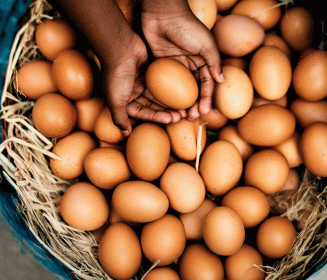
The Reality of the South African Egg Industry
Abongile Balarane
Mycoplasmosis update: Antimicrobial Resistance, Vaccines, and Control Challenges
Edgar O. Oviedo Rondón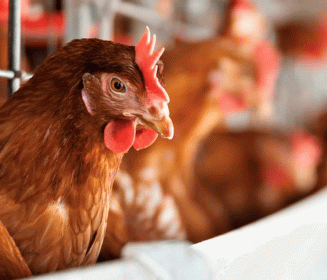
Future Flock: Antibiotic-Free Solutions for a Rising Population
Dr Ahmad Safi Dr. Faran HameedInterview Dr. Nivin Nasser
Dr. Nivin Nasser
Disinfection of Fertile Broiler Breeder Eggs
Edgar O. Oviedo Rondón
Precision Matters: Tackling Quality Issues in on‑Farm Vaccination
Jaime Sarabia Fragoso Kevin Gandon Pascal Paulet
Process Control: 30 Specific Aspects to Evaluate from Pre-Slaughter to Slaughter
Eduardo Cervantes López
Ishikawa Diagram Applied to Processing of Chickens
Eduardo Cervantes López