


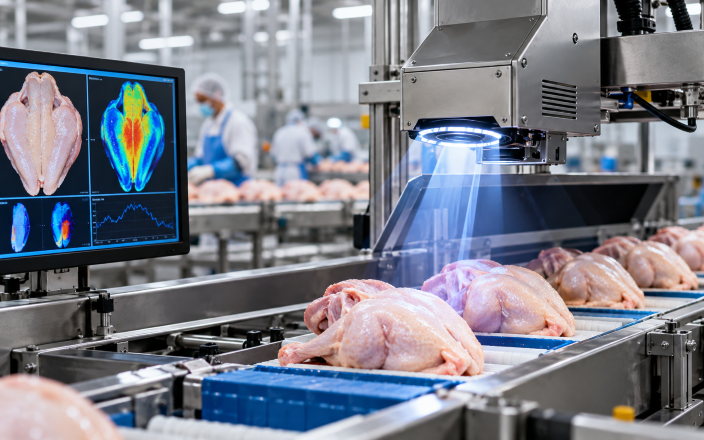
Sensor technologies and artificial intelligence are being developed for food safety and traceability
A European research and innovation project is exploring how advanced sensors and artificial intelligence could improve monitoring across the poultry supply chain, including meat quality, food safety and traceability.
The Sensor4Food project officially started in September 2026 and is scheduled to run until February 2030. Coordinated by Turku University of Applied Sciences in Finland, it has a total budget of approximately €6.98 million.
Monitoring quality beyond conventional inspection
The initiative aims to integrate several sensing technologies, including hyperspectral imaging, photonic biosensors and radio-frequency sensing combined with ultrasound. These technologies will be evaluated alongside AI-based data analysis in industrial applications.
For poultry processing, the work includes investigating methods to identify meat defects, monitor food-safety risks and improve the detection of quality variations. The project also addresses feed safety, animal welfare and the use of processing byproducts.
Traceability across the poultry chain
Another objective is to develop a digital traceability framework, including a pilot concept for a “poultry passport” that could connect relevant information across different stages of production.
The project reflects ongoing efforts to make poultry quality monitoring more data-driven. However, the technologies remain under development, and their practical performance and wider adoption will need to be demonstrated through testing.