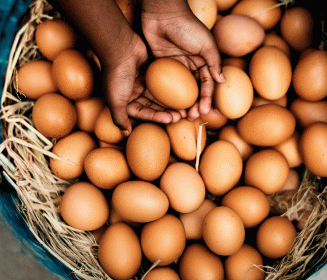
The production of indigenous chicken breeds is on the rise in Upper Myanmar, thanks to higher prices and better demand for these products.
A report by from state newspaper, Global New Light of Myanmar, quoted a local chicken trader and breeder saying that consumers are interested and prices are good in towns like Taunggyi, Kengtung, and Myitkyina.
Flexible rearing practices and feeding options
Raising native breeds typically takes between 2.5–4 months. One key advantage is that unsold chickens can still be kept and raised without major losses.


The trader noted that these chickens are known as local, indigenous, or Bamar chickens. Their meat is more tender when harvested at a younger age. Growth also depends on the type of feed. With commercial feed, the birds are ready for market in 2.5–3 months.
With home mixed feed, production takes closer to four months. This type of feed may include ingredients like paddy, rice, broken rice, rice bran, cooked rice, green feed, bean meal cake, and local plants such as silk leaves, boscai leaves, water spinach, and water hyacinth.
Sector expansion signals strength

The rise in chicken breeding reflects broader trends in Myanmar’s poultry sector. According to Report Linker, the country’s poultry production is projected to reach 2.37 million tons by 2028, up from an estimated 2.07 million tons in 2023. The represents an annual growth rate of 2.2%.
It also noted that since 1966, Myanmar’s poultry supply has grown at an average of 3.3% annually, highlighting the sector’s robustness and its vital role in the country’s economy.



Subscribe now to the poultry technical magazine
AUTHORS

Newcastle Disease: One Hundred Years On, Why Transmission Control Matters More Than Ever
Mustafa Seckin Sandikli
Egg Size Versatility in Nick Chick – Part I
H&N Technical Department
Interview with Khaled Abdel Nasser Awwad
Khaled Abdel Nasser Awwad
When the Supply Chain Breaks: Poultry Prices and the Economics of Maritime Disruption in the Middle East
Dima Chatila
Reovirus Infections in the Broiler Industry
Edgar O. Oviedo Rondón
Egg Condensation in Hatcheries: A Hidden Risk for Embryo Development, Hatchability and Chick Quality
Rasel Ahmed
From Chat to Farm Insight: Bridging the Social Data Gap in Indonesian Broiler Farming
Setiawan Guntarto
Labor Shortage in the Poultry Industry: Potential Solutions
Edgar O. Oviedo Rondón
A Comparison of Soybean Meal from Different Origins in Terms of Nutrient Composition, Amino Acid Profile, and Protein Quality
Güner GÖVENÇ
When Algorithms Start to Control Feed Composition
Henri E. Prasetyo DVM. M.Vsc