Saudi Arabia has imposed a total ban on poultry meat and table egg imports from 40 countries, including India. The measure is framed as precautionary, aimed at preventing avian influenza and other animal disease.
While the decision is broad in scope, Indian industry leaders Suresh Chitturi, Managing Director of Srinivasa Farms and First Asian Chair of the World Egg Organization, and Ricky Thaper, Joint Secretary of the Poultry Federation of India stress that the direct commercial impact on India may be limited. However, they emphasize that the policy carries strategic implications for the future positioning of India’s poultry export sector.
Reading the signal, not the loss
This is not a disruption of a major trade flow, but it is an important signal. —Suresh Chitturi

“Saudi Arabia’s recent decision to ban poultry and egg imports from 40 countries, including India, is likely to have minimal direct impact on India’s poultry sector. Our export volumes to the Kingdom have historically been very limited compared to our total production and other export markets. This is not a disruption of a major trade flow, but it is an important signal.
The broad scope of the restrictions – covering many countries, including those with strong commercial poultry industries – suggests this may be more of an industry-protecting and market-shaping measure than a narrowly targeted animal health action. Such decisions often reflect a combination of sanitary concerns, domestic producer interests, and a strategic push toward greater self-sufficiency.
For India, the key issue is not what we lose today, but what we could gain tomorrow through a strategic response. Poultry exports represent a high-potential opportunity for India, given our scale, cost competitiveness, and technical capabilities. To unlock this potential, we must move toward effective zoning and promote compartmentalization for serious exporters. This would ensure that any disease event remains geographically contained rather than affecting the entire country’s trade reputation.

Biosecurity, therefore, should not be viewed merely as a compliance requirement but as a strategic asset. A documented, independently auditable farm-to-fork biosecurity system can become part of India’s export brand. It would strengthen confidence among importing governments, retailers, and QSR chains that Indian poultry supply chains are resilient, traceable, and well risk-managed.
If industry practices, regulatory frameworks, and diplomatic engagement are aligned around this vision, such bans can become a catalyst for strengthening India’s global poultry competitiveness rather than a setback.”
India’s scale cushions the blow

Biosecurity should be treated as a strategic asset, not merely a compliance requirement.—Ricky Thaper
“Saudi Arabia’s food safety regulator had banned imports of poultry meat and table eggs from 40 countries, including India, as a precaution against bird flu and other animal diseases.
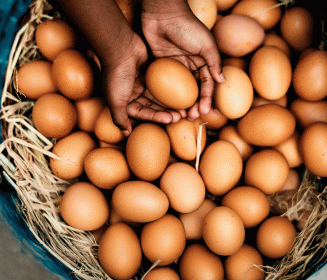
India exports around 10 million eggs to Middle East countries daily largely from Namakkal, Tamil Nadu. The exports constitute a very small share in overall poultry meat and egg productions in the country.
This restriction on imports of poultry products by Saudi Arabia would not impact the Indian poultry sector as shipments to Saudi Arabia are limited as well as local demand and consumption are rising steadily.
The Indian poultry industry is currently valued at USD0 30 billion and employs 6 million people directly or indirectly. The broiler (meat purpose) bird population is 5.5 billion annually and the layer (for eggs) population is 350 million. In addition there are 40 million backyard birds.
India is the world’s largest producer of eggs with annual production of 142.6 billion eggs. The per capita consumption is 106 eggs per person annually and the Indian poultry industry is witnessing a growth of 7-8% per annum.
India’s poultry exports will not be affected by Saudi import restrictions.”
India’s poultry in numbers
Turning restriction into opportunity
While immediate trade disruption appears limited, industry leaders underline a broader message: global poultry trade is increasingly shaped by biosecurity credibility, regulatory confidence, and national self-sufficiency agendas.
For India, this moment is less a market loss than a strategic inflection point. Strengthening zoning, compartmentalization, and auditable biosecurity systems could define the next phase of export growth.
As the global poultry landscape evolves, resilience and credibility may ultimately shape India’s global poultry future.



Subscribe now to the poultry technical magazine
AUTHORS

Newcastle Disease: One Hundred Years On, Why Transmission Control Matters More Than Ever
Mustafa Seckin Sandikli
Egg Size Versatility in Nick Chick – Part I
H&N Technical Department
Interview with Khaled Abdel Nasser Awwad
Khaled Abdel Nasser Awwad
When the Supply Chain Breaks: Poultry Prices and the Economics of Maritime Disruption in the Middle East
Dima Chatila
Reovirus Infections in the Broiler Industry
Edgar O. Oviedo Rondón
Egg Condensation in Hatcheries: A Hidden Risk for Embryo Development, Hatchability and Chick Quality
Rasel Ahmed
From Chat to Farm Insight: Bridging the Social Data Gap in Indonesian Broiler Farming
Setiawan Guntarto
Labor Shortage in the Poultry Industry: Potential Solutions
Edgar O. Oviedo Rondón
A Comparison of Soybean Meal from Different Origins in Terms of Nutrient Composition, Amino Acid Profile, and Protein Quality
Güner GÖVENÇ
When Algorithms Start to Control Feed Composition
Henri E. Prasetyo DVM. M.Vsc