


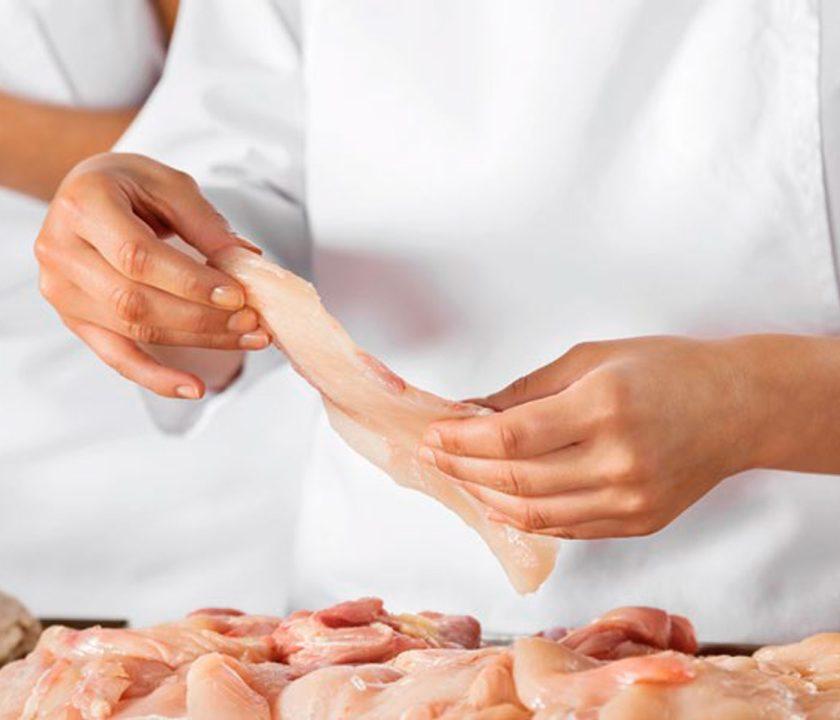
Smart Plucking: Minimizing Spaghetti Meat and Wing Breakage Through Improved Plucking
Since the 1950s, the main objective of broiler chicken breeding has been to achieve a higher growth rate, which is essential for efficient meat production.
- Breeding for faster growth has been very successful; broiler chickens grow faster each year and reach higher body weights at younger ages.
- Over the years, several growth-related “defects” have emerged (excess fat, leg problems, and ascites).
Due to the association with a high growth rate, growth-reducing diets were suggested to mitigate the negative effects of each defect.
- Finally, it was demonstrated that these defects were hereditary and genetically independent of the growth rate, which allowed selection against the defects, while continuing to select for rapid growth and other traits, and to apply management and nutrition that maximized the efficiency of broiler meat production.
This allowed selection against the defects, while continuing to select for rapid growth and other traits.
- Furthermore, it was possible to apply management and nutrition strategies that maximize the efficiency of broiler meat production.
In recent years, breast muscle myopathies have emerged, mainly
- White striping (White Stripping -WS, in 2007-)
- Wooden breast (Wooden Breast – WB, in 2011-)
- Spaghetti meat (Spaghetti Meat – SM, in 2015-)
As with previous growth-related defects, nutrition and management strategies have been suggested to reduce the incidence and severity of these myopathies, while breeding companies have modified their programs to select against them.
- In fact, WS has been decreasing, and WB is currently found only among rapidly grown males that reach high body weights (above 3.5 kg).
- It appears that the prevalence and severity of Spaghetti Meat are still not decreasing, partly due to the later onset of this myopathy.
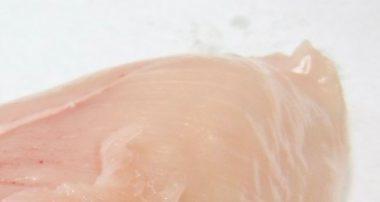
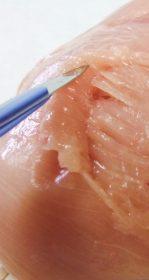
Spaghetti Meat
The different nature of Spaghetti Meat further complicates its management on the farm and its genetic mitigation. Whereas Wooden Breast clearly increases with higher body weight and breast meat yield, and is therefore rarely found in females, the prevalence and severity of SM are higher in females than in males, and within each sex are hardly associated with body weight and breast size.
- Moreover, although the tendency for Spaghetti Meat develops in broilers during rearing, it cannot be assessed in live broilers, and the SM observed in slaughterhouses reflects not only inherent tendencies, but also nongenetic processing effects.
It was suspected that the defeathering machines increased the prevalence and severity of Spaghetti Meat, because their rapidly rotating rubber fingers pluck the feathers by repeatedly striking the shackled chickens.
- In a controlled and replicated trial, we demonstrated that by reducing the intensity of defeathering by decreasing the number of defeathering machines from 7 to 5, the prevalence and severity of spaghetti meat, as well as wing breakage, were halved.
- The intensity of defeathering can also be reduced by modifying the settings of the defeathering machines, for example, by changing the horizontal and/or vertical positions of the plates that hold the rotating rubber fingers, or by using softer fingers.
We have information from several slaughterhouses (in Israel and Italy) that successfully reduced the prevalence and severity of Spaghetti Meat by reducing the intensity of defeathering. Slaughterhouses are often concerned that reducing the intensity of defeathering will result in poorer feather removal, leaving more unwanted feathers on the carcasses.
- However, our observations in many slaughterhouses show that the required feather removal is achieved before the last machines.

In the event that feather removal quality is insufficient when the last machines are stopped, there are several alternative ways to overcome this situation without increasing the prevalence and severity of spaghetti meat.
Feather Removal Without Spaghetti Meat
1. Manually remove the few remaining feathers. This practice is common in many slaughterhouses and the wages of additional workers are (in most cases) much lower than the losses due to spaghetti meat.
2. Operate with all defeathering machines, but stop (or open) the rubber finger plates that face the breasts of the carcasses, the only part that develops SM.
3. The first two methods will be necessary (if at all) only in half of the flocks if females and males are raised and slaughtered separately, because in mixed broiler flocks, the prevalence and severity of SM are approximately three times higher in females than in males.
- Therefore, reducing the intensity of defeathering and the consequent management of excess unplucked feathers, will be necessary only for females, while more intense defeathering can be applied when processing males.
4. The coefficient of variation (CV) of body weight at slaughter is around 11% in sexed batches and about 13% in mixed batches, which allows for more precise adjustment of the defeathering machines (and other processing machines!).
5. It is worth mentioning that defeathering is not necessary at all for featherless broilers, homozygous for the Scaleless (Sc) mutation. The featherless phenotype saves all costs and problems associated with defeathering and has several other advantages (heat tolerance, etc.), but its commercial production is not practical due to several disadvantages.

Conclusion
In summary, the prevalence and severity of spaghetti meat can be substantially reduced with less intensive or intelligently modified defeathering.
As slaughterhouses differ in defeathering machines, broiler size, and rearing conditions, in marketing (whole carcass, cut-up, deboned), etc., each slaughterhouse should routinely monitor its prevalence and severity of SM in its facilities.
- It is suggested to check the carcasses every morning and the breast muscles of a random sample of birds immediately after defeathering.
- If the values in this sample are not acceptable, the defeathering technicians (internal or external) must immediately modify the intensity of defeathering.