Avian influenza continues to spread across Asia, with new outbreaks reported in poultry farms in Japan and South Korea, alongside human infections confirmed in China and Cambodia. Local media and health authorities have provided details on the latest developments, underscoring the urgency of containment measures across the region.
Outbreak confirmed in Japan’s Iwate prefecture
Authorities in Iwate prefecture in northeastern Japan, has confirmed an outbreak of highly pathogenic avian influenza at a poultry farm. Citing local authorities, Jiji Press reported that the affected farm in Kanegasaki town alerted a livestock hygiene service center on February 20 after noticing unusual bird deaths.
A simple test returned positive results, and genetic analysis later confirmed the infection. Officials announced that approximately 560,000 egg-laying hens will be culled to prevent further spread. This marks the 20th outbreak nationwide this season, but the first in Iwate.


Detection in South Korea’s Jeollanam-do
On February 19, Jeollanam-do authorities announced that the H5 avian influenza antigen had been detected at a meat duck farm in Yongbang-myeon, Gurye.
The farm, which raises about 30,000 ducks, was flagged during routine pre-shipment testing. The Animal and Plant Quarantine Agency is now determining whether the strain is highly pathogenic.


Containment measures began immediately. Local officials restricted farm access, initiated culling, and launched detailed investigations. A 10km quarantine zone was established, disinfection resources were mobilized, and inspections of related farms were ordered.
The province also dispatched two on-site support officers, who are conducting a detailed investigation into the cause of the outbreak.
To prevent further spread, authorities are conducting detailed inspections of all poultry farms within a 10km quarantine zone around the affected farm. In addition, all available disinfection resources are being mobilized to disinfect roads around nearby small streams and reservoirs, as well as access roads leading to poultry farms.
To ensure early detection of infected birds, detailed inspections are also being carried out at all farms belonging to the same integrated company, in parallel with biosecurity checks.
A 24-hour standstill order, effective until 12:00 pm on February 20, was issued for the integrated company, nearby duck farms, slaughterhouses, feed factories, and livestock vehicles.
Yu DeokgyuYu Deokgyu, Director General of the Agriculture, Livestock and Food Bureau, emphasized strict biosecurity, warning that no region can be considered safe. As of February 19, South Korea has recorded 44 outbreaks nationwide, including eight in Jeollanam-do.
New human case of A(H10N3) in China
In another development, the World Health Organization (WHO) confirmed a new human infection with avian influenza A(H10N3) in Guangdong province on February 20.
The patient, a 34-year-old man, developed symptoms on December 29, 2025, and was hospitalized soon after. He remains in stable condition.
Preliminary investigations suggest exposure to live poultry before illness onset. This is the third human case of A(H10N3) reported in 2025, and the seventh globally since 2021. All cases have occurred in China, with most presenting severe or critical symptoms. No fatalities have been reported to date.
Cambodia records its first human case of H5N1 of 2026
Cambodia’s Ministry of Health (MOH) confirmed its first human case of H5N1 avian influenza this year. According to Avian Flu Diary, an infectious disease blog citing the ministry’s report, the patient is a 30-year-old man from Kampot province. He experienced fever, abdominal pain, and cough, but has since recovered.
MOH investigators noted that a dead chicken had been cooked in his household days before symptom onset.
Since 2023, Cambodia has reported 36 human H5 infections, with a case-fatality rate exceeding 40%. Most recent cases in Cambodia have involved a reassortant (2.3.2.1e) between an older H5N1 clade that has circulated in Cambodia since 2014 and the newer clade 2.3.4.4b virus that is circulating globally.



Interview Dr. Nivin Nasser


Subscribe now to the poultry technical magazine
AUTHORS

Setting the Global Standard for Soy
Isa Tan
Importance of Eggshell Temperature, Checking and Record Keeping in a Commercial Poultry Hatchery
Rasel Ahmed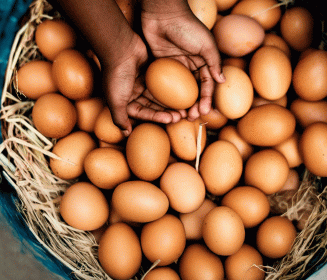
The Reality of the South African Egg Industry
Abongile Balarane
Mycoplasmosis update: Antimicrobial Resistance, Vaccines, and Control Challenges
Edgar O. Oviedo Rondón
Future Flock: Antibiotic-Free Solutions for a Rising Population
Dr Ahmad Safi Dr. Faran HameedInterview Dr. Nivin Nasser
Dr. Nivin Nasser
Disinfection of Fertile Broiler Breeder Eggs
Edgar O. Oviedo Rondón
Precision Matters: Tackling Quality Issues in on‑Farm Vaccination
Jaime Sarabia Fragoso Kevin Gandon Pascal Paulet
Process Control: 30 Specific Aspects to Evaluate from Pre-Slaughter to Slaughter
Eduardo Cervantes López
Ishikawa Diagram Applied to Processing of Chickens
Eduardo Cervantes López