The EAT-Lancet Planetary Health Diet and the quiet burden it places on the world’s poor.
In January 2019, The Lancet published what it described as a landmark report—a planetary health diet capable of feeding 10 billion people sustainably while preventing non-communicable diseases. The EAT-Lancet Commission had arrived. It was covered breathlessly across global media, adopted by governments, cited in school curricula, and elevated to near-scientific consensus.
The 2025 update, published again in The Lancet, expands on that original framework. It is more comprehensive, better documented, and, in many respects, a genuine scientific endeavor. I do not question the good faith of the researchers who produced it, nor the urgency of the planetary challenges they address.
But I do question something that the Commission itself, in a rare moment of candour, acknowledges: low-income and middle-income regions—countries like India, China, Brazil, and sub-Saharan Africa—will bear the largest burden of dietary change, face the greatest risk of increased food prices, and make the most significant reductions in agricultural land use. [1]


A diet designed to solve problems of the rich—obesity, over-consumption, environmental excess—is being prescribed to populations still fighting the first nutritional battle: getting enough to eat.
That asymmetry — between who designs the guidelines and who pays for them — is what I want to examine carefully in this article. Not to dismiss planetary health science, but to insist that the science must be held to a higher standard than it currently is, and that the loudest voices in this conversation cannot continue to be the ones with the least skin in the game.
I. Who was in the room?

The 2025 EAT-Lancet Commission involved 70 authors. Its remit was explicitly global. It spoke repeatedly about justice, equity, and the need for diverse representation in designing food systems for the world’s most vulnerable populations.
Yet a group of active nutrition researchers from across Africa—writing in The Lancet in February 2026—observed the following: of those 70 authors, just one was from Ethiopia, one from Mexico, one from Colombia, none from China, one from Indonesia, and two from India.[2]
The Commission’s authors contested this count, arguing that the tally should be based on original citizenship rather than current location, yielding five from Africa, seven from Latin America, and around ten from the rest of Asia. The dispute over numbers is itself revealing. Both tallies point to the same structural reality: the populations projected to experience the greatest dietary disruption had the least voice in designing the framework that imposed it.
This is not a peripheral issue. Nutrition science is not culturally neutral. What constitutes adequate protein, a healthy meal, or a sustainable diet is deeply shaped by context — by climate, by food infrastructure, by household income, by agricultural tradition, by the diseases that actually kill people in a given population. A framework that is disproportionately shaped by researchers based in North America, Northern Europe, and international institutions in Geneva and Stockholm will, however, unintentionally reflect the priorities and assumptions of those places.
The Commission’s own analysis admits that its recommendations will raise food prices most sharply in the very countries whose populations are already most protein-deficient. That is not a detail. It is the central moral problem.
II. What the science actually shows and what it assumes?
The 2025 Commission makes an extraordinary claim: that adoption of the Planetary Health Diet (PHD) could prevent approximately 15 million premature deaths per year. This figure has been widely cited. It deserves scrutiny.
A group of nutrition scientists—including methodologists from McMaster University and the Global Alliance for Improved Nutrition—has identified two fundamental flaws in how this mortality projection is constructed.[3]
The comparison problem
The Commission’s mortality model compares the PHD against a business-as-usual (BAU) diet. The BAU projection includes deaths from overweight and obesity. The PHD projection, however, assumes that everyone adopting the diet automatically achieves optimal caloric intake—eliminating all weight-related mortality at once. This is not a like-for-like comparison. It is the equivalent of attributing a drug’s benefit not just to the drug itself, but also to the patient quitting smoking, starting exercise, and sleeping better.
When researchers reconstructed the Commission’s own model and corrected for this asymmetry, the mortality benefit of the PHD over the BAU diet was found to be no greater than that from simply correcting for caloric excess or deficiency — not a ringing endorsement of the specific dietary composition being proposed.[4]
The transparency problem
The Commission has not released its modelling code. This is a significant omission for a document of this influence. The Global Burden of Disease project — which covers comparable analytical territory—publishes all data and code openly as a matter of standard practice. Without access to the underlying models, independent researchers cannot verify, challenge, or build on the Commission’s projections. Science that cannot be scrutinized is not science—it is authority.
The evidence-recommendation disconnect
Perhaps most strikingly, the specific food amount recommendations in the PHD—how much red meat, how much fish, how many eggs—are not actually derived from the Commission’s own mortality models or from systematic reviews of the evidence. They are based, in the authors’ own characterization, on a selection of cohort studies. The guidance on unprocessed red meat, for instance, is based solely on its relationship to type 2 diabetes, drawn from just three related US cohorts—all authored by a Commissioner. Fish consumption targets are based on a randomized controlled trial of omega-3 supplementation, which is not the same as dietary fish intake and includes no systematic review of dose-response relationships.
The PHD’s specific food recommendations are not derived from its own mortality models. They are a judgement call, dressed as a calculation.
III. The micronutrient problem the PHD cannot solve
The PHD significantly restricts animal-source foods (ASFs). Across the full diet, ASFs contribute approximately 13% of total calories. For populations where animal-source foods are currently the primary or only reliable source of several essential micronutrients, this creates a nutritional gap that the Commission does not adequately address.
Independent analysis has identified shortfalls in the PHD for Vitamin B12, zinc, iodine, and calcium.[5] These are not obscure trace elements. They are foundational nutrients for brain development in children, bone density in women, immune function in pregnant mothers, and cognitive health across the lifespan.
The Commission proposes meeting B12 needs through fermented soy and algae. The scientific literature is clear on both: fermented soy contains minimal bioavailable B12. The most commonly available algae — including spirulina — predominantly contain inactive or inhibitory B12 analogues, not the active form the body can use. Algae-based iodine sources have highly variable concentrations and are often excessive. These are not widely available, affordable, or culturally accepted food sources for most populations in South Asia or sub-Saharan Africa.
Most importantly, in 2025, the MyPlanetDiet randomized controlled trial—a real-world test of PHD adherence—found that diets modelled on the PHD increased several micronutrient inadequacies even with modest inclusion of animal-source foods, due to bioavailability challenges and real-world adherence patterns. [6]
The Commission’s authors, in their response to critics published in The Lancet, suggest that remaining inadequacies could be addressed through fortification or supplementation. This is a reasonable supplement to dietary guidance in wealthy countries with well-functioning distribution systems. In rural India, rural Nigeria, or rural Indonesia, it is an aspiration, not a solution.
IV. The India lens: When a global diet meets a local reality
I want to be precise about what the PHD’s restrictions mean in the context of India, because this is where I have spent thirty years working to close a nutritional gap that the Commission’s recommendations risk widening.
73% of Indians are protein-deficient. 18.7% of children suffer from wasting—acute, life-threatening malnutrition. The recommended protein intake for an adult is roughly 0.8g per kilogram of body weight per day. Hundreds of millions of Indians do not reach this threshold. This is not a chronic disease of over-consumption. This is a crisis of under-nutrition—the very problem the PHD was ostensibly designed to address globally, yet its construction overwhelmingly optimizes for the diseases of excess.
The most accessible, affordable, complete protein source available to India’s working population is the egg. At roughly ₹6 per egg, it delivers 6 grams of complete protein containing all essential amino acids—a nutritional profile that no plant-based alternative can match at equivalent cost and bioavailability. India produces 142.77 billion eggs annually and has become the world’s second-largest egg producer, with 900,000 farmers whose livelihoods depend on a sector built over 60 years of hard work and careful science.
The PHD’s recommended egg consumption—approximately 1.4 eggs per week—is nutritionally inadequate for a protein-deficient population and economically catastrophic for the farmers who produce them. If global dietary policy adopted the PHD as a framework for food procurement, school nutrition programs, or public health guidance in India, the effect would not be a healthier population. It would be a poorer one.
Eggs remain India’s most affordable complete protein—at INR 6 per egg versus no plant-based equivalent at a comparable cost and bioavailability. Restricting them in the name of planetary health is a tax on poverty.
Poultry is also, relative to ruminant livestock, a low-emission protein source. Broiler chickens produce roughly 3-6 kg CO₂ equivalent per kg of protein, compared to 60-100 kg CO₂ equivalent for beef. The planetary argument for reducing all animal-source foods without distinguishing between them is environmentally imprecise and economically damaging to precisely those producers and consumers who are least responsible for global emissions and most vulnerable to dietary disruption.
V. Food sovereignty: The dimension the Commission keeps deferring
A group of global health researchers—from Spain, Brazil, Cuba, Mexico, and Palestine—raised a separate but related concern in The Lancet: the Commission emphasizes global nutrient targets but does not adequately question the industrial food system that created many of the environmental and health crises it seeks to solve.[7]
By focusing on what people should eat rather than who controls the food system, the Commission risks leaving intact the very agro-industrial structures—intensive monocultures, herbicide dependency, ultra-processed food dominance — that have driven ecological degradation and displaced traditional diets across the developing world.
Small-scale farmers in India, Africa, and Latin America have developed food systems over centuries that are adapted to local ecology, cultural practice, and nutritional need. A globally homogenized dietary framework—however well-evidenced in the context of chronic disease prevention in high-income countries—carries an implicit message: that local knowledge is insufficient, and that what a population needs is an externally validated global standard rather than the strengthening of its own food sovereignty.
The Commission’s authors acknowledge this concern in their response. They affirm their commitment to agroecological principles. But commitment in a paragraph is not the same as centrality in a framework. When the specific food targets of the PHD are set—not from the Commission’s own mortality models, not from systematic reviews, but from a curated selection of cohort data drawn predominantly from US and European populations — the gesture toward food sovereignty remains precisely that: a gesture.
VI. What a genuinely just global dietary framework would look like
Again, I want to be clear: I am not arguing against planetary health science. I am not dismissing the reality of climate change, biodiversity loss, or the environmental costs of food production. These are real, urgent, and consequential challenges. I have spent years working on more sustainable poultry production, on reducing feed conversion ratios, on breed development that improves the efficiency of protein delivery to Indian consumers.
My argument is that a genuinely just global dietary framework would look substantially different from the current EAT-Lancet model in several respects.
First, it would be designed with, not for, the populations it affects most. If the Commission’s own analysis confirms that low-income and middle-income countries will experience the greatest disruption from dietary change, then researchers, farmers, and nutritionists from those countries must hold proportionate influence over the framework’s construction—not token representation calculated by birthplace.
Second, it would distinguish between protein sources by their actual environmental footprint. Poultry and eggs are not nutritionally equivalent to lentils, and they are not environmentally equivalent to beef. A framework that restricts all animal-source foods under a single planetary boundary assumption is scientifically imprecise and practically harmful.
Third, it would acknowledge what the Commission’s own critics have demonstrated: that the micronutrient adequacy of the PHD in real-world conditions—particularly for children, pregnant women, and adolescent girls in low-income settings—is not established. The MyPlanetDiet RCT published in 2025 is the most direct evidence we have on this question, and its findings are concerning.
Fourth, it would release its models. A recommendation that affects the dietary policy of 8 billion people, the livelihoods of hundreds of millions of farmers, and the procurement decisions of governments and international agencies must be reproducible. Transparency is not optional for science of this consequence.
Fifth, it would hold the immediate, certain harm of under-nutrition to the same moral standard as the future, modelled harm of environmental overload. A child dying of protein deficiency today is not a lesser tragedy than a child affected by climate change in 2050. A dietary framework that systematically optimises for the chronic disease burden of wealthy populations while inadequately protecting the acute nutrition needs of poor ones is not a planetary health diet. It is a high-income health diet with planetary framing.
Conclusion
I have spent thirty years in the Indian poultry industry. I have seen what access to affordable, high-quality protein does for families, for children’s cognitive development, for women’s health during pregnancy, and for the economic stability of farming communities. I have also seen what happens when well-intentioned but contextually blind policies—driven by distant institutions with legitimate authority but limited local knowledge—create harm at scale.
The EAT-Lancet Commission is not malicious. Its researchers are serious scientists motivated by genuine concern for both human and planetary health. But good intentions are not sufficient when the framework being constructed could become the architecture for global food policy. In that context, the obligation to be right — methodologically rigorous, representationally equitable, and sensitive to the asymmetry between who designs guidelines and who lives with their consequences — is absolute.
India’s protein crisis is immediate. The risk of an additional INR 6 egg becoming a dietary luxury, displaced by a framework designed for populations who have never faced protein deficiency, is not theoretical. It is a policy choice. And it is a choice that should be made by the people who will live with it—not made for them by those who will not.
Planetary health cannot be built on nutritional injustice. A framework that makes the protein of the poor more expensive in order to reduce the footprint of the rich is not a solution. It is a transfer of burden.
I welcome engagement from researchers, policymakers, nutritionists, and fellow industry leaders on these questions. The conversation matters too much for any single voice to dominate it—including mine.
References
[1] Rockström J, Thilsted SH, Willett WC, et al. The EAT-Lancet Commission on healthy, sustainable, and just food systems. Lancet 2025; 406: 1625-700.
[2] Fungo R, Zotor F, Prentice A, et al. The EAT-Lancet Commission: issues and responses [Correspondence]. Lancet 2026; 407: 758-59.
[3] Zagmutt FJ, Pouzou JG, Ortenzi F, et al. The EAT-Lancet Commission: issues and responses [Correspondence]. Lancet 2026; 407: 759-60.
[4] Zagmutt FJ, Pouzou JG, Costard S. The EAT-Lancet Commission’s dietary composition may not prevent noncommunicable disease mortality. J Nutr 2020; 150: 985-88.
[5] Beal T, Ortenzi F, Fanzo J. Estimated micronutrient shortfalls of the EAT-Lancet planetary health diet. Lancet Planet Health 2023; 7: e233-37.
[6] Leonard UM, Davies KP, Lindberg L, et al. Impact of sustainable diets on micronutrient intakes and status: outcomes of the MyPlanetDiet randomized controlled trial. Am J Clin Nutr 2025; 122: 1275-88.
[7] Garay J, Zeballos D, Ahmed Z, et al. The EAT-Lancet Commission: issues and responses [Correspondence]. Lancet 2026; 407: 759.
[8] Gembillo G, Soraci L, Santoro D. Dietary evidence and the 2025-2030 US guidelines. Lancet 2026; 407: 757-58.
[9] GBD 2017 Diet Collaborators. Health effects of dietary risks in 195 countries, 1990-2017. Lancet 2019; 393: 1958-72.


Subscribe now to the poultry technical magazine
AUTHORS

Setting the Global Standard for Soy
Isa Tan
Importance of Eggshell Temperature, Checking and Record Keeping in a Commercial Poultry Hatchery
Rasel Ahmed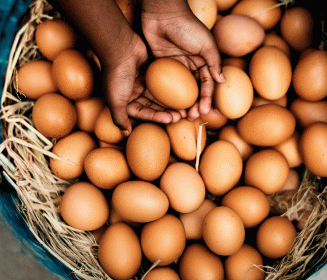
The Reality of the South African Egg Industry
Abongile Balarane
Mycoplasmosis update: Antimicrobial Resistance, Vaccines, and Control Challenges
Edgar O. Oviedo Rondón
Future Flock: Antibiotic-Free Solutions for a Rising Population
Dr Ahmad Safi Dr. Faran Hameed
Interview Dr. Nivin Nasser
Dr. Nivin Nasser
Disinfection of Fertile Broiler Breeder Eggs
Edgar O. Oviedo Rondón
Precision Matters: Tackling Quality Issues in on‑Farm Vaccination
Jaime Sarabia Fragoso Kevin Gandon Pascal Paulet
Process Control: 30 Specific Aspects to Evaluate from Pre-Slaughter to Slaughter
Eduardo Cervantes López
Ishikawa Diagram Applied to Processing of Chickens
Eduardo Cervantes López