Sources: Available upon request





Bulgaria has recently taken a significant step to protect its domestic egg producers by seeking restrictions on egg imports from Ukraine. This move comes in response to a notable increase in Ukrainian egg imports, which has raised concerns about the impact on local markets and producers.
The Bulgarian Minister of Agriculture and Food, Georgi Tahov, announced that Bulgaria has formally requested the European Commission (EC) to activate a safeguard mechanism to protect Bulgarian egg producers. This request is based on the negative market trends observed due to the influx of Ukrainian eggs. According to Minister Tahov, the first half of 2024 saw a significant rise in the import of fresh hen eggs from Ukraine compared to the same period in 2023.
The safeguard mechanism proposed by Bulgaria involves the activation of a tariff quota. This means that imports of eggs from Ukraine would be subject to a duty once they exceed a certain quantity. This measure is intended to mitigate the adverse effects on the Bulgarian egg market and ensure fair competition for local producers.
Minister Tahov emphasized the importance of this protective measure, stating that it is crucial to safeguard the interests of Bulgarian egg producers. He highlighted that the data on the situation in the sector had been presented to the EU Agriculture and Fisheries Council in Brussels, which led to the joint efforts of several member states to introduce the safeguard mechanism.


The European Commission will now assess the state of the EU market or the market of one or more member states to determine the necessity of imposing such measures. This assessment is expected to be completed within four months. If the EC finds that the market conditions warrant protective measures, the tariff quota will be activated, and imports exceeding this quota will be subject to duties.
The move by Bulgaria reflects a broader concern among EU member states about the impact of increased imports from non-EU countries on local markets. The regulation (EU) 2024/1827, which allows for the activation of such protective measures, aims to provide a temporary solution to counteract negative market trends and support domestic producers.
In conclusion, Bulgaria’s request for restrictions on Ukrainian egg imports underscores the challenges faced by local producers in the face of increased competition from non-EU countries. The activation of a safeguard mechanism by the European Commission could provide much-needed relief to Bulgarian egg producers and help stabilize the local market. This development highlights the importance of protective measures in ensuring fair competition and supporting the agricultural sector within the EU.


Sources: Available upon request


Subscribe now to the poultry technical magazine
AUTHORS

Setting the Global Standard for Soy
Isa Tan
Importance of Eggshell Temperature, Checking and Record Keeping in a Commercial Poultry Hatchery
Rasel Ahmed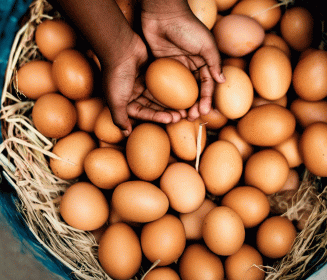
The Reality of the South African Egg Industry
Abongile Balarane
Mycoplasmosis update: Antimicrobial Resistance, Vaccines, and Control Challenges
Edgar O. Oviedo Rondón
Future Flock: Antibiotic-Free Solutions for a Rising Population
Dr Ahmad Safi Dr. Faran Hameed
Interview Dr. Nivin Nasser
Dr. Nivin Nasser
Disinfection of Fertile Broiler Breeder Eggs
Edgar O. Oviedo Rondón
Precision Matters: Tackling Quality Issues in on‑Farm Vaccination
Jaime Sarabia Fragoso Kevin Gandon Pascal Paulet
Process Control: 30 Specific Aspects to Evaluate from Pre-Slaughter to Slaughter
Eduardo Cervantes López
Ishikawa Diagram Applied to Processing of Chickens
Eduardo Cervantes López