Available in other languages:
Content available at:
Foodhouse, a leading provider of food and nutrition services in Thailand, has announced its commitment to transition to using 100% cage-free eggs by 2028.
This makes Foodhouse the first food service company in Thailand to join the global cage-free egg initiative, marking a significant step toward improving animal welfare and promoting ethical sourcing in the food supply chain.
Currently, Foodhouse serves millions of meals annually across sectors including corporate services, education, and event catering nationwide.


Partnering with Humane World for Animals to build a better food system
Humane World for Animals (formerly Humane Society International) praised Foodhouse’s commitment, noting that the collaboration began in 2022. Since then, both organizations have worked closely on various initiatives, such as:
While cage-free eggs are becoming more available in Bangkok and surrounding areas, supply in other regions remains limited. Humane World for Animals continues to assist Foodhouse in expanding its cage-free supplier network nationwide, helping ensure that the company can fully transition its entire supply chain by 2028.

Foodhouse: “Cage-free eggs are just the beginning”
Nittinan Thammahathai, Director of Foodhouse, stated: “We believe a strong organization is built on a balanced internal foundation. Our partnership with Humane World for Animals reflects our core values. This commitment to cage-free eggs is just the starting point—we aim to improve animal welfare across other farm species in the future.”
Ending the cage era for hens in Thailand
Lollada Tangcherdcharat, Country Manager for Humane World for Animals, said: “Foodhouse has demonstrated genuine dedication to building a sustainable cage-free supply chain. They are a shining example of a Thai company joining the global movement for animal welfare.”
As of 2024, an estimated 70 million egg-laying hens in Thailand are still confined in small wire cages, where they are unable to spread their wings or express natural behaviors.
In contrast, cage-free systems allow hens to roam, scratch the ground, lay eggs in nests, perch, and fully extend their wings—all of which are scientifically recognized as essential to their well-being.


White-Egg Layers Rise in UK


Subscribe now to the poultry technical magazine
AUTHORS

Setting the Global Standard for Soy
Isa Tan
Importance of Eggshell Temperature, Checking and Record Keeping in a Commercial Poultry Hatchery
Rasel Ahmed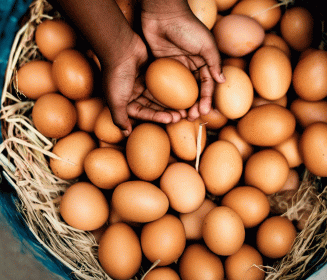
The Reality of the South African Egg Industry
Abongile Balarane
Mycoplasmosis update: Antimicrobial Resistance, Vaccines, and Control Challenges
Edgar O. Oviedo Rondón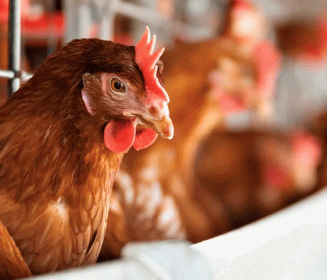
Future Flock: Antibiotic-Free Solutions for a Rising Population
Dr Ahmad Safi Dr. Faran Hameed
Interview Dr. Nivin Nasser
Dr. Nivin Nasser
Disinfection of Fertile Broiler Breeder Eggs
Edgar O. Oviedo Rondón
Precision Matters: Tackling Quality Issues in on‑Farm Vaccination
Jaime Sarabia Fragoso Kevin Gandon Pascal Paulet
Process Control: 30 Specific Aspects to Evaluate from Pre-Slaughter to Slaughter
Eduardo Cervantes López
Ishikawa Diagram Applied to Processing of Chickens
Eduardo Cervantes López