Global nutrition inequality and the strategic role of milk, eggs and poultry
Understanding malnutrition
Malnutrition is often mistaken for hunger alone. In reality, it is a more complex condition that arises when diets fail to provide balanced nutrients required for growth, immunity, cognitive development, and a productive life.
A person may consume sufficient calories, yet remain malnourished if the diet lacks adequate protein, vitamins, and essential minerals. This hidden hunger remains a serious global public health challenge.


Protein, iron, zinc, and Vitamin B12 deficiencies affect millions worldwide. The consequences include stunting, reduced learning capacity, weakened immunity, maternal health risks, and reduced economic productivity.
Nutrition experts increasingly recognize that food quality matters as much as quantity. Diets dominated by cereals without sufficient protein diversity often fail to meet physiological needs.
Animal source foods such as milk, eggs, and poultry provide complete proteins and highly bioavailable micronutrients. They remain among the most efficient tools to close nutrition gaps.

Malnutrition should therefore be seen not only as a food shortage issue. It is fundamentally a nutrition quality challenge requiring better access to affordable, nutrient-dense foods.
The global nutrition divide
The global nutrition landscape reflects deep inequalities in access to affordable animal protein. Consumption of milk, eggs, and poultry varies sharply across income levels and regions.
In developed economies such as the US, Germany, the Netherlands, and Japan, egg consumption ranges between 230 and 300 eggs per person annually. Poultry consumption in the US exceeds 40kg per capita. Milk intake in many European countries remains above 200kg per person annually. These nations have largely overcome protein deficiency and now focus more on dietary balance.
Developing countries such as China and Brazil demonstrate how poultry sector growth can improve protein access. Both report egg consumption near or above 250 eggs per capita annually. Rising incomes and efficient supply chains have made eggs and chicken affordable protein sources.
India presents a unique case of both progress and opportunity. It is a leading milk and egg producer, yet per capita consumption reveals nutrition gaps. Egg intake stands at about 103 eggs annually, well below the recommended 180 eggs. Chicken consumption remains about 6-7kg annually compared with global averages of 20-25 kg.
These figures indicate that India’s challenge is not production capacity. It is access, affordability, and nutrition awareness. With rising incomes and better distribution, the potential to improve protein intake remains significant.
In low-income countries such as Ethiopia and Niger, egg consumption may remain below 30 annually, while poultry intake remains very low. Affordability, rather than demand, remains the primary constraint. The global nutrition map clearly shows that where affordable protein is accessible, malnutrition declines.
Policy and industry alignment
Addressing malnutrition requires alignment between public policy and food production systems. Poultry and dairy industries are positioned to become strategic partners in national nutrition missions because they can supply affordable protein at scale.
Governments benefit through reduced child malnutrition, improved education outcomes, lower long-term healthcare costs, and higher workforce productivity. Industry gains stable demand growth, supportive policies, infrastructure development, and long-term market expansion.
Collaboration can focus on school feeding programs, maternal nutrition initiatives, tax rationalization on protein foods, cold chain development, and improved farm biosecurity. Countries that treat poultry and dairy as nutrition partners rather than just industries often achieve better outcomes in both public health and economic growth.
Key takeaways for stakeholders
For poultry and dairy companies, the message is clear. Protein should be positioned as a nutrition solution. Investments in quality, traceability, and affordability will expand markets sustainably.
For policymakers, animal protein should be recognized as an essential nutrition input. Integrating eggs and milk into public nutrition programs can deliver measurable social returns.
For governments, improving protein consumption is directly linked to human capital development. Nations that nourish their populations strengthen their economic competitiveness. Investing in nutrition today builds productivity tomorrow.
The larger lesson
Malnutrition is not simply a humanitarian concern. It is a structural development challenge. Countries that fail to address protein gaps risk weakening their future workforce.
By ensuring affordable access to milk, eggs, and poultry, nations strengthen their human capital base. Poultry and dairy sectors therefore operate at the intersection of agriculture, nutrition, and economic development. They are not merely food industries. They are nation-building sectors.
The fight against malnutrition will increasingly depend on strengthening local protein production systems and making nutritious foods affordable to every household.
Table. Comparative per capita egg, chicken, and milk consumption across selected countries.



Subscribe now to the poultry technical magazine
AUTHORS

Setting the Global Standard for Soy
Isa Tan
Importance of Eggshell Temperature, Checking and Record Keeping in a Commercial Poultry Hatchery
Rasel Ahmed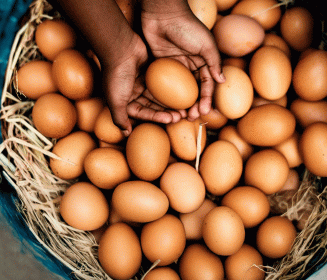
The Reality of the South African Egg Industry
Abongile Balarane
Mycoplasmosis update: Antimicrobial Resistance, Vaccines, and Control Challenges
Edgar O. Oviedo Rondón
Future Flock: Antibiotic-Free Solutions for a Rising Population
Dr Ahmad Safi Dr. Faran Hameed
Interview Dr. Nivin Nasser
Dr. Nivin Nasser
Disinfection of Fertile Broiler Breeder Eggs
Edgar O. Oviedo Rondón
Precision Matters: Tackling Quality Issues in on‑Farm Vaccination
Jaime Sarabia Fragoso Kevin Gandon Pascal Paulet
Process Control: 30 Specific Aspects to Evaluate from Pre-Slaughter to Slaughter
Eduardo Cervantes López
Ishikawa Diagram Applied to Processing of Chickens
Eduardo Cervantes López