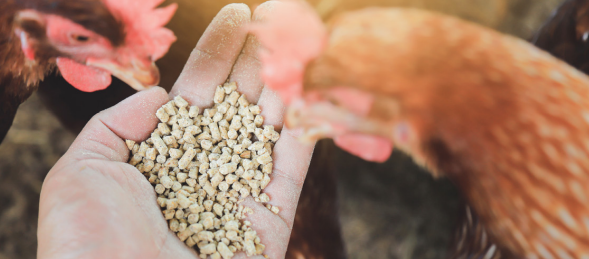






Variability in raw materials, price fluctuations, and shifting production and sustainability goals force nutritionists to constantly balance precision with practicality. This demands accurate nutrient values for the feed ingredients we use.
However, these values are not always well defined, leading to excessive safety margins that can increase costs, compromise animal health and performance, and raise the environmental footprint of feed and farming.
Before safety margins can be reduced with confidence, reliable nutrient values, derived from accurate analysis and robust formulation tools, are essential. Beyond this, targeted feed additives and nutritional expertise are needed to ensure the formulated diet delivers maximum performance.
Because the quality of raw materials and their nutrient values can vary widely, relying solely on average feed table values can result in significant formulation inefficiencies. This can be especially determinable for key nutrients such as digestible amino acids and energy.
To overcome this uncertainty in raw material quality and turn variability into value, Adisseo developed the Precise Nutrition Evaluation tool (hereafter called PNE). Based on Near Infra-Red (NIR) technology, PNE can predict multiple characteristics impacting nutritional quality, such as digestible amino acids, metabolizable energy corrected for nitrogen (AMEn) for poultry.
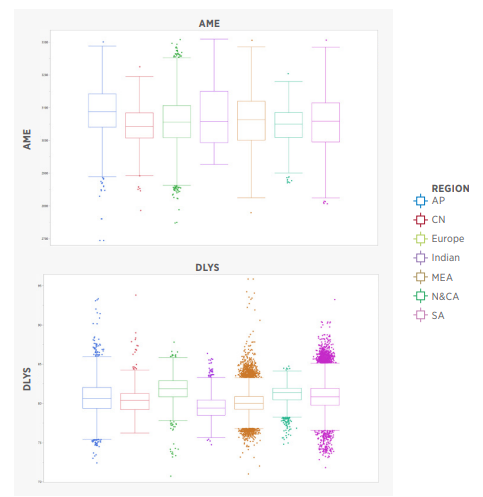
PNE data have confirmed large variability in AMEn levels in wheat batches. Wheat sourced from South Asia exhibited the highest average AMEn value, while wheat from South America showed the greatest variability (Figure 1a).

Digestible lysine levels in corn also show large variability (Figure 1b), as well as phytic phosphorous levels in corn DDGS. These real-time insights allow nutritionists to reduce uncertainty, rethink their sourcing strategy, and adjust formulations proactively.
Figure 1. Examples of the large variability seen in raw materials.
PNE also helps to assess the anti-nutritional factors (ANFs) content. ANFs include phytate, NSPs (like arabinoxylans (Ax)) and NDF (total insoluble NSPs) and can negatively affect digestibility, feed intake and hence the performance of the birds. Understanding ANFs in raw materials is important to formulate smarter (and to include enzymes more precisely, for example).
The next step is to update the nutrient matrix accordingly using accurate nutrient values. Designed by Adisseo for speed, accuracy, and simplicity, ADICT is an online tool that empowers users to incorporate PNE data directly into their feed formulations.
When diets have been reformulated, we want the diet to perform as expected in practical conditions. But from experience we know that the same feed can perform differently in another setting or farm, due to differences in the efficiency of feed digestion, driven by gender and genetics of the birds among others.
By using PNE, FDC and ADICT together, up to 3% feed cost savings can be expected! This is the result of better accuracy, fewer safety margins and more profit. So how to better predict this? The AMEn is a key indicator of feed digestibility, reflecting the energy available to the bird after accounting for energy losses in excreta. To account for individual farm and animal parameters when the feed is actually consumed, Adisseo developed the Feed Digestibility Check (hereafter called FDC).
This service enables nutritionists to accurately predict the true AMEn level of the feed in the context of real production and farming conditions
The use of enzymes and certain feed additives, with proven matrix values, are key to unlock nutrients, reduce feed costs, and improve animal performance. For optimal nutrient release through the use of enzymes, Adisseo developed the Feedase concept.
Rovabio is built on 30 years of feed digestibility expertise that revealed among others that Rovabio® Advance increases not only AME levels, but also amino acid digestibility by 3.3% in specific diet characteristics (Figure 2).
Rovabio® PhyPlus aims at degrading phytic acid (as much as possible), improving overall feed digestibility and releasing enough P to partially or completely meet the birds’ P requirements.
With Adisseo’s Feedase predictor, nutritionists can make a customized, tailor made matrix for Rovabio, based on specific PNE results on ANFs from their own scanned raw materials or use the average prediction data.
Figure 2. Proven matrix values of Rovabio® Advance (source: Cozannet et al, 2018)
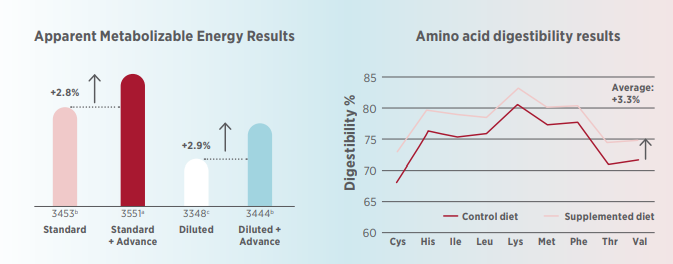
By using Rovabio® Advance in the diet, nutrients are better unlocked, which means that up 3% less digestible amino acids and 3% less AME have to be formulated. In typical US corn diets, this means a saving of 16.1 Euro per MT of feed. For wheat and barley diets in Europe, savings are seen up to 16.4 Euro per MT of feed.
Precision intelligence is also enforced by the use of FRA® LeciMax, aimed to further improve nutrient and energy digestibility and hence allows for oil reduction in the feed.
This feed additive is a concentrated lysolecithins-based emulsifier that increases enzymatic potential and nutrient absorption, translated into improved feed conversion ratio and average daily gain.
Next to this, the formulation and source of methionine chosen is key for optimal performance and profits. Rhodimet® AT88 is a source of methionine with a minimum concentration of active molecule (HMTBa) of 88%. Feed formulation matrix values for Rhodimet® AT88 on crude protein equivalence, energy values, activity, ABC-4 value are available for optimal use and value for the feed miller and to support bird performance.
Essential nutrients, including vitamins, remain a critical foundation to ensure consistency, resilience, and animal health, even under cost pressure. Vitamins represent only 0.5% of total feed cost, yet they can influence performance by up to 10%.

The quality and quantity of vitamins used in broiler diets is therefore essential to support optimal growth, reproduction, metabolic and immune function, and high-quality muscle development and metabolic functions.
But for vitamin A, to ensure good absorption by the animal, the vitamin must resist all feed processing steps and be effectively released in the bird. Microvit® A Supra 1000 was developed to meet this need.
In the case of vitamin E, which protects cells from oxidative stress by neutralizing reactive oxygen species, supports cellular integrity, strengthens immunity, and contributes to reproductive development, the required level in feed can vary depending on the objective. With Microvit® E Promix 50, Adisseo can help you determine the right dosage.
Beyond the quality and quantity of vitamins, it is essential to ensure the safety of vitamins, and the Microvit Certification System screens more than 30 contaminants and physical characteristics of each vitamin, guaranteeing its safety.
Backed by precise usage guidelines in the Microvit® Nutrition Guide 2026, the use of Microvit line, you will have a cost-effective and smart choice, ensuring optimal health and performance.
Sustainability has become an important part of precision formulation, and maybe one of the most challenging parts of the nutritionist’ balancing act. To support nutritionists to reduce the environmental footprint of feed and poultry products, Adisseo has introduced a new module within ADICT (Adisseo’s online tool to incorporate PNE data directly into feed formulations), allowing nutritionists to instantly evaluate the environmental impact of their formulations.
The values used in the module (around 1,500 ingredient/origin couples) come from the well-recognized and robust GFLI database, an international collection of feed ingredient datasets calculated by using Life Cycle Assessment (LCA) methodology. The rules from PEFCR Feed are applied in ADICT when one origin doesn’t exist for one ingredient.
Trials with 50% Rovabio matrix and 100% Rovabio matrix in broiler diets showed that the full matrix decreased the carbon impact of the feed (kg CO2 equivalent / MT feed) with 5.2% more compared to the 50% inclusion of the enzyme. For a feed mill producing 100,000 MT of feed / year this represents a decrease of around 4,600 MT CO2 equivalent / year. It is s roughly the annual energy-related CO2 emissions of about 1,000 homes, depending on region and usage and the annual emissions of around 1,000 cars.
In addition, ADICT is a crucial part of Sustainway, Adisseo’s sustainability journey service. Based on four different steps (SustainBeginner, SustainGrower, SustainPioneer and SustainMaster), this service allows customers to get familiar with and build their complete sustainability journey, considering feed, farm management, resources and animal performances.
The number of variables and constraints in feed formulation continues to grow, driven by fluctuations in raw material quality, availability, and cost. This increases uncertainty for nutritionists, who often rely on broad safety margins that are not always cost-effective.
Advanced nutritional tools can deliver double-digit Euro savings per metric ton of feed, while more precise formulation and refined safety margins also support more sustainable poultry production by reducing nutrient waste.
Subscribe now to the poultry technical magazine
AUTHORS

Setting the Global Standard for Soy
Isa Tan
Importance of Eggshell Temperature, Checking and Record Keeping in a Commercial Poultry Hatchery
Rasel Ahmed
The Reality of the South African Egg Industry
Abongile Balarane
Mycoplasmosis update: Antimicrobial Resistance, Vaccines, and Control Challenges
Edgar O. Oviedo Rondón
Future Flock: Antibiotic-Free Solutions for a Rising Population
Dr Ahmad Safi Dr. Faran Hameed
Interview Dr. Nivin Nasser
Dr. Nivin Nasser
Disinfection of Fertile Broiler Breeder Eggs
Edgar O. Oviedo Rondón
Precision Matters: Tackling Quality Issues in on‑Farm Vaccination
Jaime Sarabia Fragoso Kevin Gandon Pascal Paulet
Process Control: 30 Specific Aspects to Evaluate from Pre-Slaughter to Slaughter
Eduardo Cervantes López
Ishikawa Diagram Applied to Processing of Chickens
Eduardo Cervantes López