
Mycotoxins Biomarkers, Questions and Answers
WHAT ARE BIOMARKERS?
They are molecules derived from mycotoxins that initially entered the host orally and were subsequently transported and transformed in the livers of animals and humans.
- In the case of vomitoxins, some degree of degradation occurs in the intestines. This biotransformation can also be produced by fungal growth (Fusarium, for example) in the soil where grains are grown. Mycotoxins are also metabolites synthesized when molds grow in the field or during harvesting or storage.
When the host gets in contact with these toxic substances, the natural physiological response consists on making an attempt to reduce their toxicity by breaking them down and trying to produce less harmful substances. The objective is elimination from the body through natural secretions such as sweat, urine, milk, etc.
- Sometimes the host can reduce its toxicity, but occasionally the biotransformation is ineffective, and they retain their full capacity.
Less often, as is the case with zearalenone (ZEN), the metabolites produced by poultry and swine can be more toxic than the original toxin.
A practical and important example emphasizing the detection of metabolites in animal production is the identification of M1 in milk, a metabolite of aflatoxin (AFL) that may cause cancer in humans.
- This metabolite is less toxic than AFL, but still harmful.
In the case of T-2 toxin, it can be converted in the farmland into a metabolite named HT-2, which is detected in feed analyses of grains and feed.
Both T-2 toxin and HT-2 are characterized by producing oral lesions in the mouth of chickens. The conversion of T-2 toxin into HT-2 does not significantly affect the toxicity level.
HOW IMPORTANT ARE METABOLITES?
Not all the metabolites detected under commercial poultry production cause damage. It depends on the species evaluated and the concentration detected in the feed.
- For example, if M1 is detected in 3 to -5week-old broiler chickens, these findings show that exposure to AFL occurred. It does not necessarily mean that performance was affected or that pathological lesions were present.
Unfortunately, the detection of metabolites is not consistent, and it is not easy to make an exact extrapolation to calculate what level of mycotoxins was ingested to yield the levels of metabolites detected in blood or urine.
DON (Deoxynivalenol/Vomitoxin)
Commercial poultry can efficiently metabolize it into DON-3-sulfate in the liver and intestines through the action of the intestinal microflora, followed by rapid excretion.
- Due to rapid metabolism and low intestinal absorption, poultry is more resistant than pigs.
- DON-3-sulfate is nearly 200 times less toxic than DON.
ZEN
This is an example of a mycotoxin that is biotransformed into a metabolite more potent than the original.
Two metabolites associated with its estrogenic effect are alpha (α) zearalenol (ZAL) and beta (β) ZAL.
- α-ZAL is more estrogenic than the ZEN initially ingested.
- While β-ZAL is less potent.
Given that commercial poultry convert this mycotoxin primarily into β-ZAL, they are less susceptible to the estrogenic effects it causes.
Fumonisins (FMs)
Capable of blocking the formation of sphingolipid complexes (fats circulating in the bloodstream) at the hepatocyte level by inhibiting the enzymes necessary for their transformation.
- For decades, the concentration of sphinganine (SA)/ sphingosine (SO) in blood and urine has been measured as a biological marker indicative of FMs poisoning.
Since FUMs do not cause significant macroscopic (gross) damage in the liver, target organ, of chickens fed 100 ppm under experimental conditions; it is necessary to establish the SA/SO ratio to demonstrate that FUMs were present in the feed used in the trial.
IS THERE A CORRELATION BETWEEN THE CONCENTRATION OF METABOLITES IN BLOOD SERUM OR URINE AND THE CONCENTRATION OF MYCOTOXINS IN THE FEED?
In some species, there is a positive correlation. The higher the intake, the higher the detection level in blood serum or urine.
In commercial poultry, this correlation is, in many cases, highly irregular because poultry has a lower capacity for intestinal absorption of mycotoxins following oral ingestion, and the rate of excretion is faster and more efficient.
1. The timing of sample collection
Mycotoxins are rapidly metabolized and excreted by poultry, in some cases within 24 hours. Samples must be collected while the birds are ingesting the contaminated feed or within a few hours after ingestion, so it is difficult to predict under commercial conditions when is the right time.
In the case of broiler breeders-flocks generally eating for only 3 to 5 hours throughout the day due to feed restriction, the ideal approach would be to wait several hours after they have been fed to collect blood or urine samples.
2. What birds are evaluated?
- Ideally, take samples from the same birds to compare apples with apples.
3. Lack of uniformity in the natural distribution of mycotoxins in the feed
- If we do not know when mycotoxins enter the gastrointestinal tract, the likelihood of detecting the metabolites is lower.
4. Metabolic variability (genetics)
- Metabolism differs among different breeds, whether broilers, layers, or broiler breeders. More voracious animals eat more feed, ingest more mycotoxins, and therefore theoretically must have a higher concentration of metabolites that can be detected.
5. Simultaneous exposure to multiple mycotoxins
- Simultaneous ingestion of multiple mycotoxins interferes with the metabolic pathway used to detoxify them, thereby altering the level of excretion of their metabolites.
WHAT LABORATORY METHOD IS USED TO MEASURE METABOLITES IN BLOOD SERUM OR URINE?
LC-MS/MS (liquid chromatography coupled with tandem mass spectrometry) is often used.
- The technique is sensitive and dependable, capable of detecting simultaneously dozens of mycotoxins and metabolites.
IS THE DETECTION OF METABOLITES OF EMERGING MYCOTOXINS SUCH AS TENUAZONIC ACID (TA), ENNIATINS, AND BEAUVERICIN IMPORTANT?
Various reports show that they can be detected in commercial feed consumed by poultry around the world.
- Its deleterious effects on performance and health have not been clearly proven.
In an old scientific study published in 1978, poor performance was reported in broiler chickens after feeding relatively high doses of these mycotoxins for three weeks.
In conclusion, the detection of metabolites in the blood or urine of commercial poultry is a valuable tool that can help us determine the animals’ actual exposure.
- Unfortunately, there are many variables that can affect the results and create confusion in their interpretation.
- The number of blood and urine samples analyzed and the frequency with which they are collected are especially key factors that must be fine-tuned to obtain more reliable results and facilitate interpretation.
Table 1: Effect of FUMs and two feed additives administered for 21 days to broiler chickens on the sphinganine/sphingosine ratio (SA/SO).

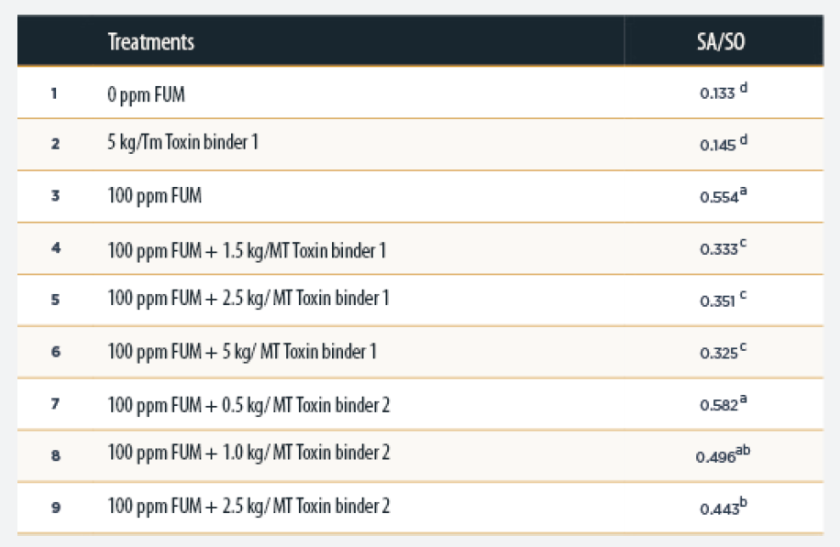
Different letters indicate statistical significance between treatments.
Mallmann, C.A. et al. Efficacy of hydrophilic and lipophilic clays against fumonisins in day old broiler chickens. International Poultry Scientific Forum, Atlanta, Georgia, US. January 2024