Available in other languages:
Content available at:
As ethical food sourcing gains momentum in Asia’s hospitality sector, ONYX Hospitality Group has announced a major animal welfare milestone: a cage-free egg policy across its hotels and resorts in Thailand, Laos, Malaysia, and Sri Lanka.
The move follows extensive dialogue with Sinergia Animal, a global animal protection organization, and marks a significant shift toward more compassionate food systems in Asia’s hospitality industry.
Building a more ethical food future


Sukamal Mondal, Executive Vice President of Operations and Sustainability at ONYX, confirmed the policy will cover its key brands—Amari, Oriental Residence, and OZO. Implementation begins in Thailand in 2025, with a goal of 50% cage-free egg use by 2026, and 100% by 2027 in all markets where the commitment applies.
“This initiative aligns with our ‘Sustainability Crafted Hospitality’ approach, where premium guest experiences are combined with responsible and ethical business practices,” Mr Mondal said.
Beyond supply chains, the policy represents a broader shift toward compassionate, consumer-aligned food systems. Mr Mondal emphasized that cage-free eggs are not just ingredients. They symbolize a more responsible and empathetic future in which the hospitality industry plays a key role.


Raising the bar for animal welfare
Saneekarn Rosmontri, Country Director for Sinergia Animal in Thailand, welcomed the move as a pivotal step for Southeast Asia’s hotel industry. She noted that cage-free eggs are fast becoming a mainstream expectation, not a niche concern.
“Confining egg-laying hens in battery cages prevents them from walking, spreading their wings, or behaving naturally. This severely compromises their physical and mental well-being,” she explained.
Sinergia Animal has worked in Thailand since 2019 to promote cage-free sourcing. One of the key tools, the Asia Cage-Free Tracker, promotes transparency and monitors progress across the region.
Chicken Watch, which tracks corporate commitments to cage-free policies, said over 300 companies in Asia have pledged to eliminate caged eggs from their supply chains. This includes major food producers, restaurant chains, and hotel groups.
A new industry standards
Ms Rosmontri urged more hospitality and food companies to follow ONYX’s lead. She stressed that ethical sourcing is no longer optional—it is a global movement aligned with consumer expectations and sustainability goals.
“Ethical sourcing must become the new normal,” she said. “Together, we can build a kinder, more sustainable food system for all.”


White-Egg Layers Rise in UK


Subscribe now to the poultry technical magazine
AUTHORS

Setting the Global Standard for Soy
Isa Tan
Importance of Eggshell Temperature, Checking and Record Keeping in a Commercial Poultry Hatchery
Rasel Ahmed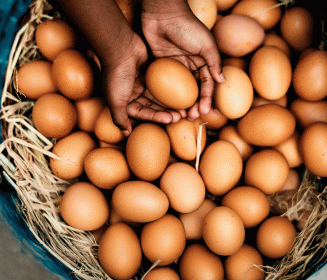
The Reality of the South African Egg Industry
Abongile Balarane
Mycoplasmosis update: Antimicrobial Resistance, Vaccines, and Control Challenges
Edgar O. Oviedo Rondón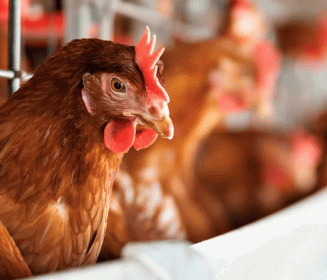
Future Flock: Antibiotic-Free Solutions for a Rising Population
Dr Ahmad Safi Dr. Faran Hameed
Interview Dr. Nivin Nasser
Dr. Nivin Nasser
Disinfection of Fertile Broiler Breeder Eggs
Edgar O. Oviedo Rondón
Precision Matters: Tackling Quality Issues in on‑Farm Vaccination
Jaime Sarabia Fragoso Kevin Gandon Pascal Paulet
Process Control: 30 Specific Aspects to Evaluate from Pre-Slaughter to Slaughter
Eduardo Cervantes López
Ishikawa Diagram Applied to Processing of Chickens
Eduardo Cervantes López