


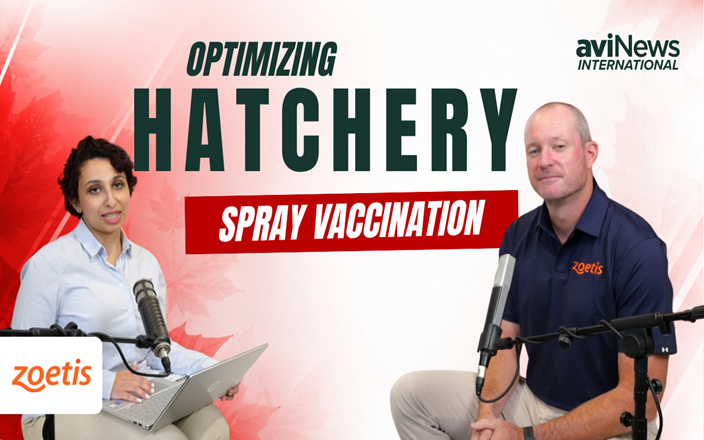
Toronto, Canada – During the World Poultry Congress, aviNews International spoke with Dr. Brian Jordan, Director of Technical and Diagnostic Services for Poultry at Zoetis U.S., about one of the most critical preventive practices in modern poultry production: hatchery spray vaccination.
As poultry production continues to expand, hatcheries must vaccinate thousands of chicks efficiently while maintaining vaccine efficacy. According to Dr. Jordan, success depends not only on the vaccine itself, but also on every step of its preparation, handling and application.
WATCH THE FULL INTERVIEW HERE
The Objective of Successful Spray Vaccination
Spray vaccination has become one of the most effective methods for mass immunization in commercial hatcheries, allowing large numbers of chicks to be vaccinated quickly without disrupting hatchery flow.
Dr. Jordan explained that the primary goal is to ensure that every chick receives an adequate dose of vaccine while preserving the biological activity of the live vaccine. Achieving this balance requires both speed and precision.
“We are trying to vaccinate a lot of birds very quickly while ensuring the vaccine reaches every chick without compromising how it is designed to work.”
Because hatcheries operate under tight production schedules, the vaccination process must be efficient while avoiding conditions that could reduce vaccine viability.
Live Vaccines Require Careful Handling
One of the interview’s key messages was that respiratory vaccines – such as those used against Newcastle disease and infectious bronchitis – are composed of live, attenuated viruses that must remain viable to stimulate the bird’s immune system.
Since these vaccines replicate within the bird to generate immunity, any mishandling before application can significantly reduce their effectiveness.
Dr. Jordan emphasized that several factors may damage live vaccines before they even reach the chicks, including:
- Poor water quality.
- High temperatures.
- Exposure to sanitizers or disinfectants.
- Mineral contamination.
- Environmental conditions during preparation.
Because vaccine preparation involves multiple stages including thawing, reconstitution, dilution and application… each step represents an opportunity to preserve or compromise vaccine performance.
Water Quality and Temperature: Two Critical Factors
Among all handling recommendations, Dr. Jordan highlighted two practical measures that can dramatically improve vaccine protection.
Use high-quality water
Water quality directly affects vaccine stability. Distilled water or another verified high-quality water source is preferred because untreated water may contain minerals, iron or other compounds capable of inactivating live viruses.
Tap water or untreated well water should be avoided whenever possible.
Keep vaccines cool
- Temperature management is equally important.
Research has shown that respiratory vaccines begin losing activity once temperatures exceed approximately 70°F (21°C). Starting with cooler vaccines around 55–60°F (13–16°C) provides hatchery personnel with a safer operating window before application.
Maintaining proper temperature throughout preparation helps preserve viral viability and supports a stronger immune response after vaccination.
Spray Cabinet Optimization is Essential
Successful vaccination extends beyond vaccine preparation. Once the vaccine reaches the spray cabinet, several mechanical factors influence whether chicks receive the correct dose.
Dr. Jordan explained that the spray cabinet functions as an integrated system in which multiple variables interact, including:
- Nozzle size.
- Pressure system.
- Flow rate.
- Line speed.
- Application volume.
Rather than optimizing each parameter independently, hatcheries should understand how adjustments in one component affect the entire spraying process.
Larger Droplets Improve Respiratory Vaccination
Based on previous research, Dr. Jordan recommends producing a relatively coarse spray.
Although there is no universal definition of an ideal droplet size, larger droplets generally provide important advantages:
- They are less affected by air movement.
- They are less susceptible to low relative humidity.
- They travel more efficiently toward the chicks.
- They remain on the down feathers longer, allowing greater vaccine contact and uptake.
Producing these larger droplets often involves using larger nozzle sizes combined with appropriate pressure adjustments and flow rates.
However, changing one parameter requires recalibrating the others to maintain consistent vaccine delivery throughout the basket.
Application volume must also be considered, as different vaccine volumes influence droplet formation and overall coverage.
Verifying Vaccination Performance
One of the most common challenges for hatchery managers is determining whether spray vaccination is being applied correctly in real time.
Traditional monitoring methods such as PCR testing several days after vaccination confirm vaccine uptake but cannot identify application problems immediately.
For routine evaluation, Dr. Jordan recommends a simple yet highly practical approach.
Placing a clear sheet of plexiglass over a chick basket and passing it through the spray cabinet allows hatchery personnel to visualize the spray pattern directly. This method helps assess:
- Coverage from side to side.
- Coverage from front to back.
- Spray start and stop timing.
- Droplet distribution.
- Overall droplet size.
If nozzle adjustments have been made, the plexiglass test also allows easy comparison between previous and current droplet patterns.
Additionally, thermal imaging cameras many of which now connect directly to smartphones can provide another valuable monitoring tool. Because the vaccine is cooler than newly hatched chicks, thermal imaging creates a visible contrast that helps operators observe vaccine distribution during application.
Precision Drives Vaccine Success
Throughout the interview, Dr. Jordan reinforced that spray vaccination remains a highly effective technology when every stage of the process is carefully managed.
Protecting vaccine viability through proper water quality, temperature control and handling practices, combined with correct spray cabinet calibration and routine verification, helps ensure that chicks receive an effective immunizing dose.
Ultimately, successful hatchery vaccination is not determined by a single factor but by the consistent execution of every step from vaccine preparation to final application allowing poultry producers to maximize flock health and long-term performance.