The poultry industry helped cushion Philippine agriculture in Q1 2026, growing 7% year‑on‑year even as total farm output dipped 0.3% due to crop and fisheries declines. Poultry’s strong performance offset weaknesses in palay, corn, and fisheries, underscoring its stabilizing role in the food supply.
According to the latest report from the Philippine Statistics Authority (PSA), overall poultry production reached 827,990 tons. This performance highlights poultry’s importance as the strongest performer among agriculture subsectors, outpacing livestock and fisheries during a period of broader challenges.
Chicken remained the backbone of poultry output, accounting for more than 70% of total production. Output reached 585,470 tons, up 5.8% year‑on‑year.
Stable consumer demand helped offset pressures from higher input costs and localized avian influenza cases. Seasonally adjusted data showed a modest 0.2% quarter‑on‑quarter increase, reflecting both industry stability and the challenges of rising feed costs.


Chicken’s performance underscores its importance in ensuring food supply and supporting farm incomes, even as producers face rising costs and disease risks.
Egg production added further strength to the industry. Chicken egg output rose 10.6% year‑on‑year to 222,950 tons, expanding its share of total poultry production.
Seasonally adjusted figures showed a 3.3% quarter‑on‑quarter increase. Improved farm efficiency and strong consumer demand sustained growth despite higher input prices.


Duck egg production also contributed, rising 3.5% year‑on‑year to 12,940 tons. Though smaller in scale, duck eggs remain a steady supply source and add diversity to poultry output.
Duck meat production reached 6630 tons, reflecting a 2.9% increase from the previous year. Ducks continue to provide niche market opportunities and regional supply diversity.
Seasonally adjusted data showed stable output. Growth was supported by smallholder producers and regional demand, highlighting ducks’ role in diversified poultry supply chains.
The PSA emphasized poultry’s resilience compared to other subsectors. Gains across chicken, eggs, and ducks demonstrate the industry’s ability to withstand broader agricultural challenges.
Still, rising feed costs, disease risks, and market volatility remain concerns. Continued investment in biosecurity, input management, and technology adoption will be critical for sustaining momentum.


Subscribe now to the poultry technical magazine
AUTHORS

Setting the Global Standard for Soy
Isa Tan
Importance of Eggshell Temperature, Checking and Record Keeping in a Commercial Poultry Hatchery
Rasel Ahmed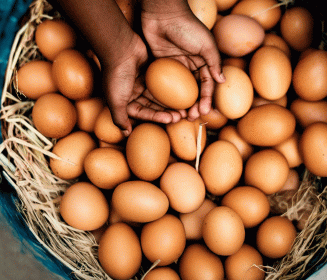
The Reality of the South African Egg Industry
Abongile Balarane
Mycoplasmosis update: Antimicrobial Resistance, Vaccines, and Control Challenges
Edgar O. Oviedo Rondón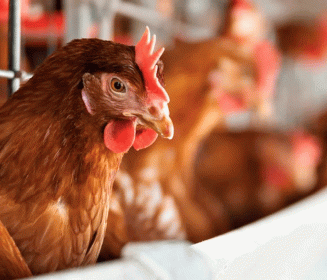
Future Flock: Antibiotic-Free Solutions for a Rising Population
Dr Ahmad Safi Dr. Faran Hameed
Interview Dr. Nivin Nasser
Dr. Nivin Nasser
Disinfection of Fertile Broiler Breeder Eggs
Edgar O. Oviedo Rondón
Precision Matters: Tackling Quality Issues in on‑Farm Vaccination
Jaime Sarabia Fragoso Kevin Gandon Pascal Paulet
Process Control: 30 Specific Aspects to Evaluate from Pre-Slaughter to Slaughter
Eduardo Cervantes López
Ishikawa Diagram Applied to Processing of Chickens
Eduardo Cervantes López