Sources: Available upon request





Available in other languages:
Content available at:
In recent months, Russia has been grappling with a significant egg crisis that has sent shockwaves through its economy and society. The crisis, marked by soaring prices and widespread shortages, has become a pressing issue for the Kremlin, highlighting deeper economic vulnerabilities and sparking political concerns.
The egg crisis began to unfold in late 2023 when the price of eggs surged by over 40%. This dramatic increase was attributed to a combination of factors, including supply chain disruptions, rising feed costs, and a series of avian flu outbreaks that decimated poultry populations. As a result, the availability of eggs plummeted, leading to long queues and empty shelves in supermarkets across the country.
The situation quickly escalated into a political issue, with President Vladimir Putin’s administration taking swift action to address the crisis. The Investigatory Committee launched an inquiry into potential price fixing, while the Federal Security Service (FSB) was tasked with cracking down on hoarding. These measures, however, have done little to alleviate the immediate impact on consumers, who continue to face high prices and limited supplies.


The egg crisis has also exposed broader economic challenges facing Russia. For over a decade, the country had prided itself on being nearly self-sufficient in egg production, relying on imports for only a small fraction of its needs. The current shortage, however, has underscored the fragility of this self-sufficiency and the vulnerability of Russia’s agricultural sector to external shocks.
As Russia continues to navigate the aftershocks of the egg crisis, the government faces the dual challenge of addressing immediate supply issues while also implementing long-term solutions to bolster the resilience of its agricultural sector. This includes investing in domestic production, improving supply chain infrastructure, and ensuring that future crises can be managed more effectively.
In conclusion, the egg crisis in Russia serves as a stark reminder of the interconnectedness of economic, social, and political factors. While the immediate impact on consumers is severe, the broader implications for the country’s stability and resilience are equally significant. The Kremlin’s ability to manage this crisis will be a critical test of its governance and its capacity to address the underlying vulnerabilities in the Russian economy.

Sources: Available upon request


Subscribe now to the poultry technical magazine
AUTHORS

Setting the Global Standard for Soy
Isa Tan
Importance of Eggshell Temperature, Checking and Record Keeping in a Commercial Poultry Hatchery
Rasel Ahmed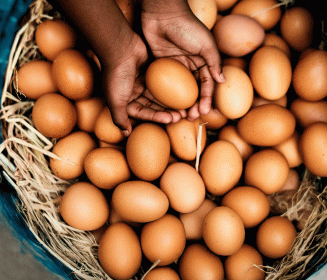
The Reality of the South African Egg Industry
Abongile Balarane
Mycoplasmosis update: Antimicrobial Resistance, Vaccines, and Control Challenges
Edgar O. Oviedo Rondón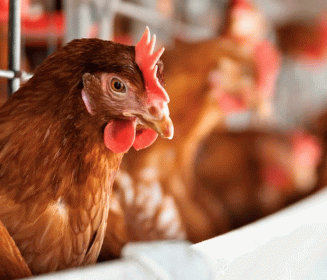
Future Flock: Antibiotic-Free Solutions for a Rising Population
Dr Ahmad Safi Dr. Faran Hameed
Interview Dr. Nivin Nasser
Dr. Nivin Nasser
Disinfection of Fertile Broiler Breeder Eggs
Edgar O. Oviedo Rondón
Precision Matters: Tackling Quality Issues in on‑Farm Vaccination
Jaime Sarabia Fragoso Kevin Gandon Pascal Paulet
Process Control: 30 Specific Aspects to Evaluate from Pre-Slaughter to Slaughter
Eduardo Cervantes López
Ishikawa Diagram Applied to Processing of Chickens
Eduardo Cervantes López