
Vietnam broiler prices plunge, leaving producers in distress on the Eve of Tet
In Ho Chi Minh City and its neighboring provinces, broiler selling prices hover around the cost of production, leaving many farms with no profit, or even resulting in losses.

Available in other languages:
This post is also available in:
Broiler and live hog prices have fallen in tandem ahead of Tet Dinh Mui 2027, even as feed prices remain elevated. Many farmers and companies have been forced to scale back production or postpone restocking.
Prolonged price slump piles pressure on producers
At the end of October 2026, live hog prices in some localities fell to around USD 1.63 per kg, nearly USD 1.52 per kg lower than at the start of the year.
Tran Van Quang, who owns a hog farm in Xuan Loc commune, Dong Nai city, said he had decided against restocking after selling his last batch of hogs last month.
According to Mr Quang, African swine fever remains a complex problem, feed is costly and live hog prices are low, so he has put restocking on hold. This means his family will lose its main source of income during the Tet season.
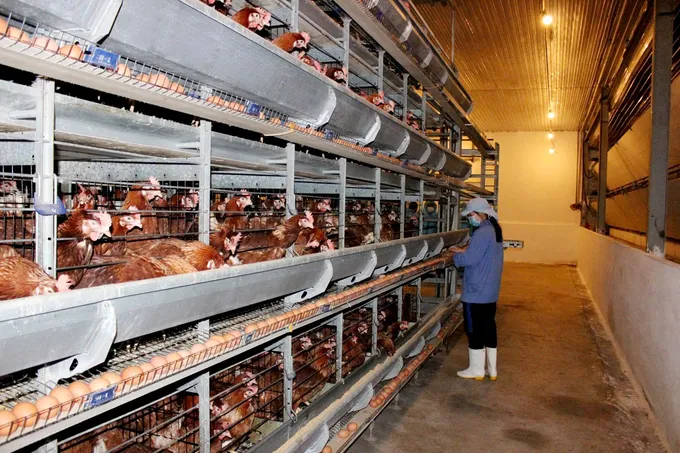
A facility for raising egg-laying hens in Phu Giao Commune, Ho Chi Minh City (Photo courtesy: Duc Trung, SGGP).
Companies are under similar strain. Pham Truong Giang, Director of Trang Linh Co Ltd in Xuyen Moc commune, Ho Chi Minh City, said feed prices have risen by about 20% since the beginning of 2026.


With 3,600 sows and 46,000 fattening hogs, the company must source more than 2,400 tons of feed every month.
To ease financial pressure, it is reviewing its herd size, reducing the share of fattening hogs and selling off part of its weaned piglets.
The poultry market is faring no better. According to the Vietnam Poultry Association, at the end of October 2026, white-feather broilers in the Southeast region sold for only USD 0.99-1.14 per kg, while colored-feather broilers fetched USD 1.75-1.98 per kg, both down more than 20% from the beginning of the year.
In Ho Chi Minh City and neighboring provinces, selling prices are hovering around production cost, leaving many farms with no profit and some operating at a loss.
After 10 months of unfavorable prices, many enterprises may struggle to hold out if the situation persists through the end of the year.
Tet supply is sufficient, but shortages may follow
At the Ministry of Industry and Trade’s third-quarter 2026 press briefing, Nguyen Thuy Hien, Deputy Director of the Domestic Market Management and Development Department, said food supplies are sufficient to meet year-end demand.
She stressed, however, that measures are needed to help farmers sustain production and avoid herd reductions or distress sales when prices are low.
Without timely restocking, supplies in the coming months could be affected.
Nguyen Quy Khiem, Vice Chairman and General Secretary of the Vietnam Poultry Association, said abundant but unstable supply is one of the factors weighing on the market.
He proposed stepping up public awareness campaigns to encourage consumers to prioritize domestic products, along with measures to curb cross-border smuggling. Companies should also share information to avoid localized oversupply and price-cutting competition.
Chain linkages, lower costs and export orientation needed
Tran Phu Cuong, Head of the Sub-department of Livestock Production and Animal Health under the Ho Chi Minh City Department of Agriculture and Environment, said enterprises and farmers should develop export-oriented strategies rather than rely solely on the domestic market.
He noted that the sector still lacks effective chain linkages and has too many intermediaries; only by cutting these layers can domestic farms gain a stronger competitive edge.
In the longer term, Pham Kim Dang, Deputy Director of the Department of Livestock Production and Animal Health under the Ministry of Agriculture and Environment, emphasized that the sector must improve competitiveness by developing concentrated farming, applying technology, reducing production costs and becoming more self-reliant in domestic feed raw materials.
Related to Market

Article 31 Jul


Poultry Feed Challenges Amid Strait of Hormuz Closure

News 11 Jun
Frozen Poultry Exports Surge at Georgia Ports

Article 30 May
When the Supply Chain Breaks: Poultry Prices and the Economics of Maritime Disruption in the Middle East

News 25 Mar
Turmoil Hits Poultry Sector in Syria

News 18 Mar
Middle East War Shakes Poultry Supply Chains

News 16 Mar
Egg Exports from Ukraine Rise by Over 60%
Article 16 Mar
The Reality of the South African Egg Industry

News 11 Mar
Defining forces in the U.S. egg market in 2026