Available in other languages:
Content available at:
The model of applying digital technology in egg-laying chicken farming by Nguyen Van Nguyen in Toan Luu Commune (Ha Tinh) has become a bright spot, generating tens of millions of dong in daily revenue and creating sustainable livelihoods for rural residents.
Before 2018, Mr Nguyen was a farmer raising free-range chickens in the traditional way.
Despite his diligence, the economic efficiency was low due to unstable egg productivity and frequent disease outbreaks. Refusing to accept that situation, he spent time learning and determined to innovate.


He boldly invested more than USD 200,000 to build a modern farm on 3 hectares of land in Bau Am Hamlet, Toan Luu Commune.
He chose Isa Brown breed from the Netherlands, raised in a closed housing system. The entire process, from feeding troughs, automatic water lines, lighting, cooling, and temperature control, is scientifically programmed.
“At first, I was worried, but thanks to technical support, loan assistance, and study tours organized by the local authorities and the Farmers’ Association, I gained more confidence to start this new path,” Mr Nguyen shared.
Currently, Mr Nguyen’s farm maintains 15,000 laying hens. The chickens are cared for under strict procedures, receiving 18 types of vaccines before entering the egg-laying stage. They begin laying from the 18th week and reach nearly 100% productivity by the 25th week.
Every day, the farm harvests about 12,000 eggs. With a stable selling price of USD 0.12 per egg, the average daily revenue reaches about USD 1,440.
Eggs are collected and properly preserved on-site before being supplied to trusted buyers. In addition, revenue from culled chickens at the end of each laying cycle also contributes significantly to overall profit.
The key factor driving efficiency lies in digital technology. Mr Nguyen can operate and monitor the entire farm directly from his smartphone, including feeding, lighting, cooling fans, and temperature control.
“Technology is not the goal but a tool to help me manage more efficiently. Even when I’m away, I can still keep track of the farm,” he said, emphasizing the flexibility and risk reduction of the model.
Alongside poultry, Mr Nguyen also raises a herd of 150 Belgian Blue (3B) beef cattle, bringing in USD 40,000 annually and diversifying income while reducing risks for his business model.
The farm also prioritizes environmental protection by using biological products to control odors, ensuring sustainability.
The success of the model extends beyond family economics. The farm has created stable jobs for 10 local workers, each earning USD 320-400 per month – a meaningful figure for a rural area.
Nguyen Mau Duong, Chairman of the Toan Luu Commune Farmers’ Association, said, “Mr Nguyen’s model is clear proof of the spirit of daring to think and act, and of applying high technology. It is an example for other farmers to learn from and replicate.”
From a traditional chicken farmer, Mr Nguyen has become one of the leading high-tech farm owners in the region. His story is a living proof that the combination of hard work, technical knowledge, and investment courage is the key to building an efficient economy, making practical contributions to new rural development and sustainable poverty reduction.


White-Egg Layers Rise in UK




Subscribe now to the poultry technical magazine
AUTHORS

Setting the Global Standard for Soy
Isa Tan
Importance of Eggshell Temperature, Checking and Record Keeping in a Commercial Poultry Hatchery
Rasel Ahmed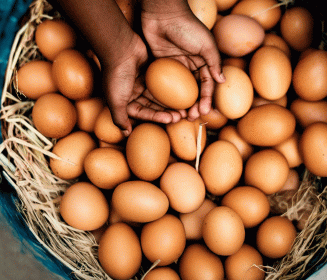
The Reality of the South African Egg Industry
Abongile Balarane
Mycoplasmosis update: Antimicrobial Resistance, Vaccines, and Control Challenges
Edgar O. Oviedo Rondón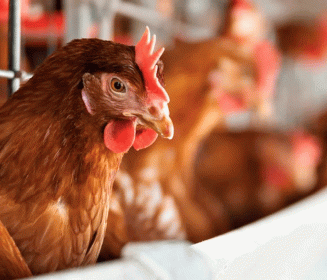
Future Flock: Antibiotic-Free Solutions for a Rising Population
Dr Ahmad Safi Dr. Faran Hameed
Interview Dr. Nivin Nasser
Dr. Nivin Nasser
Disinfection of Fertile Broiler Breeder Eggs
Edgar O. Oviedo Rondón
Precision Matters: Tackling Quality Issues in on‑Farm Vaccination
Jaime Sarabia Fragoso Kevin Gandon Pascal Paulet
Process Control: 30 Specific Aspects to Evaluate from Pre-Slaughter to Slaughter
Eduardo Cervantes López
Ishikawa Diagram Applied to Processing of Chickens
Eduardo Cervantes López