Sources: Available upon request





The poultry industry in the U.S. has long relied on conventional hatchery practices to meet the growing demand for chicken and turkey production. However, in recent years, alternative production methods have gained traction as producers seek to balance efficiency, animal welfare, and sustainability. These innovations are reshaping hatchery operations and influencing the broader poultry supply chain.
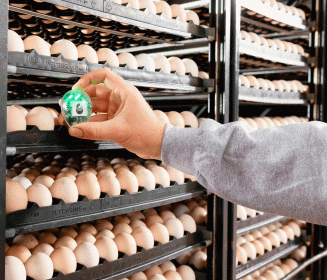
Advances in technology are also fueling alternative hatchery practices. Automated monitoring systems now track embryo development with precision, ensuring optimal incubation conditions. Some hatcheries are experimenting with in-ovo feeding, where nutrients are introduced into the egg before hatching. This technique enhances chick vitality, reduces early mortality, and supports stronger growth performance. Such innovations demonstrate how science is reshaping traditional hatchery models.
The U.S. market plays a decisive role in shaping hatchery practices. Retailers and food service companies increasingly demand poultry products that meet specific welfare and sustainability standards. As a result, hatcheries adopting alternative production methods gain competitive advantages. This shift reflects a broader trend in which consumer expectations directly influence production strategies, pushing the industry toward more transparent and responsible practices.
Despite the benefits, alternative hatchery production faces challenges. Higher costs, logistical complexities, and the need for specialized equipment can limit widespread adoption. However, opportunities abound for producers who invest in these systems. By differentiating their products and meeting evolving market demands, hatcheries can secure long-term resilience and profitability.

Alternative production in U.S. hatcheries represents a dynamic intersection of welfare, technology, and sustainability. While challenges remain, the industry’s willingness to innovate signals a future where hatcheries play a central role in delivering poultry that meets both consumer expectations and global sustainability goals.
Sources: Available upon request
Subscribe now to the poultry technical magazine
AUTHORS

Setting the Global Standard for Soy
Isa Tan
Importance of Eggshell Temperature, Checking and Record Keeping in a Commercial Poultry Hatchery
Rasel Ahmed
The Reality of the South African Egg Industry
Abongile Balarane
Mycoplasmosis update: Antimicrobial Resistance, Vaccines, and Control Challenges
Edgar O. Oviedo Rondón
Future Flock: Antibiotic-Free Solutions for a Rising Population
Dr Ahmad Safi Dr. Faran Hameed
Interview Dr. Nivin Nasser
Dr. Nivin Nasser
Disinfection of Fertile Broiler Breeder Eggs
Edgar O. Oviedo Rondón
Precision Matters: Tackling Quality Issues in on‑Farm Vaccination
Jaime Sarabia Fragoso Kevin Gandon Pascal Paulet
Process Control: 30 Specific Aspects to Evaluate from Pre-Slaughter to Slaughter
Eduardo Cervantes López
Ishikawa Diagram Applied to Processing of Chickens
Eduardo Cervantes López