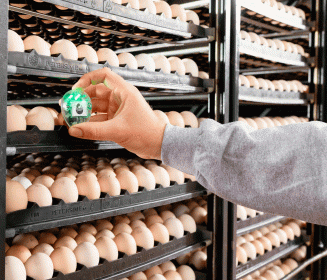
Find the previous parts here:
Part 4: Management, KPIs, challenges, and conclusion
People and operational management
Despite technological advancements, human resources remain essential.


Key operational teams include:
Success depends on:
Key Performance Indicators (KPIs)

Performance measurement is essential for improvement.
Important KPIs include:
Efficient hatcheries typically achieve 85–90% hatchability of fertile eggs.
Operational challenges
Common challenges faced in hatchery operations include:
These challenges require proactive planning, monitoring, and contingency strategies.
Role of hatchery in poultry industry
The hatchery plays a pivotal role in the poultry value chain.
Its efficiency directly impacts:
Even minor inefficiencies at the hatchery level can result in significant downstream losses.
Conclusion
In conclusion, a successful hatchery operation is built on three key pillars:
From selecting high-quality eggs to delivering healthy chicks, every step in the process is critical.
As the demand for poultry products continues to rise, hatcheries must evolve by adopting automation, data-driven decision-making, and best management practices.
Ultimately, the quality of chicks produced determines the success of the entire poultry production system.


Subscribe now to the poultry technical magazine
AUTHORS

Setting the Global Standard for Soy
Isa Tan
Importance of Eggshell Temperature, Checking and Record Keeping in a Commercial Poultry Hatchery
Rasel Ahmed
The Reality of the South African Egg Industry
Abongile Balarane
Mycoplasmosis update: Antimicrobial Resistance, Vaccines, and Control Challenges
Edgar O. Oviedo Rondón
Future Flock: Antibiotic-Free Solutions for a Rising Population
Dr Ahmad Safi Dr. Faran Hameed
Interview Dr. Nivin Nasser
Dr. Nivin Nasser
Disinfection of Fertile Broiler Breeder Eggs
Edgar O. Oviedo Rondón
Precision Matters: Tackling Quality Issues in on‑Farm Vaccination
Jaime Sarabia Fragoso Kevin Gandon Pascal Paulet
Process Control: 30 Specific Aspects to Evaluate from Pre-Slaughter to Slaughter
Eduardo Cervantes López
Ishikawa Diagram Applied to Processing of Chickens
Eduardo Cervantes López