

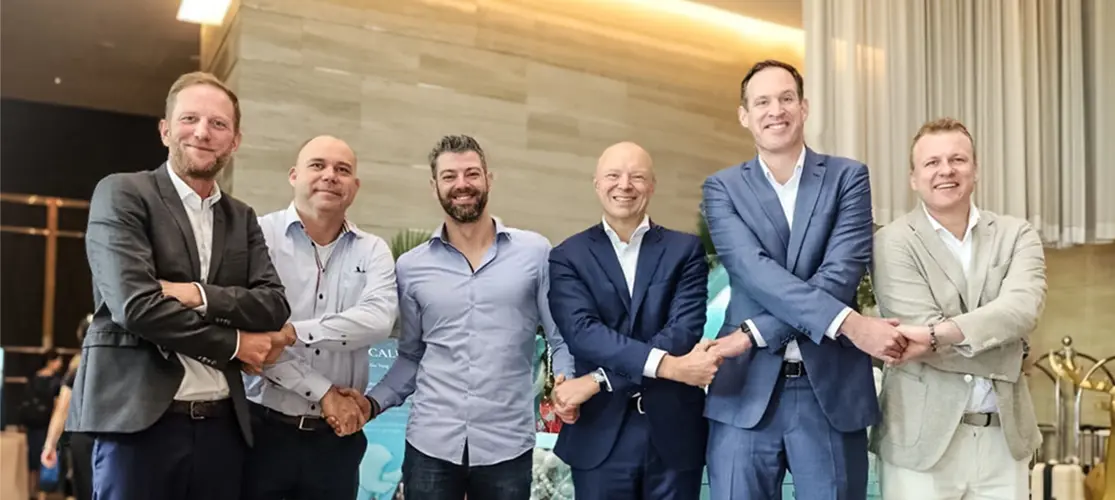
From left, Rasmus Hanssen (De Heus, Director Food Vietnam), Mike Jansen (JBT Marel WWT), Nick Adams (JBT Marel Poultry), Koen de Heus (De Heus CEO), Gabor Fluit (De Heus, Director Asia), Johan van der Ban (De Heus, Director Vietnam).







After years of working through joint ventures in Vietnam, De Heus is taking full ownership of a new poultry processing facility. This greenfield plant, built entirely under the De Heus name, marks a major milestone for the company in Southeast Asia.
Capitalizing on its extensive experience in the region, the company is confident in this strategic move. With JBT Marel as its trusted partner for equipment supply, the project promises mutual benefits for all involved.
From left, Rasmus Hanssen (De Heus, Director Food Vietnam), Mike Jansen (JBT Marel WWT), Nick Adams (JBT Marel Poultry), Koen de Heus (De Heus CEO), Gabor Fluit (De Heus, Director Asia), Johan van der Ban (De Heus, Director Vietnam).


A model facility in Tây Ninh
The plant will be built in Tây Ninh district, about a 75-minute drive south from Ho Chi Minh City.
To ensure top-tier operations, the Vietnamese team to run the plant will train in the Netherlands to gain advanced expertise in poultry processing.

De Heus aims for the facility to earn ‘reference’ status, with excellent efficiency and maintenance. Arno Streng, an experienced CTO in poultry processing, will lead the factory during its initial phase.
Prepared for the future
Initial capacity is set at 6000 birds/hour, with infrastructure already in place to double that to 12,000. The spacious layout allows for future expansion without major redesigns.
The evisceration department is fully future-proofed. From the JBT Marel Vent Cutter and Opening Machine to the Nuova-i eviscerator, from the NIC neck inspection machine to the FIM final inspection machine and other backend operations, everything is prepared for 12,000 birds/hour.
De Heus deliberately opted for this smart investment to ensure the second phase will be simpler and more cost-effective.
The same forward thinking applies to the Feet Processing System, which includes scalding, peeling, and chilling technologies. In Vietnam, chicken feet are high-value items, often priced higher than breast meat in Europe.
Advanced chilling technology
Product chilling will follow a combined and fully inline water-air chilling system. Immersion chillers first cool products while they remain on the overhead conveyor. Products then move into a ventilated cold air tunnel.
Water cools more aggressively than air, quickly dropping product temperature from 40°C to around 32°C in the first-stage immersion. The air tunnel completes the process, offering the benefits of air chilling with minimal water pickup (about 1%). This hybrid approach meets local market preferences while saving space by avoiding a larger air-only tunnel.
Secondary process
After chilling, whole products are discharged based on weight. Remaining products are rehung onto two J-shackle lines, where operators manually cut and debone the products in the shackles.
This process will remain manual until De Heus finalizes cut specifications for its QSR customers. Fast food chains like Popeyes and Jollibee each require specific cuts, so the process will adapt to meet their needs.
Beyond customer-supplier
“The way we work together on this project truly feels like a partnership, one that goes beyond the typical customer-supplier relationship,” said Nick Adams, JBT Marel Director Poultry APAC Sales.
“We are partners working together to make this processing plant a success. Through Marel’s long-standing consultancy role, we’ve built trust into our relationship,” he added.
“Our involvement doesn’t end with the sale of a machine. It extends to providing support, training, and ongoing growth. It is our job to enable our customers to be successful in their market. For JBT Marel, success is only complete when that goal is realized and the customer says, ‘We managed to achieve this together. That is fantastic’.”




Subscribe now to the poultry technical magazine
AUTHORS

Newcastle Disease: One Hundred Years On, Why Transmission Control Matters More Than Ever
Mustafa Seckin Sandikli
Egg Size Versatility in Nick Chick – Part I
H&N Technical Department
Interview with Khaled Abdel Nasser Awwad
Khaled Abdel Nasser Awwad
When the Supply Chain Breaks: Poultry Prices and the Economics of Maritime Disruption in the Middle East
Dima Chatila
Reovirus Infections in the Broiler Industry
Edgar O. Oviedo Rondón
Egg Condensation in Hatcheries: A Hidden Risk for Embryo Development, Hatchability and Chick Quality
Rasel Ahmed
From Chat to Farm Insight: Bridging the Social Data Gap in Indonesian Broiler Farming
Setiawan Guntarto
Labor Shortage in the Poultry Industry: Potential Solutions
Edgar O. Oviedo Rondón
A Comparison of Soybean Meal from Different Origins in Terms of Nutrient Composition, Amino Acid Profile, and Protein Quality
Güner GÖVENÇ
When Algorithms Start to Control Feed Composition
Henri E. Prasetyo DVM. M.Vsc







