

Animal Nutrition
Effects Of Cu Methionine-Hydroxy-Analogue Chelate and Cu Sulfate on Broiler Performance and Pododermatitis Prevention
To read more content about avinews International December 2025
Animal Nutrition
To read more content about avinews International December 2025
OBJETIVE
High doses of copper (Cu) are extensively used as a growth promoter in poultry production, with Cu sulfate as the traditional source.
However, Cu Methionine-Hydroxy-Analogue Chelate is an alternative due to its higher bioavailability.
MATERIALS & METHODS
Animals:
Diets:

Treatment:
RESULTS
The results showed that from 1 to 35 days, there were no statistical differences (P>0.05) in feed intake and feed conversation across treatments.



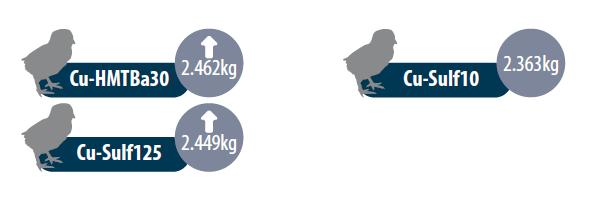
There was trend to increase Body Weight (p=0.0709) in a group supplemented with Cu-HMTBa30 (2.462kg) and Cu-Sulf125 (2.449kg) compared with Cu-Sulf10 (2.363kg).
Weight gain from 21 to 35 days was significantly (P<0.05) higher in the Cu-HMTBa30 (1.524kg) and Cu-Sulf125 (1.427kg) in comparison to the Cu-Sulf10 (1.431kg).
Results of FPL were significantly (p<0.05) lower in the Cu-Sulf125 and Cu- HMTBa30 in comparison to the Cu-Sulf10.
CONCLUSION
The results indicate that a lower dosage of Cu in the form of Methionine-Hydroxy- Analogue Chelate (30ppm) can replace high dosages of Cu sulfate (125ppm) with no harm on performance or feet pad health.




RECOMMENDED





