LIPA®: The Science Behind Consistent Broiler Performance
LIPA® is not just a natural emulsifier: it's a tool for maintaining production consistency against raw material variability and environmental challenges.

LIPA®: The Science Behind Consistent Broiler Performance
A two-part explanation: the established fat digestion mechanism, and emerging functions
Fat Digestion and Energy Utilization
Efficient extraction of dietary energy from fat depends on a well-functioning sequence of events: emulsification, enzymatic hydrolysis, micelle formation, and absorption at the enterocyte membrane (1).
In commercial production, however, this cascade rarely operates with 100% efficiency. Due to heat stress or formulations containing fat sources of variable quality and digestibility, stepwise losses occur during the process. This results in an energy gap directly affecting feed conversion ratio (FCR) and growth performance.
LIPA® from Franklin Biotech addresses this bottleneck at its source through a concentrated, standardized supply of lysophospholipids (LPL) derived from enzymatic hydrolysis of soy lecithin. The active content of every production batch is confirmed by (lyso)phospholipid profile analysis through NMR spectroscopy, ensuring that each inclusion delivers a defined dose.
From Lecithin to Lysophospholipid: The Chemistry
Soy lecithin contains a natural phospholipid mixture, of which the predominant phospholipid fraction is phosphatidylcholine. In its intact form, soy lecithin provides moderate emulsification. Through enzymatic hydrolysis by phospholipase A2 (PLA2), one of the two fatty acid chains of the phospholipids is removed. The hydrolysis process delivers lysophospholipids (LPL), particularly lysophosphatidylcholine (LPC).

This single structural change is commercially significant. Lysophospholipids have a higher hydrophilic-lipophilic balance (HLB) than phospholipids. Their single fatty acid chain confers a cone-shaped geometry that promotes stable mixed micelle formation and the ability to act as an effective emulsifier, independent of endogenous bile salt support. The ability to function as an emulsifier is especially important when animals are experiencing stress or when dietary fat quality is suboptimal. In those critical moments, keeping fat digestion efficient defines the system’s profitability.

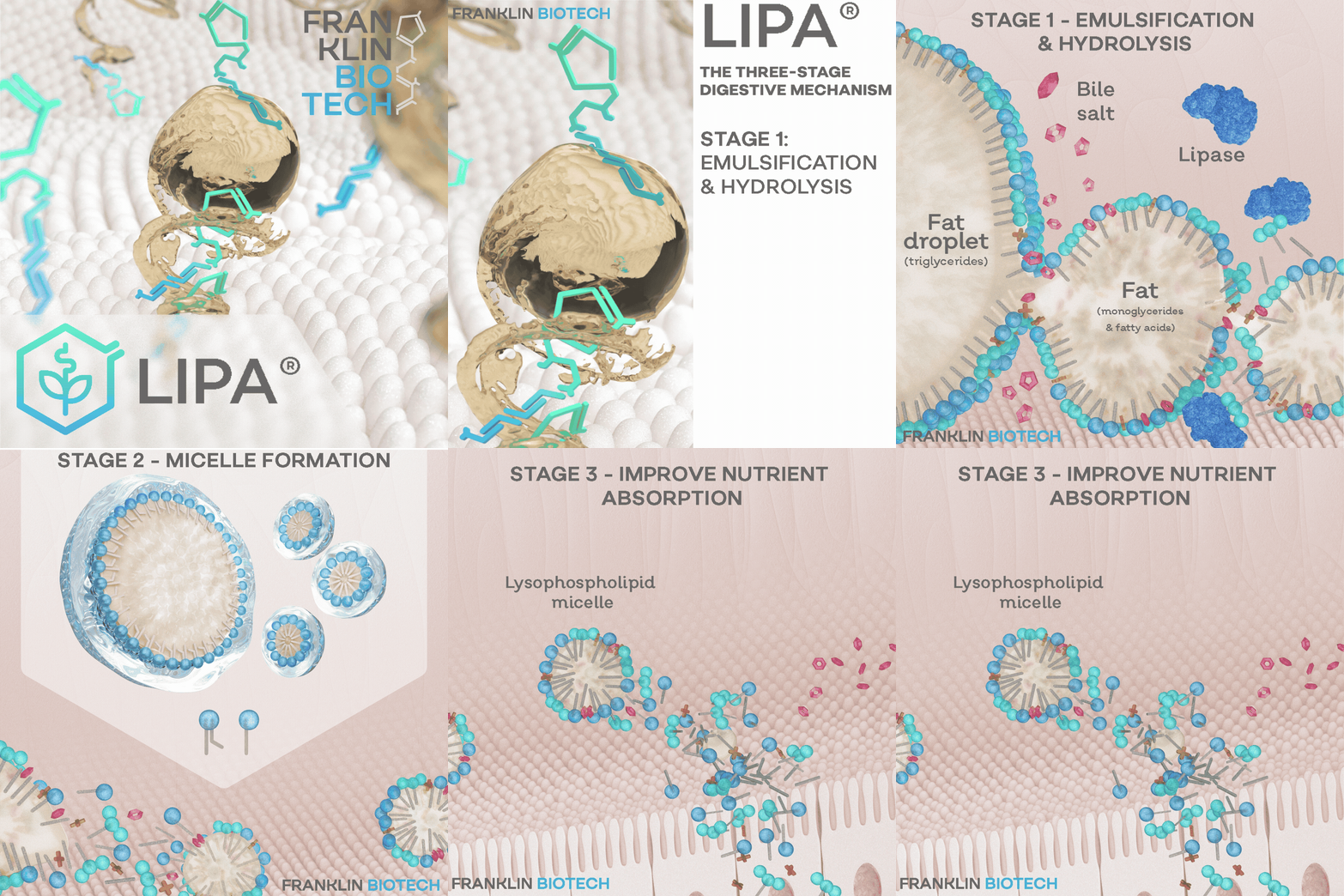
The Three-Stage Digestive Mechanism
Stage 1 — Emulsification and Hydrolysis
LIPA® reduces the size of dietary fat droplets, increasing the surface area accessible to pancreatic lipase. This accelerates the conversion of triglycerides into free fatty acids and monoglycerides, the absorbable forms of dietary lipid.
Stage 2 — Micelle Formation and Luminal Transport
After hydrolysis, free fatty acids and monoglycerides must traverse the aqueous environment of the intestinal lumen to reach the enterocyte surface. Mixed micelles are necessary for carrying and delivering these lipophilic nutrients across the lumen to the brush border. LPL can positively affect micellar behavior and stability, optimizing the transport of lipophilic nutrients through the lumen (2–4).
Stage 3 — Membrane-Level Absorption
LPL integrates into the phospholipid bilayer of enterocyte membranes, thereby modifying its fluidity to enhance the uptake of fatty acids, fat-soluble vitamins, and other lipophilic nutrients (5).
Performance Outcomes
Across published broiler trials under thermoneutral and heat stress conditions, LPL supplementation is consistently associated with improved apparent ileal digestibility (AID) of crude fat and gross energy, with positive downstream effects on body weight gain (BWG) and FCR (3,4,6). The magnitude of the response is influenced by diet fat content, fat source quality, ambient temperature, and baseline gut health status (7).
Within the energy range of commercial diet reformulation, it is commonly assumed that reducing dietary metabolizable energy will prompt broilers to increase their feed intake and self-correct. However, multiple studies have shown that changes in dietary metabolizable energy within the commercial reformulation range do not influence feed intake (8). Any energy gap created by reduced fat inclusion must therefore be recovered through improved fat digestibility, a process supported by the LPL mechanism.
Beyond Emulsification: Emerging Functions of Lysophospholipids
While LPL consistently enhances lipid digestion and absorption across various fat inclusion levels and qualities, these dynamic molecules also exhibit diverse biological functionalities. Consequently, the subsequent section concisely reviews their implications for gut barrier integrity, antioxidant activity, and metabolic health.
Mechanism: Membrane Integration and Gut Barrier Protection
The integration of LPL into the enterocyte cell membrane modifies its structural organization. LPL can create disordered regions within the bilayer, increasing its fluidity and permeability.
This restructuring at the cellular level facilitates nutrient transit and absorption, a physiological advantage that becomes highly relevant when the bird faces metabolic challenges or heat stress (5).

Intestinal barrier integrity can be negatively affected under stress conditions. This leads to a common gut health issue: leaky gut. As the gut wall thins, its barrier function weakens and permeability increases (9). This means it can no longer efficiently keep harmful substances from entering the bloodstream, triggering body-wide inflammation that stunts growth, reduces feed intake, and overall performance (10).
Numerous investigations suggest that LPLs may contribute to reversing intestinal lesions. Initially, Chen et al. (2019) reported an increase in small intestine villus height and higher expression of Claudin-3 in LPL-supplemented broilers (11). Subsequently, Eid et al. (2025) demonstrated that, even under oxidative stress, LPLs successfully restore villar architecture and normalize Claudin-3 levels, linking this improvement to efficient nutrient absorption and robust pathogen protection (12). Ultimately, these findings indicate that LPLs could be an effective tool for supporting the gut barrier.
Mechanism: Antioxidant Defense Under Heat Stress
Under high temperature circumstances, reactive oxygen species (ROS) production accelerates beyond what the animal’s natural antioxidant defenses can neutralize, tipping the balance toward oxidative stress. This leads to cell membrane damage, protein breakdown, and accelerated tissue injury. During this unbalanced oxidation process, the cellular byproduct malondialdehyde (MDA) is naturally generated. Consequently, blood MDA is used as a precise biomarker: the greater the oxidative damage, the higher MDA levels (12).
LPL supplementation has been shown to strengthen the animal’s antioxidant defenses. Eid et al. (2025) reported that LPL-supplemented broilers under oxidative stress not only have lower MDA levels but also show significantly higher activity levels of three key protective enzymes: superoxide dismutase (SOD), catalase (CAT), and glutathione peroxidase (GPX). This positive effect could be related to the activation of the Nrf2-Keap1 cellular defense pathway, which is a regulator of antioxidant gene expression (12). It could also be due to the improved cell membrane stability, which would help limit damage induced by ROS.
Mechanism: Serum Lipid Profile and Metabolic Health
Heat stress in broilers frequently elevates serum triglycerides, total cholesterol, and low-density lipoprotein cholesterol (LDL-C). This alteration reflects failure in hepatic lipid clearance and an increase in fat synthesis. The addition of LPLs counteracts this problem, normalizing the lipid profile by decreasing detrimental fats (including LDL-C) and elevating high-density lipoprotein cholesterol (HDL-C)(7). Furthermore, in laying hens and breeding birds, this protective effect could be key to reducing the risk of Fatty Liver Hemorrhagic Syndrome (FLHS), where hepatic lipid retention is the primary pathological lesion.
LIPA®: From Science to Commercial Logic
The value of LIPA® lies in its ability to improve fat digestibility. LIPA® recovers energy from dietary fat through improved emulsification, micelle stability, and enterocyte membrane absorption which allows fat inclusion to be reduced without compromising bird performance.
However, its biological activity goes far beyond the intestinal lumen. During the absorption process, the components of LIPA® structurally integrate into the cell membranes of the enterocyte, strengthening tight junctions and consolidating intestinal barrier function. Under conditions of metabolic or environmental stress, this action boosts the bird’s antioxidant defenses and optimizes its lipid profile, drastically reducing the physiological factors that can trigger liver inflammation (12,13).
The commercial value of LIPA® therefore is driven by its ability to recover digestible energy, regardless of fat quality variability. In a thermoneutral, low-challenge environment with consistent fat quality, LPL can optimize the energy matrix, which translates into lower feed costs. Under heat stress or other gut health challenges, LPL supports the maintenance of performance by limiting the drop in FCR and BWG.
LIPA® is not just a natural emulsifier: it’s a tool for maintaining production consistency against raw material variability and environmental challenges. Supporting lipid digestion, intestinal integrity, and metabolic resilience, it helps protect the economic return of the formulation.
References
- Fox SI. Human Physiology. 14th ed. McGraw Hill; 2015. 832 p.
- Koehler J, Sulistijo ES, Sakakura M, Kim HJ, Ellis CD, Sanders CR. Lysophospholipid Micelles Sustain the Stability and Catalytic Activity of Diacylglycerol Kinase in the Absence of Lipids. Biochemistry. 2010 Aug 24;49(33):7089–99. doi:10.1021/bi100575s
- Boontiam W, Hyun YK, Jung B, Kim YY. Effects of lysophospholipid supplementation to reduced energy, crude protein, and amino acid diets on growth performance, nutrient digestibility, and blood profiles in broiler chickens. Poult Sci. 2019 Dec 1;98(12):6693–701. doi:10.3382/ps/pex005
- Haetinger VS, Dalmoro YK, Godoy GL, Lang MB, de Souza OF, Aristimunha P, et al. Optimizing cost, growth performance, and nutrient absorption with a bio-emulsifier based on lysophospholipids for broiler chickens. Poult Sci. 2021 Apr 1;100(4):101025. doi:10.1016/j.psj.2021.101025
- Sawai T, Drongowski RA, Lampman RW, Coran AG, Harmon CM. The effect of phospholipids and fatty acids on tight-junction permeability and bacterial translocation. Pediatr Surg Int. 2001 May 1;17(4):269–74. doi:10.1007/s003830100592
- Zhao PY, Kim IH. Effect of diets with different energy and lysophospholipids levels on performance, nutrient metabolism, and body composition in broilers. Poult Sci. 2017 May 1;96(5):1341–7. doi:10.3382/ps/pew469
- Mohiti-Asli M, Ghanaatparast-Rashti M, Sharifi SD, Rouhanipour H, Akbarian P. Effects of lysophospholipid supplementation in diets with different oil sources on broiler performance under heat stress. Front Vet Sci. 2025 Apr 24;12. doi:10.3389/fvets.2025.1561679
- Leeson S, Caston L, Summers JD. Broiler Response to Diet Energy. Poult Sci. 1996 Apr 1;75(4):529–35. doi:10.3382/ps.0750529
- Rostagno MH. Effects of heat stress on the gut health of poultry. J Anim Sci. 2020 Apr 1;98(4):skaa090. doi:10.1093/jas/skaa090
- Mellouk A, Mahmood T, Jlali M, Vieco-Saiz N, Michel V, Cozannet P, et al. Potential of guar gum as a leaky gut model in broilers: Digestibility, performance, and microbiota responses. Anim Nutr. 2024 Jun 1;17:177–87. doi:10.1016/j.aninu.2024.01.005
- Chen C, Jung B, Kim WK. Effects of lysophospholipid on growth performance, carcass yield, intestinal development, and bone quality in broilers. Poult Sci. 2019 Sep 1;98(9):3902–13. doi:10.3382/ps/pez111
- Eid Y, El-Soud SA, Gamel MZ, El-Kassas S, Azzam MMM, Di Cerbo A, et al. Dietary lysophospholipids enhance broiler performance, immune response, meat quality, and mitigate oxidative stress. Front Immunol. 2025 Aug 29;16. doi:10.3389/fimmu.2025.1572314
- Boontiam W, Jung B, Kim YY. Effects of lysophospholipid supplementation to lower nutrient diets on growth performance, intestinal morphology, and blood metabolites in broiler chickens. Poult Sci. 2017 Mar 1;96(3):593–601. doi:10.3382/ps/pew269


Related to Alternative production

Article 24 Nov


Alternative Turkey Production: Can Locally Adapted Genotypes Outperform Commercial Hybrids Outdoors?

Article 27 Oct
Beyond Outdoor Access: Measuring Sustainability in Alternative Poultry Production

Article 29 Sep
Silvopasture Poultry Production: Integrating Trees, Pasture and Birds for a More Resilient System

Article 04 Sep
Canola Meal as a Alternative to Soybean Meal in Broiler Nutrition

Article 01 Sep
Mobile Poultry Housing: Managing Pasture, Nutrients and Flock Health

Article 04 Aug
Alternative Production Systems in Broiler Farming

Company News 22 Jul
Efficiency is the Key to Sustainable Poultry Production

Article 06 Jul
Alternative Feed Ingredients for Sustainable Broiler Finisher Diets