








Available in other languages:
Content available at:
In Vietnam’s Quang Tri province, the herbal chicken farming model is opening up opportunities for high and stable incomes for many farming households.
After around five months of rearing, chickens reach an average live weight of 1.6-2 kg per bird and are sold at approximately about USD 3.04 per kg. The product is well received by the market thanks to its firm, aromatic and ‘clean’ meat quality.
Nguyen Tien Sy, a resident of Thuan Hoa residential quarter (Dong Son Ward, Quang Tri), is among the pioneers in developing this model.


Before establishing his company, he spent nearly five years raising chickens on a small scale using traditional methods, gradually accumulating experience in both production and market development.
Realizing that success required a distinct approach, making use of available feed resources while cutting costs, Mr Sy decided to shift to herbal chicken farming and expand his operation to a larger farm scale.
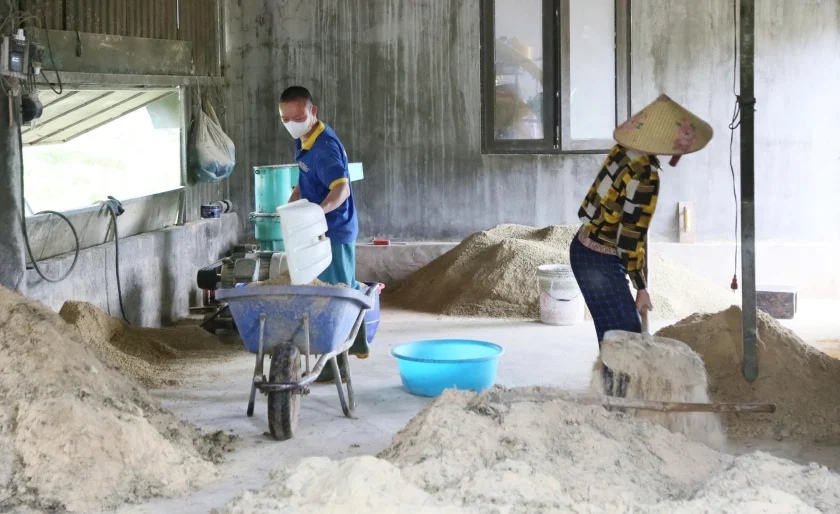
At the farm, chicken feed is processed according to a proprietary formula, with a strong focus on supplementing natural herbs and agricultural bio-products to enhance immunity and minimize the use of antibiotics.


Processing herbal feed at the chicken farm (Photo: Nong nghiep Moi truong).
Chicken feed is blended from various ingredients such as bran, maize, mung beans and soybeans, combined with home-grown herbal plants including:
After harvesting, the herbs are thoroughly washed, finely ground and mixed with agricultural by-products at ratios adjusted to each stage of the chickens’ growth.
According to Mr Sy, chickens fed with herbal diets develop strong immunity and suffer fewer diseases, meaning antibiotics are rarely used, except for a short period during the early brooding stage. Once the chickens are over one month old, the farm switches entirely to herbal feed.
As a result, the flock remains healthy, grows steadily, and produces meat with a naturally firm texture and sweet flavor.
From initial batches of just a few thousand birds, the farm has now expanded to 10,000-20,000 birds per cycle. Day-old chicks are sourced from reputable suppliers in Hai Phong. The chickens grow well and are largely free from disease outbreaks.
Mr Sy shared that the competitive pricing of market-ready chickens is made possible by the company’s ability to secure its own herbal feed ingredients, significantly reducing input costs.
Thanks to this advantage, the products remain competitive, consumption is stable, and customers consistently rate the chickens highly for being clean, tasty and safe.
The company currently operates two farming facilities, located in Dong Son Ward and Nam Trach Commune (Quang Tri).
To ensure a steady supply for restaurants and hotels within the province and neighboring areas, the farm applies a staggered production model, releasing new flocks at one-month intervals.
Each facility is divided into six zones, with each zone covering approximately 1,200 sqm, designed for year-round production regardless of cold, rainy or hot weather conditions.
Economic efficiency of the herbal chicken model
Thanks to a closed-loop, well-structured farming process and technical support from the Quang Tri Department of Agriculture and Environment, the farm achieves high productivity.
Annually, the operation supplies 50,000-60,000 market-standard chickens, generating revenues of around USD 456,000, with profit margins of 20-30%.
Mr Sy noted that by proactively managing herbal feed sources and reducing production costs, the farm’s herbal chicken products continue to be warmly welcomed by the market. The naturally fragrant and flavorful meat remains a key advantage that earns strong customer trust.


White-Egg Layers Rise in UK


Subscribe now to the poultry technical magazine
AUTHORS

Newcastle Disease: One Hundred Years On, Why Transmission Control Matters More Than Ever
Mustafa Seckin Sandikli
Egg Size Versatility in Nick Chick – Part I
H&N Technical Department
Interview with Khaled Abdel Nasser Awwad
Khaled Abdel Nasser Awwad
When the Supply Chain Breaks: Poultry Prices and the Economics of Maritime Disruption in the Middle East
Dima Chatila
Reovirus Infections in the Broiler Industry
Edgar O. Oviedo Rondón
Egg Condensation in Hatcheries: A Hidden Risk for Embryo Development, Hatchability and Chick Quality
Rasel Ahmed
From Chat to Farm Insight: Bridging the Social Data Gap in Indonesian Broiler Farming
Setiawan Guntarto
Labor Shortage in the Poultry Industry: Potential Solutions
Edgar O. Oviedo Rondón
A Comparison of Soybean Meal from Different Origins in Terms of Nutrient Composition, Amino Acid Profile, and Protein Quality
Güner GÖVENÇ
When Algorithms Start to Control Feed Composition
Henri E. Prasetyo DVM. M.Vsc







