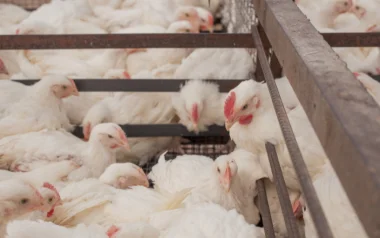
India’s poultry sector grows nearly 7% annually, but pre‑slaughter transport practices continue to raise serious concerns for animal welfare and meat quality.
In a study published in March 2025, researchers examined how different transport durations affect broiler chickens’ health, stress responses, and meat quality under Indian field conditions. The trial involved 120 birds divided into four groups:
Meat quality and sensory traits
Meat quality indicators shifted with longer transport times.


Sensory attributes declined after four hours of transport.
Flavor remained stable across all groups, showing no significant difference.
Stress biomarkers

Blood analysis revealed sharp increases in stress indicators with longer transport.
Oxidative stress markers also shifted.
These biochemical changes confirm that prolonged transport disrupts homeostasis and damages liver health.
Implications for poultry welfare
The study concludes that transporting broilers for more than four hours under Indian conditions significantly harms welfare and meat quality.
Shorter journeys reduce stress, improve product value, and protect farmer income. Limiting transport time is therefore essential for both animal welfare and economic sustainability.


Subscribe now to the poultry technical magazine
AUTHORS

Newcastle Disease: One Hundred Years On, Why Transmission Control Matters More Than Ever
Mustafa Seckin Sandikli
Egg Size Versatility in Nick Chick – Part I
H&N Technical Department
Interview with Khaled Abdel Nasser Awwad
Khaled Abdel Nasser Awwad
When the Supply Chain Breaks: Poultry Prices and the Economics of Maritime Disruption in the Middle East
Dima Chatila
Reovirus Infections in the Broiler Industry
Edgar O. Oviedo Rondón
Egg Condensation in Hatcheries: A Hidden Risk for Embryo Development, Hatchability and Chick Quality
Rasel Ahmed
From Chat to Farm Insight: Bridging the Social Data Gap in Indonesian Broiler Farming
Setiawan Guntarto
Labor Shortage in the Poultry Industry: Potential Solutions
Edgar O. Oviedo Rondón
A Comparison of Soybean Meal from Different Origins in Terms of Nutrient Composition, Amino Acid Profile, and Protein Quality
Güner GÖVENÇ
When Algorithms Start to Control Feed Composition
Henri E. Prasetyo DVM. M.Vsc