“We are projecting that in the next coming three decades or so, we will require like 100 million chickens to slaughter annually to provide enough chicken meat to the Kenyan population,” Gikonyo said.





In Kenya, at least 45 million people frequently consume chicken, with 27.6 percent of the total population partaking in the meal once a week. Official projections by global bodies such as World Bank put Kenya’s total population at 53.77 million as of 2020. The UN-Food and Agriculture Organisation (FAO) says 92.6% of the population frequently eats chicken meat, and consumption is projected to rise over the next three decades.
Stephen Gikonyo, Animal Production and Value Chain analyst at FAO-Kenya, said poultry farming is expected to be the most rapidly growing livestock sector driven by growing demand by a more extensive and increasingly affluent urban and peri-urban population.
“We are projecting that in the next coming three decades or so, we will require like 100 million chickens to slaughter annually to provide enough chicken meat to the Kenyan population,” Gikonyo said.
Currently, about 50 million birds are slaughtered annually in Kenya.


Gikonyo said poultry meat and eggs consumption is projected to rise to 92,000 tons (+289%) and 245,000 tons (+211%) by 2050, respectively.
While speaking to the Star on Wednesday, Gikonyo said current macro, economic, population, and other mega drivers indicate that Kenyans are going to have more disposable incomes.
“We project that in 2050, per capita income will be over 3,000 dollars, and the population will double in the next 30 years. All this will push demand in the number of chickens needed.”


Gikonyo said projections show that livestock transformation (based on urbanization, population growth, and increases in incomes) is going to push consumption of poultry production more than the other livestock.
Source: The Star
To read the complete article visit here
[/register]


White-Egg Layers Rise in UK



Subscribe now to the poultry technical magazine
AUTHORS

Setting the Global Standard for Soy
Isa Tan
Importance of Eggshell Temperature, Checking and Record Keeping in a Commercial Poultry Hatchery
Rasel Ahmed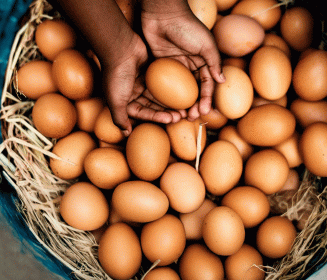
The Reality of the South African Egg Industry
Abongile Balarane
Mycoplasmosis update: Antimicrobial Resistance, Vaccines, and Control Challenges
Edgar O. Oviedo Rondón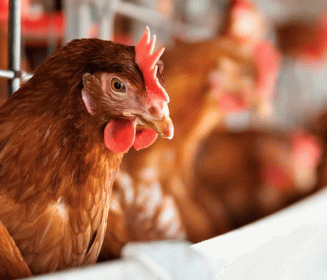
Future Flock: Antibiotic-Free Solutions for a Rising Population
Dr Ahmad Safi Dr. Faran Hameed
Interview Dr. Nivin Nasser
Dr. Nivin Nasser
Disinfection of Fertile Broiler Breeder Eggs
Edgar O. Oviedo Rondón
Precision Matters: Tackling Quality Issues in on‑Farm Vaccination
Jaime Sarabia Fragoso Kevin Gandon Pascal Paulet
Process Control: 30 Specific Aspects to Evaluate from Pre-Slaughter to Slaughter
Eduardo Cervantes López
Ishikawa Diagram Applied to Processing of Chickens
Eduardo Cervantes López