



Available in other languages:
Content available at:
For many years, the commercial incubation industry has relied almost entirely on the multi-stage (many loads) incubation methods, and with good results. The concept of thermal interaction efficiency between endothermic and exothermic eggs, as well as its ease of use, has made this the ideal solution. 
However, as chicken consumption grew worldwide and the poultry industry became intensive, it became clear that the multi-stage method could not meet the level of biosecurity required by the modern market.
Furthermore, the academic world clearly demonstrated that multiple-stage incubation was unable to provide optimal conditions for the developing embryo.


For a time, many publications and articles theorized about the potential of a single-stage (1 loading) incubation as a solution to both biosecurity issues and providing optimal conditions required by the embryo.
However, the first single-stage methodologies posed difficulties in obtaining the same results as their multi-stage counterparts.
The challenge of single-stage, for both commercial incubator manufacturers and academics, was to identify the ideal conditions for the embryo and create an incubator that could generate such conditions on a large scale.

It was almost inevitable that during this period there would be a debate between supporters of multi-stage and single-stage, but today it cannot be doubted that a modern well-managed single-stage hatchery can produce results – both pre and post-hatch — superior to the best possible results in a multi-stage hatchery. 
The following chart shows the optimal ranges for the developing embryo through key parameters such as temperature, humidity, and CO 2.
TEMPERATURE
As the main parameter, it is more accurately described as the absorption and dissipation of energy produced through heat exchange. Many academic studies and commercial trials have shown how precise temperature control – which cannot be achieved in a multi-stage environment – positively and significantly affects both chick quality and all aspects of post-hatch performance. 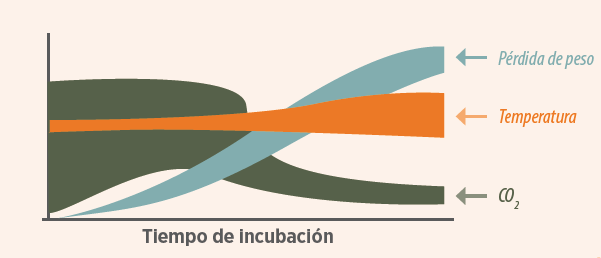
Graph 1. Variable requirements of the hatching egg depending on the incubation period


Subscribe now to the poultry technical magazine
AUTHORS

Newcastle Disease: One Hundred Years On, Why Transmission Control Matters More Than Ever
Mustafa Seckin Sandikli
Egg Size Versatility in Nick Chick – Part I
H&N Technical Department
Interview with Khaled Abdel Nasser Awwad
Khaled Abdel Nasser Awwad
When the Supply Chain Breaks: Poultry Prices and the Economics of Maritime Disruption in the Middle East
Dima Chatila
Reovirus Infections in the Broiler Industry
Edgar O. Oviedo Rondón
Egg Condensation in Hatcheries: A Hidden Risk for Embryo Development, Hatchability and Chick Quality
Rasel Ahmed
From Chat to Farm Insight: Bridging the Social Data Gap in Indonesian Broiler Farming
Setiawan Guntarto
Labor Shortage in the Poultry Industry: Potential Solutions
Edgar O. Oviedo Rondón
A Comparison of Soybean Meal from Different Origins in Terms of Nutrient Composition, Amino Acid Profile, and Protein Quality
Güner GÖVENÇ
When Algorithms Start to Control Feed Composition
Henri E. Prasetyo DVM. M.Vsc







