Available in other languages:
Content available at:
A school lunch may seem ordinary for many children. Yet in remote areas, a single egg can mean proper nutrition, learning energy, and hope for a better future.
Now in its 37th year, the CP Egg-Laying Hens for School Lunch Program continues to show how a practical initiative can help build sustainable school lunch systems and improve the lives of Thai children.
According to Thailand’s Department of Health, more than one in seven school-aged children suffers from malnutrition. Conditions range from stunting and underweight to overweight.


The root cause is unequal access to nutritious food, particularly in remote and underserved communities. This issue goes beyond hunger. It represents a gradual erosion of the nation’s future human capital.
In response, the Charoen Pokphand Group, through the Charoen Pokphand Foundation for Rural Life Development, has followed the royal initiative of
Her Royal Highness Princess Maha Chakri Sirindhorn to promote nutrition among children in remote areas.
Launched in 1989, the program enables rural schools to raise laying hens independently, with students participating under teacher supervision. The result is a steady supply of fresh, safe, and high-quality eggs for school lunches.

CPF contributes its expertise in animal husbandry by transferring knowledge, introducing technologies, and providing poultry housing, hens, feed for the first production cycle, and continuous support from livestock officers.
The impact is measurable: average egg consumption among participating students rose from 156 eggs/person/year to 276, up more than 77%.
The program’s strength lies not in giving chickens, but in creating a self-sustaining model. Under the ‘one-time investment, long-term continuity’ concept, schools generate income by selling surplus eggs and spent hens.
These revenues form a revolving fund, exceeding USD 3000 from the first production cycle and growing by about USD 1000/cycle. Schools then purchase new hens and feed at cost prices, without relying on external support.
Some schools, such as Ratchaprachanukroh School 47 in Phetchaburi and Border Patrol Police School Ban Pa Mak in Prachuap Khiri Khan, have sustained the program for decades, evolving into community learning centers.
Som-O, a Grade 5 student at Wat Bang Pit Lang School in Trat Province, began raising hens in Grade 3. She says she has learned responsibility and feels proud knowing that eggs she helped produce are served to her classmates. Her favorite dish is braised eggs, which she says are both delicious and nutritious.
Today, the program covers 1018 schools across 74 provinces, benefiting 229,673 students, 17,473 teachers and staff, and 2690 communities.
It also creates employment opportunities for 535 persons with disabilities, who are hired by CPF as assistant poultry caretakers in schools within their own communities. This promotes inclusion and social equity.
CPF has upgraded selected model schools by introducing IoT systems and real-time monitoring applications to manage housing conditions, water, lighting, and temperature.
These technologies reduce costs, improve productivity, and expose students to modern agricultural practices. As a result, participating schools function not only as egg producers but also as Action-Based Learning centers, providing hands-on education in farming, management, and sustainability.
Each participating school also serves as a community learning hub, sharing knowledge on poultry farming, fund management, and waste-to-organic fertilizer practices.
Schools become local food hubs—strengthening community food security and building resilient, self-sustaining ecosystems.
An egg from the CP Egg-Laying Hens Program is more than a school lunch item.
It is an investment in the nation’s intellectual and human capital.
One egg, given with care by CP and CPF, helps ensure Thai children eat well, grow strong, and develop with dignity—becoming capable contributors to society and the country’s future.


Subscribe now to the poultry technical magazine
AUTHORS

Setting the Global Standard for Soy
Isa Tan
Importance of Eggshell Temperature, Checking and Record Keeping in a Commercial Poultry Hatchery
Rasel Ahmed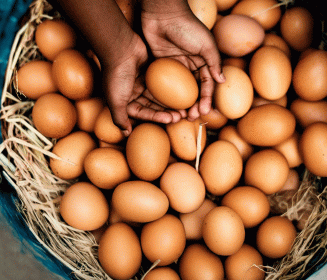
The Reality of the South African Egg Industry
Abongile Balarane
Mycoplasmosis update: Antimicrobial Resistance, Vaccines, and Control Challenges
Edgar O. Oviedo Rondón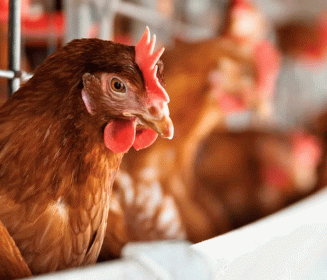
Future Flock: Antibiotic-Free Solutions for a Rising Population
Dr Ahmad Safi Dr. Faran Hameed
Interview Dr. Nivin Nasser
Dr. Nivin Nasser
Disinfection of Fertile Broiler Breeder Eggs
Edgar O. Oviedo Rondón
Precision Matters: Tackling Quality Issues in on‑Farm Vaccination
Jaime Sarabia Fragoso Kevin Gandon Pascal Paulet
Process Control: 30 Specific Aspects to Evaluate from Pre-Slaughter to Slaughter
Eduardo Cervantes López
Ishikawa Diagram Applied to Processing of Chickens
Eduardo Cervantes López