The Philippine food industry is undergoing a significant transformation in 2025, with major brands and operators across the nation committing to cage-free eggs.
Since the start of the year, players including The Figaro Group, Andok’s, and 333 Foods—with nearly 600 stores combined—along with key airline caterer Cebu Pacific Catering Services, have all pledged to transition to 100% cage-free eggs within their operations, reflecting a strong collective move toward more humane and sustainable sourcing.
Building on this growing wave, Shakey’s Pizza Asia Ventures and Century Pacific Food, among the Philippines’ leading food service groups and food manufacturers, have also committed to sourcing 100% cage-free eggs across all restaurants and product lines.
Among Shakey’s Pizza’s portfolio of restaurants and kiosks are beloved brands like Shakey’s, Potato Corner, and Peri-Peri Charcoal Chicken.


“Shakey’s Pizza Asia Ventures and all its brands mandated the use of only cage-free fresh eggs from accredited suppliers across all brands and stores,” the company noted in a statement.
“Furthermore, we are actively transitioning all remaining egg ingredients to cage-free sources and are aiming to complete this shift by 2030 as part of our commitment to responsible sourcing.”
Century Pacific will similarly shift all egg ingredients used in its products to cage-free sourcing by 2030.

Animal welfare and responsible sourcing
Cage-free laying hen farming allows hens to move freely, nest, forage, and socialize—natural behaviors that are impossible in conventional battery cages where birds are confined in cramped spaces.
This humane approach produces healthier hens and higher-quality eggs with superior taste and nutrition.
“The comprehensive commitments released this year by groups like Andok’s, Shakey’s and Century Pacific, Figaro, 333 Foods, and others have helped the restaurant sector set a new benchmark for responsible sourcing in the Philippines,” said Robyn del Rosario, Sustainability Program Lead at Lever Foundation, an international NGO that worked with each of these companies on developing their new policies.
“When a company of the scale of groups like these takes such a step, it doesn’t just change their own supply chains—it changes expectations for the entire industry. Their leadership, alongside that of other major players, is helping create the market conditions necessary for an industry-wide transformation.”
Public support is overwhelming
Public support for a shift to cage-free eggs is overwhelming.
A 2024 GMO Research survey shows that:
Consumers are also willing to pay a modest premium—below 1%—for cage-free products. Industry response reflects this demand.
For example, Bounty Fresh, a major egg producer, plans to expand cage-free egg capacity by 30% by 2026, driven by increasing consumer demand, and reported a 41% rise in cage-free egg sales by early this year.
This growing movement marks a turning point toward a more ethical and sustainable food system—one where humane egg sourcing is becoming the norm rather than the exception.
Consumers benefit from greater confidence in the quality and integrity of the products they buy, while businesses gain recognition as leaders in responsible production and sustainability, positioning Philippine brands competitively in both domestic and international markets.


Subscribe now to the poultry technical magazine
AUTHORS

Setting the Global Standard for Soy
Isa Tan
Importance of Eggshell Temperature, Checking and Record Keeping in a Commercial Poultry Hatchery
Rasel Ahmed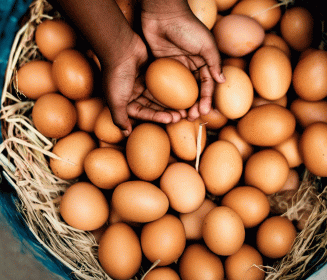
The Reality of the South African Egg Industry
Abongile Balarane
Mycoplasmosis update: Antimicrobial Resistance, Vaccines, and Control Challenges
Edgar O. Oviedo Rondón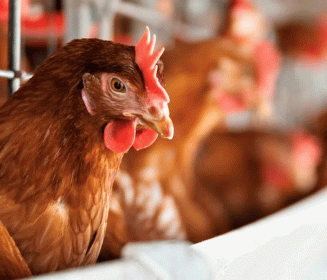
Future Flock: Antibiotic-Free Solutions for a Rising Population
Dr Ahmad Safi Dr. Faran Hameed
Interview Dr. Nivin Nasser
Dr. Nivin Nasser
Disinfection of Fertile Broiler Breeder Eggs
Edgar O. Oviedo Rondón
Precision Matters: Tackling Quality Issues in on‑Farm Vaccination
Jaime Sarabia Fragoso Kevin Gandon Pascal Paulet
Process Control: 30 Specific Aspects to Evaluate from Pre-Slaughter to Slaughter
Eduardo Cervantes López
Ishikawa Diagram Applied to Processing of Chickens
Eduardo Cervantes López