




Content available at:
Newly hatched chicks are unable to thermoregulate, therefore air temperature, humidity and air velocity all have a direct impact on their body temperature post-incubation.
Avoiding dehydration in day-old chicks is essential if we want to attain their maximum genetic potential from the start. During the hot season, it is even more crucial, as chicks can encounter high temperatures on arrival at the farm and in some areas this can combine with low humidity, further exacerbating dehydration.
There are two main factors that must be reviewed in the hatcheries to prevent dehydration of day-old chick:


A desired chick yield should be between 67-68%. This ensures that we will have active chicks ready to eat and drink as soon as they are housed at the farm. Yields below 67% can lead to dehydration, as this means that there are less yolk reserves. Chicks with low yield are often overactive and noisy.

Analysing the amount of fecal dirt (meconium) on the eggshells at the time of the hatch is an effective indicator whether the chicks have been in the hatcher for too long or not (very long hatch window).
The procedure consists of selecting the dirtiest eggs from random hatcher trays (ideally 5 trays/hatcher). Figure 1 shows what egg shells should look like on hatching trays. The goal is to get a score between 1 and 2. If the eggshells are too stained, the following key points should be checked:


Figure 1. Status of the eggshell at hatch
Comfort in the loading area and in transport
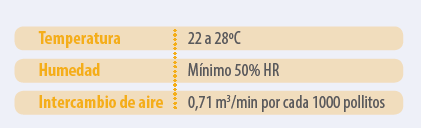 Table 1. Summary of optimal conditions in the chick holding room and chick transport. Temperature, humidity and air speed should be checked to prevent chicks from panting, thus losing water at a higher speed, leading to dehydration. Chicks that are not at a correct body temperature will have a lower performance than the rest.

Subscribe now to the poultry technical magazine
AUTHORS

Newcastle Disease: One Hundred Years On, Why Transmission Control Matters More Than Ever
Mustafa Seckin Sandikli
Egg Size Versatility in Nick Chick – Part I
H&N Technical Department
Interview with Khaled Abdel Nasser Awwad
Khaled Abdel Nasser Awwad
When the Supply Chain Breaks: Poultry Prices and the Economics of Maritime Disruption in the Middle East
Dima Chatila
Reovirus Infections in the Broiler Industry
Edgar O. Oviedo Rondón
Egg Condensation in Hatcheries: A Hidden Risk for Embryo Development, Hatchability and Chick Quality
Rasel Ahmed
From Chat to Farm Insight: Bridging the Social Data Gap in Indonesian Broiler Farming
Setiawan Guntarto
Labor Shortage in the Poultry Industry: Potential Solutions
Edgar O. Oviedo Rondón
A Comparison of Soybean Meal from Different Origins in Terms of Nutrient Composition, Amino Acid Profile, and Protein Quality
Güner GÖVENÇ
When Algorithms Start to Control Feed Composition
Henri E. Prasetyo DVM. M.Vsc







