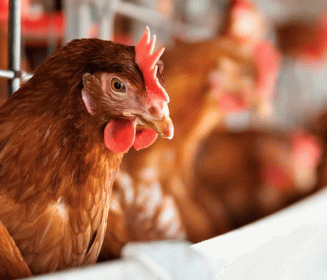
Sri Lanka’s poultry industry, for decades, has operated in the shadows of half-truths, clever labels, and fine print, according to an observation by Lanka Business News.
Consumers were told their chicken was safe without ever being shown the evidence. Marketing campaigns reassured households that poultry is healthy, yet no one could answer the simplest of questions: Was this bird raised without antibiotics?
With its Haritha Hari chicken meat range, New Anthoney’s Farms has planted a flag that redefines what poultry means in Sri Lanka: clean, traceable, and antibiotic-free from farm to fork. And unlike the vague promises that dominate the market, the poultry company has the proof to back it.
New Anthoney’s Farms stands apart because it has chosen a harder path. Eliminating antibiotics is not just a marketing tagline—it is a structural overhaul. It requires bio-secure farms, rigorous veterinary oversight, higher investment in bird welfare, and a traceability system that can withstand scrutiny. It means putting people over profit margins in an industry that has, for too long, looked the other way.


The cornerstone of the company’s bold stance is transparency. Every batch of HarithaHari chicken meat is backed by third-party laboratory tests that confirm it is 100% free of antibiotics.
“Marketing claims don’t feed families—evidence does. If we’re confident enough to put our test reports in your hand, then every producer in Sri Lanka should be able to do the same. We’re not asking for special treatment. We’re asking for accountability,” CEO Neil Suraweera told the local media.
Strict biosecurity protocols

At New Anthoney’s Farms, strict biosecurity protocols are implemented to prevent disease before it begins. Stocking densities are carefully monitored to avoid overcrowding. Birds are raised on carefully formulated, antibiotic-free feed.
These are not hidden trade secrets. They are the foundations of an ‘Open Farm Protocol’.
“If we want to change the industry, then let’s do it in the open,” said Mr Suraweera. “Audit us. Question us. Standards that live in locked filing cabinets don’t change an industry. Standards you can read, check, and trust—those do.”
Implementing biosecurity and welfare-driven systems costs more. It takes longer. It eats into margins. But New Anthoney’s is betting that Sri Lankan consumers are ready to reward authenticity with loyalty.
‘No Antibiotics Ever’ standard
New Anthoney’s Farms is calling on regulators, consumer groups, and industry peers to establish a nationwide ‘No Antibiotics Ever’ standard.
Such a standard would make it illegal to market poultry as clean or antibiotic-free without independent verification. Labels would have to mean something tangible: no routine antibiotics at any stage of the bird’s life, transparent testing, and penalties for non- compliance.
“If you want to claim antibiotic-free, prove it,” said Mr Suraweera. “Sri Lanka deserves nothing less. Otherwise, we’re just lying to the public with pretty words on packaging.”
While the challenge is directed at the industry, the real power lies with Sri Lankan consumers. Every household that chooses Haritha Hari is sending a message: “We will no longer accept chicken raised on shortcuts. We will not be silent partners in fueling antimicrobial resistance.”
By making Haritha Hari accessible across retail outlets and positioning it as a mass-market clean protein option rather than a niche luxury, New Anthoney’s Farms is democratizing food safety. This is not about a premium price point; it is about setting a new baseline for what every chicken in Sri Lanka should be.
Facing pushbacks
The poultry sector is vast, competitive, and highly price sensitive. Industry pushback is inevitable. Rivals may dismiss the move as marketing. They may claim that ‘withdrawal periods’ after antibiotic use make their chicken safe.
But withdrawal periods do not erase the problem of antimicrobial resistance (AMR). Nor do they build trust with consumers who increasingly demand zero tolerance when it comes to antibiotic residues.
New Anthoney’s is unapologetic: “If being bold puts a target on our back, so be it. Better to take fire for leading than hide in the crowd of mediocrity.”


White-Egg Layers Rise in UK


Subscribe now to the poultry technical magazine
AUTHORS

Newcastle Disease: One Hundred Years On, Why Transmission Control Matters More Than Ever
Mustafa Seckin Sandikli
Egg Size Versatility in Nick Chick – Part I
H&N Technical Department
Interview with Khaled Abdel Nasser Awwad
Khaled Abdel Nasser Awwad
When the Supply Chain Breaks: Poultry Prices and the Economics of Maritime Disruption in the Middle East
Dima Chatila
Reovirus Infections in the Broiler Industry
Edgar O. Oviedo Rondón
Egg Condensation in Hatcheries: A Hidden Risk for Embryo Development, Hatchability and Chick Quality
Rasel Ahmed
From Chat to Farm Insight: Bridging the Social Data Gap in Indonesian Broiler Farming
Setiawan Guntarto
Labor Shortage in the Poultry Industry: Potential Solutions
Edgar O. Oviedo Rondón
A Comparison of Soybean Meal from Different Origins in Terms of Nutrient Composition, Amino Acid Profile, and Protein Quality
Güner GÖVENÇ
When Algorithms Start to Control Feed Composition
Henri E. Prasetyo DVM. M.Vsc