



In today’s poultry industry, traceability is becoming a cornerstone of compliance, performance, and reputation. As hatcheries scale up and face growing pressure from retailers and consumers, the ability to track every step of the process is turning into a competitive differentiator.
Pressure on hatcheries is increasing. Rising demands around food safety and supply chain transparency are reshaping poultry production, while hatchery operations themselves grow larger and more complex.
Traditionally, hatcheries relied on manual records and operator experience to manage egg and chick batches. While once sufficient, these methods now fall short in environments where thousands of eggs move through multiple incubators and rooms every day.
The next step for traceability is therefore digital integration. Traceability is evolving into the ability to digitally follow the journey of egg and chicks through every stage of the hatchery production process. By linking physical actions to digital data, it creates a transparent flow of information that both ensures transparency and strengthens decision-making at every level.

A well-designed traceability system does more than record data: it transforms how hatcheries operate. Here’s what it makes possible:


Hatcheries that invest in traceability gain more than just compliance. They unlock sharper insights, greater efficiency and deeper customer trust.
At Petersime, we believe that traceability should empower hatchery teams, not slow them down. The Traceability module, part of the Eagle Trax™ cloud-based software, seamlessly links every physical trolley movement in the hatchery to data-driven intelligence in a clear and straightforward way.
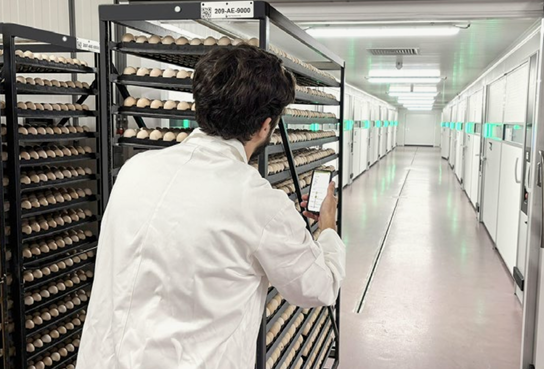
In this setup, every trolley carries a unique ID plate with QR code. When an egg batch is ready to be loaded onto the trolleys – whether at the farm, in transport, upon delivery or just before setting – the trolley QR codes are scanned and the egg batch data is logged. From that point on, every trolley movement is tracked with precision.
Every hatchery room and incubator also has its own QR code, and farm storage facilities or transport trucks can be included as well. As trolleys move through the process, operators scan the QR codes at each step, updating the location and status in real time.

In practice, this delivers:
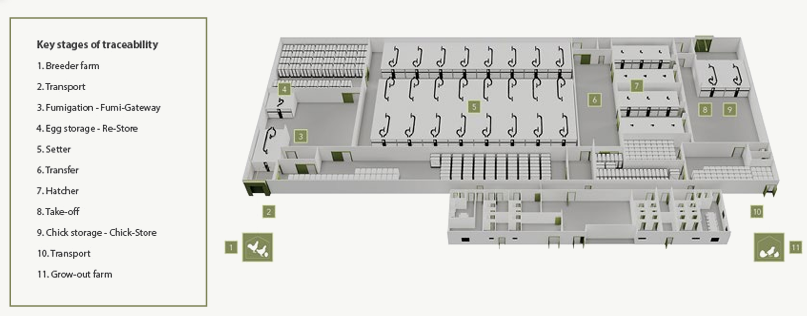
Petersime’s Traceability module keeps track of every trolley’s journey throughout the hatchery, providing full transparency of internal operations while uncovering opportunities to boost performance.
As customer expectations for transparency grow, the question for hatchery owners is no longer whether to embrace traceability, but how to make it work efficiently.
Hatcheries that invest in transparent, data-driven processes gain more than just compliance – they unlock sharper insights, stronger error prevention, greater efficiency and deeper customer trust. Please don’t hesitate to contact us for more information about the Eagle Trax™ software.



Subscribe now to the poultry technical magazine
AUTHORS

Setting the Global Standard for Soy
Isa Tan
Importance of Eggshell Temperature, Checking and Record Keeping in a Commercial Poultry Hatchery
Rasel Ahmed
The Reality of the South African Egg Industry
Abongile Balarane
Mycoplasmosis update: Antimicrobial Resistance, Vaccines, and Control Challenges
Edgar O. Oviedo Rondón
Future Flock: Antibiotic-Free Solutions for a Rising Population
Dr Ahmad Safi Dr. Faran Hameed
Interview Dr. Nivin Nasser
Dr. Nivin Nasser
Disinfection of Fertile Broiler Breeder Eggs
Edgar O. Oviedo Rondón
Precision Matters: Tackling Quality Issues in on‑Farm Vaccination
Jaime Sarabia Fragoso Kevin Gandon Pascal Paulet
Process Control: 30 Specific Aspects to Evaluate from Pre-Slaughter to Slaughter
Eduardo Cervantes López
Ishikawa Diagram Applied to Processing of Chickens
Eduardo Cervantes López