Available in other languages:
In Vietnam, poultry egg prices have continued to plunge during the first months of 2026, causing significant losses for many farmers. Yet despite an oversupply of fresh eggs, the country still spends millions of US dollar each year importing egg powder for food processing. This paradox is raising major questions for Vietnam’s poultry industry.
Since the beginning of the year, the poultry egg market has faced an oversupply situation as production has expanded rapidly while consumer demand has remained largely unchanged. The sharp decline in egg prices has resulted in losses of approximately USD 0.02-0.03 per egg for farmers.
According to the Southeast Livestock Association, the primary reason is the strong expansion of laying hen populations following the period of high egg prices in 2025. Many pig and broiler chicken farmers shifted their investments to egg-laying hens after seeing attractive profit margins. This simultaneous expansion across the industry led to a rapid increase in egg production within a short period. Meanwhile, domestic consumption showed little change.
The oversupply situation has become even more severe as egg exports to Cambodia have faced difficulties. Previously, exports to Cambodia helped ease pressure on domestic supply. However, as this export channel contracted, more eggs were redirected to the domestic market, resulting in a clear supply-demand imbalance.


Currently, industrial chicken eggs at many farms are selling for only around USD 0.05–0.05 per egg for large-sized eggs, while smaller eggs are priced at just USD 0.02-0.02 per egg. Some companies have even been forced to liquidate inventories at lower prices to recover capital.
In addition to low selling prices, livestock producers are facing mounting pressure from rising input costs.
Animal feed prices are currently about USD 0.04 per kilogram higher than a year ago due to increased import costs for raw materials and higher transportation expenses. At the same time, electricity, fuel, and labor costs have all increased, significantly reducing profit margins.


With selling prices falling and production costs rising, many farms and livestock businesses are experiencing prolonged financial losses.
One notable issue is that despite the abundance of fresh eggs in the domestic market, large volumes of imported egg powder continue to be consumed. The reason lies in the fundamental differences between fresh eggs and ingredients used in industrial food processing.
Egg powder has a long shelf life, is easy to transport, and is highly convenient for large-scale food manufacturing, including confectionery, sauces, instant noodles, and ready-to-eat products. Compared with fresh eggs, egg powder requires less stringent storage conditions, allowing food manufacturers to significantly reduce logistics and inventory costs.
Although Vietnam possesses abundant egg supplies, the country has yet to develop an egg powder industry capable of competing effectively with imported products. Several companies have explored or tested investments in egg powder production but have encountered challenges related to production costs.
According to industry businesses, imported egg powder, particularly from India, is significantly cheaper than domestically produced alternatives. As a result, investment projects in local egg powder production have struggled to achieve economic viability.
While egg powder remains dependent on imports, many Vietnamese companies have successfully developed processed egg products such as pasteurized liquid eggs, ready-to-eat eggs, and egg-based ingredients for the food industry. These products generate approximately 30% more added value than fresh eggs while extending shelf life and expanding market opportunities.
Many businesses are investing in modern processing lines to increase the utilization of domestically produced eggs. This is considered a key solution for reducing oversupply and enhancing the value of Vietnam’s poultry sector.
Notably, several companies have already begun exporting processed egg products to demanding markets such as Japan and South Korea. Compared with fresh eggs, processed products offer significant advantages in storage, transportation, and compliance with international quarantine standards.
In addition to deep processing, industry experts believe farmers should diversify their product offerings instead of focusing excessively on industrial egg-laying chickens.
Segments such as duck eggs, quail eggs, native chicken eggs, free-range and welfare-certified eggs, and regional specialty products still offer substantial growth potential. These are areas where domestic businesses and farmers maintain advantages in breeding stock, technical expertise, and product identity.
In particular, Vietnam’s salted duck eggs continue to enjoy stable exports to various Asian markets, creating opportunities for further development of value-added egg products.
As competition intensifies with foreign-invested enterprises in the industrial poultry sector, expanding deep processing capabilities and developing niche segments are increasingly viewed as more sustainable strategies for Vietnam’s poultry industry.
The current situation-where fresh eggs are oversupplied while egg powder imports remain necessary-highlights a missing link in Vietnam’s egg value chain: advanced processing.
Once challenges related to technology and production costs are addressed, domestic egg supplies could generate significantly greater value instead of competing primarily on production volume.

Subscribe now to the poultry technical magazine
AUTHORS

Setting the Global Standard for Soy
Isa Tan
Importance of Eggshell Temperature, Checking and Record Keeping in a Commercial Poultry Hatchery
Rasel Ahmed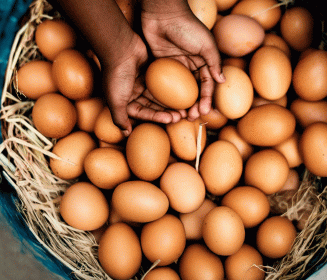
The Reality of the South African Egg Industry
Abongile Balarane
Mycoplasmosis update: Antimicrobial Resistance, Vaccines, and Control Challenges
Edgar O. Oviedo Rondón
Future Flock: Antibiotic-Free Solutions for a Rising Population
Dr Ahmad Safi Dr. Faran Hameed
Interview Dr. Nivin Nasser
Dr. Nivin Nasser
Disinfection of Fertile Broiler Breeder Eggs
Edgar O. Oviedo Rondón
Precision Matters: Tackling Quality Issues in on‑Farm Vaccination
Jaime Sarabia Fragoso Kevin Gandon Pascal Paulet
Process Control: 30 Specific Aspects to Evaluate from Pre-Slaughter to Slaughter
Eduardo Cervantes López
Ishikawa Diagram Applied to Processing of Chickens
Eduardo Cervantes López