



Available in other languages:
Content available at:
The Vietnam Poultry Association (VPA) held its 2025 annual review conference on March 6 in Ho Chi Minh City, outlining priorities for 2026.
The year 2025 marked both the start of the association’s new term and a pivotal transition for Vietnam’s poultry sector from traditional farming toward greener, more sustainable production systems.
Strengthening organization and supporting businesses


VPA currently has 318 members, including 103 enterprises and cooperatives, as well as 215 individual members.
Over the past year, the association strengthened governance by issuing 15 internal regulatory frameworks, consolidating six specialized committees, and opening a representative office in Ho Chi Minh City. These steps improved operational efficiency and transparency.
Nguyen Quy Khiem, VPA Vice Chairman and General Secretary, said the association actively supported member enterprises through communication campaigns, seminars, trade fairs, and both domestic and international trade promotion activities, helping businesses expand partnerships and market access.


Member enterprises drive the value chain
VPA member companies remain central to supplying poultry breeding stock.
In 2025, they produced an estimated 530-550 million day-old chicks, accounting for 65-70% of the national supply. This included 310 million colored-feather chickens, 120 million white-feather broilers, and nearly 100 million ducklings.
These products served domestic demand and were exported to Laos, Cambodia, and Myanmar.
Across the value chain, member enterprises also dominate poultry feed production, holding around 60-65% of the domestic market share.
In veterinary medicine and vaccines, several companies developed large-scale production and distribution systems, exporting to over 50 countries and territories.
Meanwhile, major players invested in modern slaughtering and processing lines, building fully integrated value chains from breeding and feed to farming, processing, and distribution. These efforts enhanced the overall value of poultry products.
Market stabilization and trade promotion
A key highlight in 2025 was VPA’s role in stabilizing the market amid misinformation.
Following rumors about ‘fake eggs’, the association worked closely with authorities and media to provide accurate information, restoring consumer confidence and protecting producers.
Egg prices recovered from approximately USD 0.05-0.06/egg to USD 0.07-0.08 by mid-year, and currently range between USD 0.09-0.10.
VPA also participated in major international industry events such as VIV Asia, VIV Select China, Vietstock 2025, and Poultry India Expo 2025, expanding global partnerships and market opportunities.
Toward a sustainable poultry industry
At the conference, delegates discussed enhancing the VPA’s role as a bridge between businesses and regulators, while promoting market expansion and exports. The association also honored eight organizations and 12 individuals for their contributions to the sector.
In his closing remarks, Chairman Nguyen Thanh Son highlighted challenges in 2026, including global market volatility, rising input costs, import competition, and stricter environmental and animal welfare standards.
In response, VPA aims to strengthen trade promotion, expand export markets, enhance training for member enterprises, and reinforce its role in supporting sustainable industry growth.


Subscribe now to the poultry technical magazine
AUTHORS

Setting the Global Standard for Soy
Isa Tan
Importance of Eggshell Temperature, Checking and Record Keeping in a Commercial Poultry Hatchery
Rasel Ahmed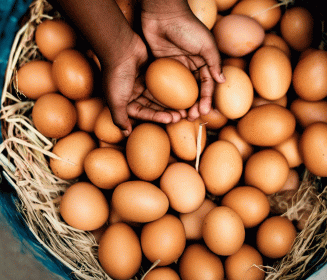
The Reality of the South African Egg Industry
Abongile Balarane
Mycoplasmosis update: Antimicrobial Resistance, Vaccines, and Control Challenges
Edgar O. Oviedo Rondón
Future Flock: Antibiotic-Free Solutions for a Rising Population
Dr Ahmad Safi Dr. Faran Hameed
Interview Dr. Nivin Nasser
Dr. Nivin Nasser
Disinfection of Fertile Broiler Breeder Eggs
Edgar O. Oviedo Rondón
Precision Matters: Tackling Quality Issues in on‑Farm Vaccination
Jaime Sarabia Fragoso Kevin Gandon Pascal Paulet
Process Control: 30 Specific Aspects to Evaluate from Pre-Slaughter to Slaughter
Eduardo Cervantes López
Ishikawa Diagram Applied to Processing of Chickens
Eduardo Cervantes López