Available in other languages:
Content available at:
Poultry eggs have long been regarded as one of the most nutritious and biologically valuable foods. They are a complete source of protein, containing all essential amino acids that the human body cannot synthesize on its own. In addition, eggs provide a wide range of vitamins, minerals, and antioxidants beneficial to health.
In many countries, eggs are a staple in daily meals. However, in Vietnam, per capita egg consumption remains significantly lower than the global average—indicating vast untapped potential for this sector.
According to the Vietnam Poultry Association (VPA), the domestic egg industry has achieved an annual growth rate of 7-8% over the past decade – the highest among all livestock sectors.


In 2024, total egg production is estimated to exceed 20 billion units, making an important contribution to national food security.
Despite this, direct egg consumption in Vietnam currently averages only about 185-190 eggs per person per year, well below the global average of 300-350 eggs per person per year.
With a population of nearly 100 million, Vietnam’s egg market holds substantial growth potential in production, distribution, and processing.


As demand for safe and high-quality food rises, many farms and production facilities are shifting toward closed-loop farming models that emphasize disease control and biosecurity.
The development of nutrient-enriched egg products, such as those fortified with omega-3, vitamins, or micronutrients, is also gaining attention.
Moreover, compliance with international standards on food safety, animal welfare, and sustainability is seen as a necessary step if Vietnam aims to expand exports or establish a regional egg brand.
Experts suggest that, in addition to improving productivity, Vietnam’s egg industry should focus on scientific and technological innovation, supply chain efficiency, and stronger market forecasting.
Applying technology in quality management and traceability is also essential for Vietnamese eggs to meet the increasingly stringent requirements of domestic and global consumers.
With stable growth, strong demand potential, and a clear consumer shift toward safe and sustainable food, Vietnam’s egg industry is well-positioned for significant expansion in the coming years – provided it follows the right strategies and develops sustainably.


Subscribe now to the poultry technical magazine
AUTHORS

Setting the Global Standard for Soy
Isa Tan
Importance of Eggshell Temperature, Checking and Record Keeping in a Commercial Poultry Hatchery
Rasel Ahmed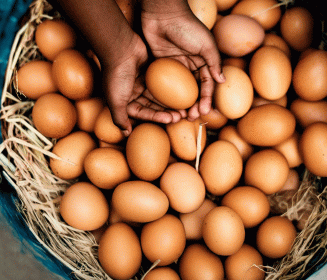
The Reality of the South African Egg Industry
Abongile Balarane
Mycoplasmosis update: Antimicrobial Resistance, Vaccines, and Control Challenges
Edgar O. Oviedo Rondón
Future Flock: Antibiotic-Free Solutions for a Rising Population
Dr Ahmad Safi Dr. Faran Hameed
Interview Dr. Nivin Nasser
Dr. Nivin Nasser
Disinfection of Fertile Broiler Breeder Eggs
Edgar O. Oviedo Rondón
Precision Matters: Tackling Quality Issues in on‑Farm Vaccination
Jaime Sarabia Fragoso Kevin Gandon Pascal Paulet
Process Control: 30 Specific Aspects to Evaluate from Pre-Slaughter to Slaughter
Eduardo Cervantes López
Ishikawa Diagram Applied to Processing of Chickens
Eduardo Cervantes López