








Available in other languages:
Content available at:
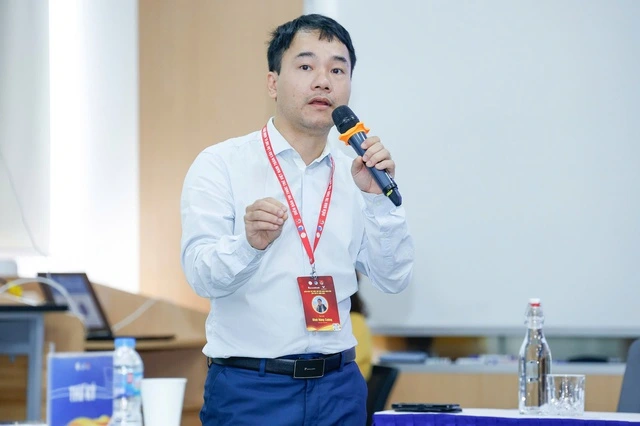
Two products, including what has been recognized by Belgium as the ‘world’s best-tasting eggs’, took centerstage at the 6th Global Vietnamese Young Intellectuals Forum held on July 20 in Hanoi.
Dinh Hung Cuong, Head of R&D at the Fukoda Institute of Marine Chemistry (Japan), brought the eggs to the forum, along with a premium rice variety served only in high-end restaurants and hotels in Japan.

Dr Dinh Hung Cuong speaking at the 6th Global Vietnamese Young Intellectuals Forum. Photo: Tuoi Tre.
Both products are organically farmed, using ionized fertilizers and feed to optimize nutrient absorption while minimizing environmental residue—marking a shift from conventional chemical methods.
Dr Cuong had previously tested this ionization technology on coffee plants in Dak Lak, Vietnam, resulting in coffee beans rich in flavor and nutrients.

However, he noted a major challenge. Much of Vietnam’s farmland has been degraded by chemical fertilizers and now requires years of rehabilitation or the development of an adapted version of the technology.
His purpose in sharing these products at the forum was not commercial promotion, but to inspire ideas for clean and sustainable agriculture.
To illustrate market potential, he cited Japanese mangoes priced at over USD 95/fruit. Their value lies not only in taste, but in organic standards and effective marketing.
Meanwhile, Vietnamese mangoes are just as delicious, yet remain undervalued due to the lack of branding strategies.
The forum’s discussion on green agriculture moved beyond technology and into policy challenges.
Dr Cuong shared that although his ionized fertilizer had passed testing, it has yet to receive trademark protection in Vietnam—despite completing the necessary procedures.
Other young delegates also pointed out that complicated and prolonged administrative processes hinder the commercialization of scientific research.
Many scientific projects praised internationally still face significant difficulties when applied locally.
Meanwhile, clean and organic products remain disadvantaged. They cost more to produce, yield less, and struggle to reach consumers.
Enterprises seeking to invest in green economy initiatives also face financing issues. Existing credit systems rely mainly on collateral assets, credit scores, and projected profitability, leaving little room for sustainability-focused ventures.
To address these issues, delegates proposed:


Subscribe now to the poultry technical magazine
AUTHORS

Newcastle Disease: One Hundred Years On, Why Transmission Control Matters More Than Ever
Mustafa Seckin Sandikli
Egg Size Versatility in Nick Chick – Part I
H&N Technical Department
Interview with Khaled Abdel Nasser Awwad
Khaled Abdel Nasser Awwad
When the Supply Chain Breaks: Poultry Prices and the Economics of Maritime Disruption in the Middle East
Dima Chatila
Reovirus Infections in the Broiler Industry
Edgar O. Oviedo Rondón
Egg Condensation in Hatcheries: A Hidden Risk for Embryo Development, Hatchability and Chick Quality
Rasel Ahmed
From Chat to Farm Insight: Bridging the Social Data Gap in Indonesian Broiler Farming
Setiawan Guntarto
Labor Shortage in the Poultry Industry: Potential Solutions
Edgar O. Oviedo Rondón
A Comparison of Soybean Meal from Different Origins in Terms of Nutrient Composition, Amino Acid Profile, and Protein Quality
Güner GÖVENÇ
When Algorithms Start to Control Feed Composition
Henri E. Prasetyo DVM. M.Vsc







