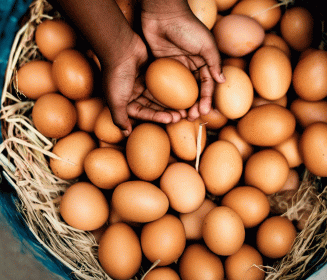
From ten chicks to a USD 12 billion empire, Harim’s rise mirrors the vision of its founder, Chairman Kim Hong-guk. Today, Harim is South Korea’s largest chicken producer and one of the nation’s top 30 food conglomerates, spanning livestock, feed, shipping, and food manufacturing.
At the heart of its success is Mr Kim’s enduring belief: “The best taste comes from freshness.”
Mr Kim is credited with pioneering what became known as the “integration of the three chapters”—linking farms, processing plants, and markets into one seamless chain. This model revolutionized Korea’s poultry industry, improving efficiency and guaranteeing freshness from production to plate.
Freshness defines flavor


That belief in freshness still drives Mr Kim today. Now in his late sixties, he visits Harim’s R&D Kitchen in Seoul twice a week to test new recipes.
“Freshness defines flavor,” he remarked. While preparing The Artisan Ramen, one of Harim’s latest products, he explained that “we use real chicken, beef bone, and pork bone broth simmered for 20 hours. It’s not flavoring powder — it’s real food.”
Mr Kim’s philosophy took root early. Growing up in Iksan, his grandmother gave him ten chicks and told him to raise them well. Selling and repurchasing the birds sparked his entrepreneurial spirit. “That experience was the prototype of Harim,” he recalled.

Expansion into feed and pork
After high school, Mr Kim went straight into poultry and pig farming. By his twenties, he had built his own broiler farm and founded Korea Derica Food, which became Harim in 1986.
His vision, however, extended beyond chicken. In the 2000s, Harim expanded into feed and pork production, and in 2015, it acquired shipping company Pan Ocean to stabilize grain imports and global logistics.
Mr Kim’s leadership style, known as ’15-degree management’, favors steady progress without excess ambition.
“If you rush up a steep slope, you’ll stumble; if the road is too flat, you’ll never progress,” he said. “A gentle slope lets you rise again when you fall.”
Harim has faced setbacks, including a devastating fire in 2003 and avian influenza outbreaks. But Mr Kim’s resilience kept the company moving forward.
“That year taught me that difficulties will always be near,” he said, “but fear doesn’t have to be.”


Subscribe now to the poultry technical magazine
AUTHORS

Newcastle Disease: One Hundred Years On, Why Transmission Control Matters More Than Ever
Mustafa Seckin Sandikli
Egg Size Versatility in Nick Chick – Part I
H&N Technical Department
Interview with Khaled Abdel Nasser Awwad
Khaled Abdel Nasser Awwad
When the Supply Chain Breaks: Poultry Prices and the Economics of Maritime Disruption in the Middle East
Dima Chatila
Reovirus Infections in the Broiler Industry
Edgar O. Oviedo Rondón
Egg Condensation in Hatcheries: A Hidden Risk for Embryo Development, Hatchability and Chick Quality
Rasel Ahmed
From Chat to Farm Insight: Bridging the Social Data Gap in Indonesian Broiler Farming
Setiawan Guntarto
Labor Shortage in the Poultry Industry: Potential Solutions
Edgar O. Oviedo Rondón
A Comparison of Soybean Meal from Different Origins in Terms of Nutrient Composition, Amino Acid Profile, and Protein Quality
Güner GÖVENÇ
When Algorithms Start to Control Feed Composition
Henri E. Prasetyo DVM. M.Vsc