Over the past two decades, broiler chicken has shifted from a supplementary product to a decisive protein in the global food economy. Poultry meat is faster to produce than red meat, more efficient in feed conversion, and affordable for mass consumers. In emerging economies, this has made chicken the first scalable protein to reach middle-income households.
India reflects this global transition but with a key difference. Production capacity has grown through integrated poultry systems, yet consumption remains modest compared to international standards. Infrastructure is in place, but demand has not fully matured.
India now produces about 5.17 million tons of broiler meat annually. Poultry has become a central pillar of affordable protein supply, no longer a peripheral contributor.
Globally, average poultry intake is 17.5kg per person each year. In high-consumption countries, levels exceed 50kg, as seen in the US and Malaysia. Brazil, Australia, Saudi Arabia, and Mexico also surpass the global mean.


India lags at 5.1kg per person. This gap highlights that demand is limited not by production, but by slower dietary normalization. Simply put, India is still under-consuming chicken.
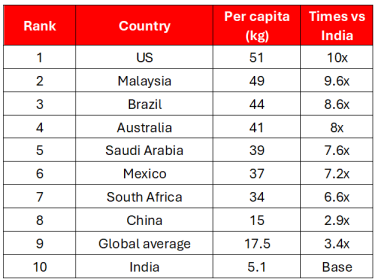
Table 1. Global broiler meat consumption benchmark


Agriculture and allied activities contribute 17.7% to India’s GDP. Within this, poultry has become one of the most monetized livestock sectors, generating value through feed, hatcheries, breeding, processing, transport, and retail.
The poultry industry contributes about 1.25% of GDP, with broilers alone accounting for 0.82%. This positions broiler production as a major industrial enterprise, not just a farm-level activity.
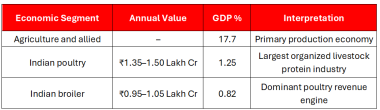
Table 2. GDP contribution hierarchy
Broiler production is concentrated in states where integrators, feed supply, hatcheries, logistics, and urban demand align. Maharashtra leads with 780,000 tons of output. Telangana and Andhra Pradesh form the next major southern production axis, while Tamil Nadu and Karnataka maintain strong organized broiler throughput through integrated farm-to-market systems.
West Bengal, Haryana, and Uttar Pradesh have also expanded, though their market dynamic differs in terms of live bird movement and fresh poultry turnover.
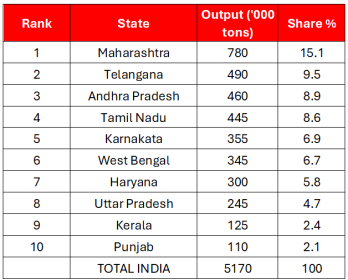
Table 3. India state-wise commercial broiler production
Operationally, commercial clusters drive the industry more than state boundaries. Western Maharashtra is a major integrated zone. Telangana and coastal Andhra are critical contract farming territories. Tamil Nadu’s Coimbatore–Palladam–Udumalpet–Dharapuram corridor remains a key processing belt. Similar concentrations exist in Karnataka, West Bengal, and the NCR-linked northern chain.
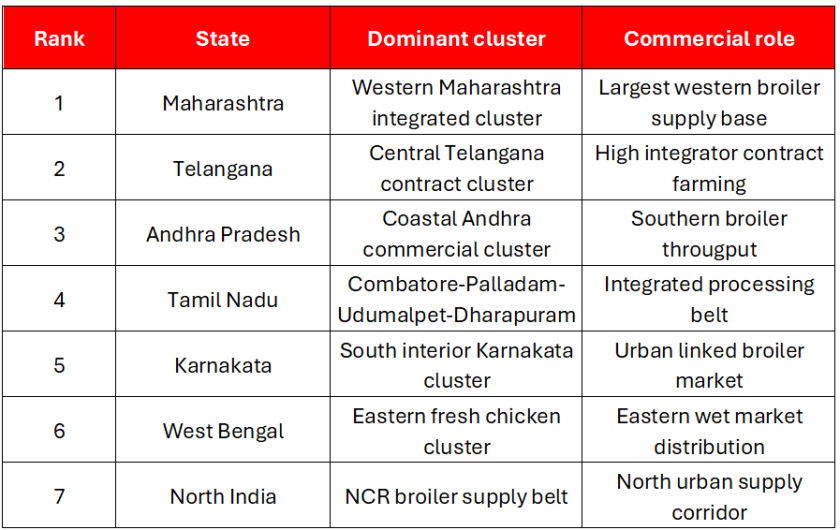
Table 4. Major commercial broiler clusters in India
These clusters shape feed movement, chick placement, processing throughput, and fresh chicken circulation far more than state averages alone reveal.
India’s decisive growth indicator is under-consumption. Southern states such as Telangana, Andhra Pradesh, Kerala, Tamil Nadu, and Karnataka show stronger household intake, while northern and western states remain lower.
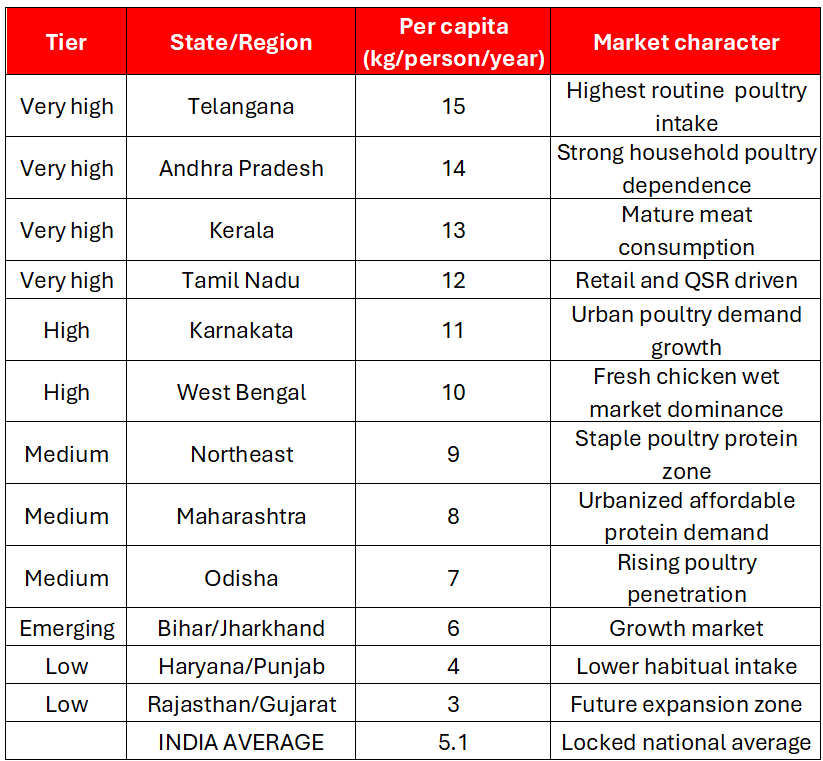
Table5. State-wise per capital broiler consumption pattern
This creates a measurable growth window. Every one kilogram rise in per capita intake nationally would add 1.43 million tons of demand. Few livestock sectors in India hold such latent potential.
The industry is therefore entering a commercially sensitive phase. Production is organized, but demand has room to deepen. This combination is rare: a sector with existing industrial capacity, established integrator networks, and still-unrealized consumer penetration.
Thus, the future depends less on production capacity and more on chicken becoming a routine staple across wider geographies.



Subscribe now to the poultry technical magazine
AUTHORS

Newcastle Disease: One Hundred Years On, Why Transmission Control Matters More Than Ever
Mustafa Seckin Sandikli
Egg Size Versatility in Nick Chick – Part I
H&N Technical Department
Interview with Khaled Abdel Nasser Awwad
Khaled Abdel Nasser Awwad
When the Supply Chain Breaks: Poultry Prices and the Economics of Maritime Disruption in the Middle East
Dima Chatila
Reovirus Infections in the Broiler Industry
Edgar O. Oviedo Rondón
Egg Condensation in Hatcheries: A Hidden Risk for Embryo Development, Hatchability and Chick Quality
Rasel Ahmed
From Chat to Farm Insight: Bridging the Social Data Gap in Indonesian Broiler Farming
Setiawan Guntarto
Labor Shortage in the Poultry Industry: Potential Solutions
Edgar O. Oviedo Rondón
A Comparison of Soybean Meal from Different Origins in Terms of Nutrient Composition, Amino Acid Profile, and Protein Quality
Güner GÖVENÇ
When Algorithms Start to Control Feed Composition
Henri E. Prasetyo DVM. M.Vsc