Sources: Available upon request




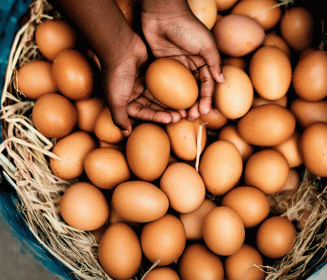
The recent 12-day war between Iran and Israel has left a noticeable mark on Iran’s egg market, exposing the fragility of food supply chains during geopolitical conflict. While Iran’s egg production—estimated at 115,000 tonnes per month—remained physically undamaged, the war disrupted logistics, consumer access, and market stability.
According to Mohammad Moradi, CEO of the Central Union of Poultry Farmers, the conflict caused short-term turmoil in food delivery across several Iranian cities. Although production facilities continued operating, transportation bottlenecks and urban congestion led to delays in getting eggs to consumers. These disruptions triggered price volatility, with some retailers accused of exploiting the situation for profit.
However, the war’s economic ripple effects continue to threaten the sector. Iran’s broader financial instability—exacerbated by years of sanctions, inflation exceeding 40%, and a sharply devalued currency—has weakened consumer purchasing power. Moradi warned that egg consumption, already declining due to economic hardship, could fall further during the hot summer months, when demand typically dips. This seasonal oversupply risks pushing producers into financial losses unless government support is provided.
The egg market’s resilience amid conflict highlights both its vulnerabilities and adaptability. While the war did not directly damage production infrastructure, it exposed how quickly food systems can be destabilized by external shocks. The Iranian poultry industry now braces for potential future escalations, with contingency plans in place to secure raw materials and maintain supply chains.


In a country already grappling with economic strain, the egg market’s experience serves as a microcosm of the broader challenges facing Iran’s food security. As tensions with Israel simmer, the industry remains on alert—hoping for peace but preparing for disruption.
Sources: Available upon request




Subscribe now to the poultry technical magazine
AUTHORS

Newcastle Disease: One Hundred Years On, Why Transmission Control Matters More Than Ever
Mustafa Seckin Sandikli
Egg Size Versatility in Nick Chick – Part I
H&N Technical Department
Interview with Khaled Abdel Nasser Awwad
Khaled Abdel Nasser Awwad
When the Supply Chain Breaks: Poultry Prices and the Economics of Maritime Disruption in the Middle East
Dima Chatila
Reovirus Infections in the Broiler Industry
Edgar O. Oviedo Rondón
Egg Condensation in Hatcheries: A Hidden Risk for Embryo Development, Hatchability and Chick Quality
Rasel Ahmed
From Chat to Farm Insight: Bridging the Social Data Gap in Indonesian Broiler Farming
Setiawan Guntarto
Labor Shortage in the Poultry Industry: Potential Solutions
Edgar O. Oviedo Rondón
A Comparison of Soybean Meal from Different Origins in Terms of Nutrient Composition, Amino Acid Profile, and Protein Quality
Güner GÖVENÇ
When Algorithms Start to Control Feed Composition
Henri E. Prasetyo DVM. M.Vsc