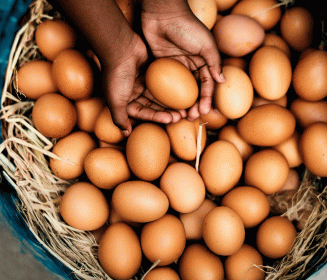



Indonesia’s egg industry is entering a new phase of growth. Eggs remain one of the most affordable, stable, and accessible sources of animal protein for the population, driving continuous increases in national demand.
In recent years, government policies, production distribution, and evolving market dynamics have created strong momentum for industry players and new investors.
Indonesia: The 3rd or 4th largest egg producer in the world
Data from FAO and various industry sources indicate that Indonesia produces more than 144 billion eggs annually, positioning the country as the 3rd or 4th largest table egg producer globally – comparable to China, India, and the United States.


This growth is supported by rising domestic consumption and relatively stable egg prices.

Estimation of egg production, 2020-2026 (billion eggs)

East Java remains the core of Indonesia’s egg production ecosystem
East Java contributes 30-35% of the nation’s egg production. The region’s dominance is driven by strong advantages:
These factors make East Java the central hub of Indonesia’s egg industry.

GPS import restriction: Controlled population, more stable prices
The government has tightened control on layer population growth by limiting grand-parent stock (GPS) imports to 27,000 birds.
This policy aims to prevent over-supply and protect farm-gate egg prices. As a result, price stability has improved, farmer margins are healthier, and investment opportunities remain open.

Demand outlook 2025-2026: Expected growth of 5-10%
Egg demand is projected to rise due to:
Egg consumption is expected to increase 5-8% in 2025 and 7-10% in 2026.

Moderate layer population growth
With the GPS restriction in place, layer population is projected to grow only 2-4% in 2025 and 3-5% in 2026—significantly lower than demand growth.
This creates a favorable environment for improved profitability and stable production margins.

Projection of demand vs layer population, 2020-2026
Support from MBG and Danantara funding
The government’s IDR 20 trillion Danantara financing program is designed to strengthen existing farmers and open pathways for new investments through structured financing and partnership models.
With MBG ensuring consistent demand, the egg market has solid long-term prospects.

Key industry challenges
Strategies for farmers and new investors

2025-2026: A golden momentum for growth
With rising demand, controlled population growth, and strong government support through MBG and financing programs, the years 2025-2026 present a strategic window for expansion in the layer sector.
Producers and investors who embrace modern management, feed efficiency, strong biosecurity, and robust marketing networks will be well-positioned to lead Indonesia’s evolving egg industry.


Subscribe now to the poultry technical magazine
AUTHORS

Newcastle Disease: One Hundred Years On, Why Transmission Control Matters More Than Ever
Mustafa Seckin Sandikli
Egg Size Versatility in Nick Chick – Part I
H&N Technical Department
Interview with Khaled Abdel Nasser Awwad
Khaled Abdel Nasser Awwad
When the Supply Chain Breaks: Poultry Prices and the Economics of Maritime Disruption in the Middle East
Dima Chatila
Reovirus Infections in the Broiler Industry
Edgar O. Oviedo Rondón
Egg Condensation in Hatcheries: A Hidden Risk for Embryo Development, Hatchability and Chick Quality
Rasel Ahmed
From Chat to Farm Insight: Bridging the Social Data Gap in Indonesian Broiler Farming
Setiawan Guntarto
Labor Shortage in the Poultry Industry: Potential Solutions
Edgar O. Oviedo Rondón
A Comparison of Soybean Meal from Different Origins in Terms of Nutrient Composition, Amino Acid Profile, and Protein Quality
Güner GÖVENÇ
When Algorithms Start to Control Feed Composition
Henri E. Prasetyo DVM. M.Vsc