The resumption of Indonesian government’s free nutritious meal (Makan Bergizi Gratis or MBG) program alongside the start of the new school year has brought fresh air to poultry farmers in the country.
After experiencing pressure due to weakening demand, the prices of live broilers and chicken eggs at the farm level have begun to show an upward trend toward more reasonable price ranges.
This price movement serves as a positive signal for the sustainability of farmers’ businesses, especially after several weeks of facing pressure from low market absorption.
With millions of students once again receiving the benefits of the MBG program, the demand for nutritious food ingredients such as eggs and chicken meat is expected to continue increasing.


“So MBG program has an impact. As children start going back to school and MBG begins, prices for eggs and live broilers have started to rise,” said I Gusti Ketut Astawa, Deputy for Availability and Food Stabilization at the National Food Agency (Bapanas).
Live broiler prices
Bapanas data shows that the average price of live broiler as of July 14 reached USD 1.21/kg. This figure increased by 4.11% compared to the previous week, which was at USD 1.16/kg.


Nevertheless, price conditions still vary across regions. In South Sumatra, the price of live broiler is still recorded at around USD 1.01/kg.
Meanwhile, in Riau, the average price has reached USD 1.42/kg, even exceeding the Reference Purchase Price (HAP) at the producer level, which is set at USD 1.39/kg live weight.
Chicken egg prices
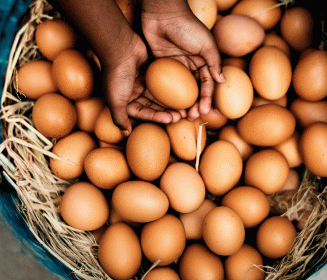
A similar trend has also begun to appear in the chicken egg commodity. As of July 14, the national average price at the farm level stood at USD 1.26/kg, an increase of 0.66% compared to the previous week, which was still at USD 1.25/kg.
The lowest egg price was recorded in Banten at USD 1.13/kg, while the highest price was in North Sulawesi, reaching USD 1.57/kg. The HAP for chicken eggs at the farm level is set at USD 1.47/kg.
Factors affecting weakened prices
Mr Ketut explained that the previous price weakening was also influenced by seasonal factors, coinciding with the month of Suro (the first month in the traditional Javanese calendar), which is traditionally associated with a reduction in various community activities such as weddings or celebrations.
This condition caused demand for chicken meat and chicken eggs to decline as well, leading to a correction in prices at the farm level.
“Actually, the month of Suro also had a significant impact because last month was relatively the month of Suro, so wedding events and the like were halted, causing demand related to chicken to decline relatively, and prices corrected,” he explained.
Momentum for price recovery
Mr Ketut is optimistic that the combination of the end of the Suro month period and the increasing food demand through the MBG program will serve as a momentum for price recovery for national poultry farmers.



Subscribe now to the poultry technical magazine
AUTHORS

Newcastle Disease: One Hundred Years On, Why Transmission Control Matters More Than Ever
Mustafa Seckin Sandikli
Egg Size Versatility in Nick Chick – Part I
H&N Technical Department
Interview with Khaled Abdel Nasser Awwad
Khaled Abdel Nasser Awwad
When the Supply Chain Breaks: Poultry Prices and the Economics of Maritime Disruption in the Middle East
Dima Chatila
Reovirus Infections in the Broiler Industry
Edgar O. Oviedo Rondón
Egg Condensation in Hatcheries: A Hidden Risk for Embryo Development, Hatchability and Chick Quality
Rasel Ahmed
From Chat to Farm Insight: Bridging the Social Data Gap in Indonesian Broiler Farming
Setiawan Guntarto
Labor Shortage in the Poultry Industry: Potential Solutions
Edgar O. Oviedo Rondón
A Comparison of Soybean Meal from Different Origins in Terms of Nutrient Composition, Amino Acid Profile, and Protein Quality
Güner GÖVENÇ
When Algorithms Start to Control Feed Composition
Henri E. Prasetyo DVM. M.Vsc