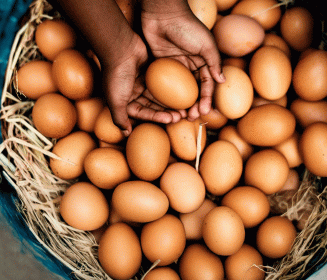
India’s leading poultry hub, Namakkal in Tamil Nadu, is currently facing a significant market disruption. Egg exports to West Asia have stalled, triggering sharp declines in domestic prices and mounting losses for poultry farmers.
Namakkal, known as the ‘Egg City of India,’ produces more than 6-7 crore eggs daily. It supplies eggs across India as well as international markets, particularly Gulf countries such as the United Arab Emirates, Qatar, and Oman.
Exports have long helped stabilize local prices, but recent geopolitical tensions—particularly the Iran-Israel conflict—have disrupted shipping routes and forced exporters to suspend shipments.
Industry sources estimate losses of nearly INR 5 crore per day for farmers and exporters in the Namakkal poultry cluster.


Oversupply drives down prices
With exports halted, eggs meant for overseas buyers are flooding the domestic market. Warehouses and farms are struggling to manage the sudden surplus.
The National Egg Coordination Committee (NECC) has repeatedly lowered egg procurement prices. Over the past two weeks, prices in Namakkal have dropped by about INR 1.10/egg, falling from around INR 5.40 to approximately INR 4.30/egg.


Some farmers report even deeper cuts, with eggs selling well below NECC’s benchmark in certain markets.
Weak demand intensifies pressure
Seasonal consumption patterns have worsened the situation. Summer demand typically dips, while Ramzan fasting and the Christian Lent period further reduce egg consumption in several markets.
Combined with export stoppages, this weak demand has intensified the oversupply situation and placed further pressure on farmgate prices.
Industry seeks government support
Farmers and exporters in Namakkal are urging authorities to step in. They seek support for alternative export markets, assistance with logistics, and measures to absorb excess domestic supply.
Without timely intervention, prolonged low prices could severely affect the financial sustainability of poultry farms in the region.
Strategic role of Namakkal
Namakkal remains India’s most important egg production cluster, home to more than 1000 farms, and a well-developed network of hatcheries, feedmills, and exporters. It supplies eggs to government nutrition programs, domestic markets, and international markets.
Prices may recover once exports resume and demand stabilizes. Until then, the sector faces one of its toughest challenges in recent years.



Subscribe now to the poultry technical magazine
AUTHORS

Newcastle Disease: One Hundred Years On, Why Transmission Control Matters More Than Ever
Mustafa Seckin Sandikli
Egg Size Versatility in Nick Chick – Part I
H&N Technical Department
Interview with Khaled Abdel Nasser Awwad
Khaled Abdel Nasser Awwad
When the Supply Chain Breaks: Poultry Prices and the Economics of Maritime Disruption in the Middle East
Dima Chatila
Reovirus Infections in the Broiler Industry
Edgar O. Oviedo Rondón
Egg Condensation in Hatcheries: A Hidden Risk for Embryo Development, Hatchability and Chick Quality
Rasel Ahmed
From Chat to Farm Insight: Bridging the Social Data Gap in Indonesian Broiler Farming
Setiawan Guntarto
Labor Shortage in the Poultry Industry: Potential Solutions
Edgar O. Oviedo Rondón
A Comparison of Soybean Meal from Different Origins in Terms of Nutrient Composition, Amino Acid Profile, and Protein Quality
Güner GÖVENÇ
When Algorithms Start to Control Feed Composition
Henri E. Prasetyo DVM. M.Vsc