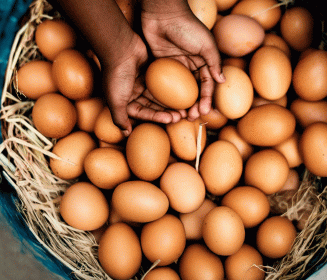
Penang’s livestock industry recorded strong growth in 2024, generating USD 412 million, up USD 9 million from the previous year.
Poultry and duck products accounted for over 91% of the state’s total livestock revenue, with meat and egg production remaining the dominant contributors.
At the Penang Farmers, Livestock Breeders, and Fishermen Day, Chief Minister Chow Kon Yeow stressed livestock as both a key protein source and a pillar of the state’s agricultural economy.
“The livestock industry remains a vital source of protein for the people of this state,” he said, highlighting the role of the poultry and duck faming in food security and economic growth.


Preliminary data from the Penang Agricultural Census 2023 shows livestock contributed 44% of the state’s total agricultural sales, valued at USD 760 million. This underscores its dominance in Penang’s farm economy, even amid global food system challenges.
The state is taking steps to transition its livestock operations—including poultry and pig farming—towards a more sustainable and technology-enabled model.
“The Livestock Enactment provides a framework to modernize self-sustaining industries, encouraging a shift to large-scale, tech-driven operations,” said Mr Chow.

Penang is accelerating the adoption of closed-house farming systems, which enhance biosecurity, improve efficiency, and reduce environmental impact. These systems are particularly beneficial in tropical climates where temperature and humidity fluctuations can compromise animal health and productivity.
At the same time, the state is supporting small-scale traditional farmers through initiatives like the Livestock Industry Development Project. These efforts aim to ensure inclusive growth and prevent rural marginalization.
Penang’s livestock strategy aligns with Malaysia’s National Agro-Food Policy 2021–2025 (DAN 2.0), which prioritizes food security, farm resilience, and public health.
With zoonotic diseases posing ongoing risks, Mr Chow reaffirmed that controlling animal-borne pathogens remains a central priority.
“Efforts to control zoonotic diseases are crucial to safeguard public health and industry sustainability,” he said.
Beyond livestock, Penang is investing in strategic agricultural infrastructure, including the development of high-tech agricultural parks such as Ara Kuda and Mayfield. These sites support integrated, tech, and data-driven farming systems.
Federal initiatives such as the Integrated Agricultural Development Area are also playing a role in boosting production efficiency and resilience in the rice sector, though livestock remain Penang’s top agricultural earner.
As global markets shift toward sustainable protein sources and resilient supply chains, Penang’s poultry-powered growth and policy direction offer a model for sub-national governments aiming to scale livestock sectors while balancing modernization with inclusive development.


Subscribe now to the poultry technical magazine
AUTHORS

Newcastle Disease: One Hundred Years On, Why Transmission Control Matters More Than Ever
Mustafa Seckin Sandikli
Egg Size Versatility in Nick Chick – Part I
H&N Technical Department
Interview with Khaled Abdel Nasser Awwad
Khaled Abdel Nasser Awwad
When the Supply Chain Breaks: Poultry Prices and the Economics of Maritime Disruption in the Middle East
Dima Chatila
Reovirus Infections in the Broiler Industry
Edgar O. Oviedo Rondón
Egg Condensation in Hatcheries: A Hidden Risk for Embryo Development, Hatchability and Chick Quality
Rasel Ahmed
From Chat to Farm Insight: Bridging the Social Data Gap in Indonesian Broiler Farming
Setiawan Guntarto
Labor Shortage in the Poultry Industry: Potential Solutions
Edgar O. Oviedo Rondón
A Comparison of Soybean Meal from Different Origins in Terms of Nutrient Composition, Amino Acid Profile, and Protein Quality
Güner GÖVENÇ
When Algorithms Start to Control Feed Composition
Henri E. Prasetyo DVM. M.Vsc