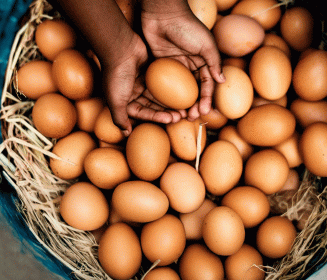
While Singapore’s local vegetable and seafood production continued to decline in 2024, egg production saw a notable increase, with domestic farms producing 34.4% of all eggs consumed—up from 31.9% in 2023, according to the latest Singapore Food Statistics report.
This growth in local egg supply comes amid broader struggles in the agri-food sector, where high costs and farm closures have impacted output. Yet, Singapore’s three remaining egg farms have bucked this trend through strategic upgrades, operational improvements, and automation—positioning eggs as one of the more secure food categories in the nation’s food resilience strategy.
Chew’s Agriculture
At the center of this growth is Chew’s Agriculture, Singapore’s largest egg producer, known for its high-tech farming systems and sustainable practices. Chew’s has played a pivotal role in helping Singapore boost domestic egg output through its vertically integrated operations, including in-house feed production, disease control, and energy-efficient systems.


Chew’s is a subsidiary of Malaysia-based Huat Lai Resources, which has been leading major investments in cage-free egg production both in Malaysia and Singapore. Its ability to scale efficiently and maintain consistent quality has made it a cornerstone of Singapore’s egg supply.
Technological innovation
The Singapore Food Agency attributes the growth to technological innovation and stronger farm management practices, even as other sectors like aquaculture and vegetable farming shrink. Egg farms are also less impacted by sea-space leasing schemes or weather fluctuations, giving them a structural advantage.

As Singapore reviews its 30-by-30 target—aiming to produce 30% of its nutritional needs locally by 2030—eggs are emerging as one of the few food types where the country is making clear, measurable progress.


Subscribe now to the poultry technical magazine
AUTHORS

Newcastle Disease: One Hundred Years On, Why Transmission Control Matters More Than Ever
Mustafa Seckin Sandikli
Egg Size Versatility in Nick Chick – Part I
H&N Technical Department
Interview with Khaled Abdel Nasser Awwad
Khaled Abdel Nasser Awwad
When the Supply Chain Breaks: Poultry Prices and the Economics of Maritime Disruption in the Middle East
Dima Chatila
Reovirus Infections in the Broiler Industry
Edgar O. Oviedo Rondón
Egg Condensation in Hatcheries: A Hidden Risk for Embryo Development, Hatchability and Chick Quality
Rasel Ahmed
From Chat to Farm Insight: Bridging the Social Data Gap in Indonesian Broiler Farming
Setiawan Guntarto
Labor Shortage in the Poultry Industry: Potential Solutions
Edgar O. Oviedo Rondón
A Comparison of Soybean Meal from Different Origins in Terms of Nutrient Composition, Amino Acid Profile, and Protein Quality
Güner GÖVENÇ
When Algorithms Start to Control Feed Composition
Henri E. Prasetyo DVM. M.Vsc